What if the most important script for your professional success in Singapore isn’t the complex kanji you’ve been dreading, but the “English” words hidden in plain sight? You’ve likely sat in a boardroom or a ramen shop near Tanjong Pagar, staring at katakana characters that look nearly identical. It’s exhausting to mix up “shi” and “tsu” or “ri” and “so” while trying to decode a technical manual. You know the words are often borrowed from English, yet they remain unrecognizable when transformed into Japanese phonetics.
We understand that the three-script system feels like an administrative burden on your brain. This 2026 guide is designed to simplify these characters once and for all. We’ll show you the underlying logic of loanwords so you can identify key terms in business meetings and read menus with total confidence. By mastering this script, you’ll reduce your learning friction and build a professional foundation for a Conversational Japanese Course. We’ll move from the labor of guessing to the satisfaction of instant recognition, ensuring you’re ready for the 1,100 Japanese companies operating right here in our city.
Key Takeaways
- Understand how this angular script functions as the primary tool for technical and business terminology in 2026.
- Learn the phonetic rules of “Katakanization” to decode English loanwords that often sound unrecognizable to native speakers.
- Master katakana by identifying high-frequency characters and using visual associations to speed up your character recognition.
- Transition from the frustration of guessing to the satisfaction of reading technical manuals and menus with professional accuracy.
- Discover why classroom guidance from certified native speakers provides the corrected feedback necessary for true conversational success in Singapore.
What is Katakana? Understanding the Role of Japan’s Second Script
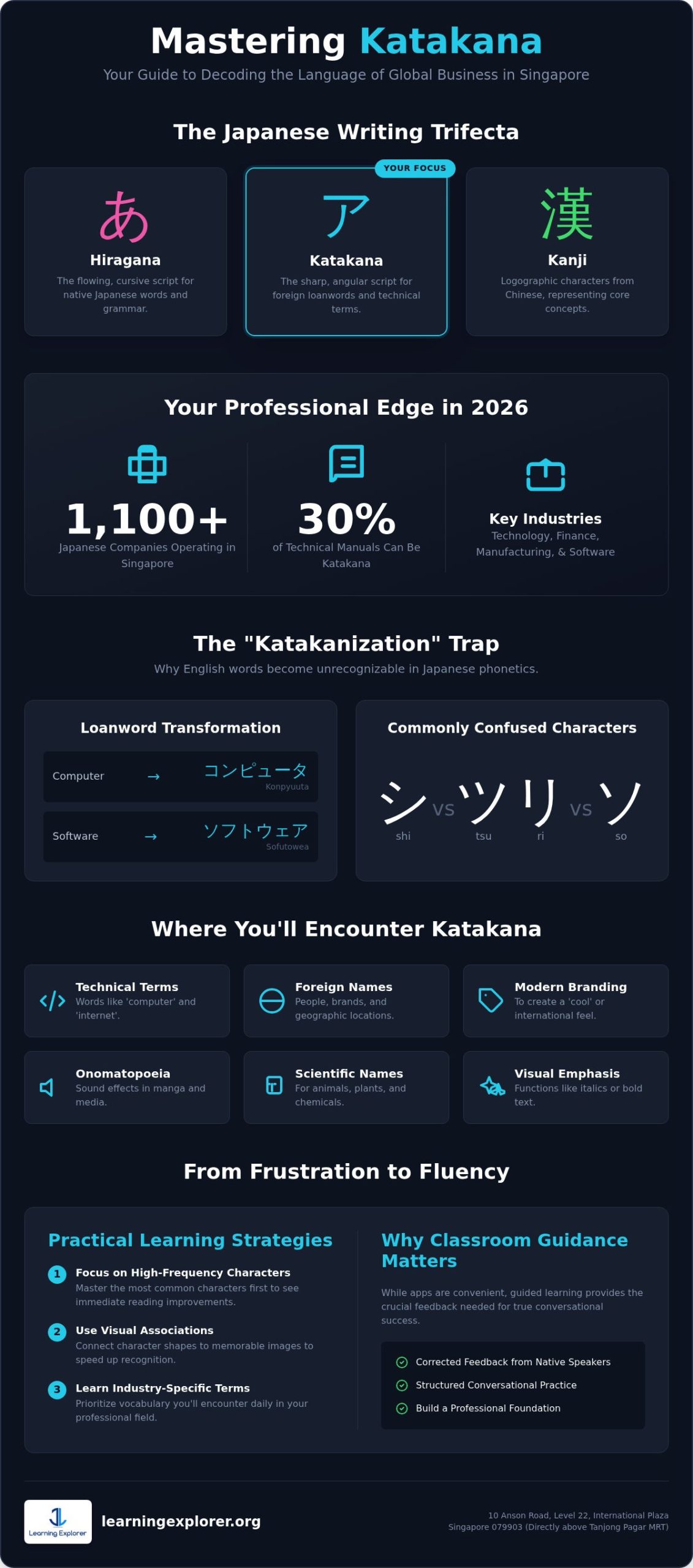
Katakana is a phonetic alphabet used alongside Hiragana and Kanji to form the complete Japanese writing system. While Kanji represents meanings and Hiragana handles grammar, Katakana serves as the primary tool for modern adaptation and global communication. It consists of 46 basic characters that follow a strict “one sound, one character” rule. This phonetic consistency is a relief for learners; once you memorize the sound of a character, it never changes, regardless of the words surrounding it.
You’ll notice a distinct visual difference between the scripts. Hiragana is cursive and flowing, but katakana is defined by sharp, angular strokes and a minimalist aesthetic. This visual “hardness” makes it stand out on a page, acting almost like italics or bold text in English. In the fast-paced business environment of 2026, this script has become more vital than ever for identifying global technical terms, scientific names, and foreign brands in the Singapore market.
To better understand how these characters look and sound, watch this helpful video:
The Three-Script Synergy: Kanji, Hiragana, and Katakana
Japanese sentences often mix all three scripts to create a clear hierarchy of information. Kanji provides the core meaning, while Hiragana connects those meanings with grammar. Katakana steps in to provide visual emphasis for anything “outside” traditional Japanese culture. For English speakers, it acts as a linguistic bridge. It signals that the word you’re looking at likely has a familiar Western origin, reducing the mental labor of decoding entirely new vocabulary. This synergy allows readers to scan a document and immediately pick out foreign concepts or technical data.
When Do You Actually Use Katakana?
Its most common role is transcribing “Gairaigo,” or loanwords. These are terms borrowed from other languages like English, German, or Portuguese. In Singapore’s tech and finance sectors, you’ll see it used for:
- Technical terminology like “computer” (konpyuuta) or “software” (sofutowea).
- Non-Japanese personal names and geographic locations.
- Onomatopoeia to represent specific sounds in manga or digital media.
- Scientific names for plants, animals, and chemical compounds.
It’s also a creative tool for modern branding. Advertisers use it to make a product look international or “cool,” while media creators use it to represent robotic voices or loud shouting. Mastering this script is your first step toward the satisfaction of discovery in a professional Japanese context.
Why Katakana is Crucial for Business and Technology in 2026
In the high-stakes environment of Singapore’s Central Business District, language isn’t just about grammar; it’s about speed and accuracy. By 2026, “Katakana English” has become the standard for global corporate communication. With over 1,100 Japanese companies operating in Singapore, many as regional headquarters, the ability to decode this script is a non-negotiable asset. When you can instantly read a project brief or a technical email, you reduce administrative friction and increase your value in any multinational team.
Mastering this script provides an immediate boost to your social confidence. Instead of feeling overwhelmed by the three-script system, you’ll start to see katakana as a familiar friend. Since it primarily transcribes English-based loanwords, you already know the vocabulary; you just need to learn the visual code. For those looking for Practical Strategies to Master Katakana, focusing on industry-specific terms is the fastest way to see results in your daily work life.
The Script of Innovation: Tech and Semiconductor Terminology
Technical fields like IT and semiconductors rely heavily on this phonetic script. In fact, many Japanese technical manuals are composed of up to 30% Katakana. You’ll encounter terms like “Konpyuuta” (computer) or “Semikandakutaa” (semiconductor) constantly. If you’re working in manufacturing or software development, recognizing these terms prevents costly misunderstandings. Our Conversational Japanese Course in Tanjong Pagar specifically targets these industry-relevant terms to help you excel in the CBD’s competitive landscape.
Katakana in the Singapore Business Context
Your professional interactions often begin with the exchange of business cards, or Meishi. Corporate titles and department names are frequently written in Katakana. Being able to read “Maaketingu” (Marketing) or “Manajee” (Manager) on a card during a networking event at International Plaza saves you from awkward pauses. There’s a massive psychological benefit to this. Recognizing a loanword in a fast-paced meeting acts as a creative catalyst, allowing you to stay engaged with the conversation rather than getting lost in the translation of a single character. This transition from the labor of seeking to the satisfaction of discovery is what transforms a student into a professional partner.
- Identify corporate titles instantly during networking events.
- Decode technical manuals without relying on translation software.
- Build rapport with Japanese counterparts by pronouncing loanwords with the correct phonetic “accent.”
The “Katakanization” Trap: Why Native English Speakers Struggle
You might expect that borrowing words from your own language would make learning Japanese easier. Instead, many professionals in Singapore find that English loanwords become unrecognizable once they enter the Japanese phonetic grid. This happens because Japanese is a mora-based language with a limited set of sounds. Katakanization is the phonetic adaptation of foreign phonemes into the Japanese mora system. This process forces English words into a rigid structure that often strips away their original identity, leaving you to guess the meaning of a word you technically already know.
The core struggle lies in the missing sounds. Japanese lacks a distinct “L” or “V” sound. “L” is typically substituted with an “R” sound, and “V” often becomes a “B.” For a comprehensive overview of katakana and its historical evolution, understanding these phonetic constraints is essential. Additionally, Japanese phonetics don’t allow for consonant clusters. Every consonant, except for “n,” must be anchored by a vowel, usually “o” or “u.” This is why a simple word like “desk” transforms into the three-syllable “desuku.”
Decoding Phonetic Shifts: A Comparison Table
Reverse-engineering katakana back into English requires a bit of detective work. Use this table to recognize how common brand names and technical terms shift when they’re adapted for Japanese speakers.
| English Word | Katakana Spelling | Phonetic Pronunciation |
|---|---|---|
| McDonald’s | マクドナルド | Ma-ku-do-na-ru-do |
| Starbucks | スターバックス | Su-taa-bak-ku-su |
| Personal Computer | パソコン | Pa-so-kon |
To master this, try reading the phonetic pronunciation out loud at increasing speeds. Often, the original English word “pops” into clarity once you hear the rhythm rather than just looking at the characters.
Common Pitfalls: The “Look-Alike” Characters
Even if you understand the phonetics, the visual similarity between certain characters can cause administrative headaches. Many students at our Tanjong Pagar center struggle with these pairs:
- Shi (シ) vs. Tsu (ツ): Think of Shi as “smiling” from the side (the strokes are more horizontal). Tsu is “falling” from the top (the strokes are more vertical).
- So (ソ) vs. N (ン): Similar to the pair above, So has a vertical orientation, while N is written with a flatter, more horizontal stroke.
Certified native-speaker instructors often teach a “stroke direction” mnemonic. If the pen moves from the bottom up, it’s likely Shi or N. If it moves from the top down, it’s Tsu or So. Focusing on these small visual cues transforms the labor of seeking into the satisfaction of discovery.
Practical Strategies to Master Katakana Fast
Mastering katakana doesn’t require hours of rote memorization. It requires a strategic focus on the characters you’ll actually use in a professional setting. Start by identifying high-frequency characters found in common loanwords like “konpyuuta” (computer) or “maaketingu” (marketing). Use “Radical” association to bridge the gap between scripts. Many characters are just simplified, angular versions of the Hiragana shapes you’ve already learned. For example, the character for “ka” is nearly identical to the left side of its Hiragana counterpart. This reduces the mental load of learning a “third” alphabet from scratch.
Five Steps to Katakana Fluency
- Step 1: Master the “A-I-U-E-O” vowels first. These are the building blocks for every other sound in the phonetic grid.
- Step 2: Use mnemonics. Link angular shapes to English objects; for instance, “he” looks like a “haystack” or a mountain peak.
- Step 3: Practice writing stroke order. Writing characters correctly cements muscle memory and helps you distinguish between similar-looking strokes during fast-paced note-taking.
- Step 4: Label your office equipment. Place a “purintaa” (printer) sticker on your machine and a “monitaa” (monitor) label on your screen to force active recall throughout your workday.
- Step 5: Integrate these terms into your professional routine. Use the Japanese terms for common tasks when thinking about your daily to-do list.
Leveraging Local Resources in Singapore
Singapore offers a unique immersion environment that rivals a trip to Tokyo. Visit a Japanese supermarket like Don Don Donki and challenge yourself to read the product signage before looking at the English translation. When dining at Tanjong Pagar Japanese restaurants, use the “Katakana Search” method: scan the menu specifically for loanwords you recognize from your own industry. This turns a simple social outing into a high-impact study session. To ensure you aren’t just reading but also speaking correctly, join a Conversational Japanese Course. Hearing certified native speakers model the correct phonetic “accent” prevents you from falling into the “Katakanization” trap mentioned earlier.
Ready to transition from the labor of seeking to the satisfaction of discovery? Join our next Conversational Japanese Course at International Plaza to perfect your technical vocabulary with expert guidance.
Master Japanese in Singapore: Why Classroom Guidance Beats Apps
Learning apps offer convenience, but they often fall short when you’re trying to decode the nuances of katakana in a corporate setting. Apps can’t hear your pronunciation or correct the subtle phonetic shifts that make “Katakanization” so challenging. Without real-time feedback, you risk cementing incorrect habits that lead to confusion during high-stakes business meetings. Certified native speakers provide the interactive environment needed to perfect your “Japanese accent,” ensuring you sound professional rather than robotic. They help you bridge the gap between English words and their Japanese phonetic counterparts with a level of precision no algorithm can match.
There’s also the community factor to consider. Learning alongside other Singapore-based professionals creates a supportive atmosphere that solo study lacks. You’ll share the satisfaction of discovery with peers who face the same administrative burdens and career goals in the CBD. This collaborative energy acts as a creative catalyst, keeping you motivated through the more complex technical modules. Engaging with others allows you to practice these loanwords in a safe, face-to-face environment before you use them in a boardroom or a client lunch.
Expert Instruction at International Plaza
Our bilingual native speakers are more than just teachers; they’re expert guides who understand the specific linguistic bridge between English and Japanese. They provide structured modules that align with global standards, moving you quickly from basic character recognition to industry-specific terminology. We focus on adult learners who need practical, actionable skills for their careers. You can find our training center at Level 22, 10 Anson Road, Singapore 079903, conveniently located just above the Tanjong Pagar MRT. This central location makes it easy for you to integrate your studies into a busy professional schedule without adding extra travel time.
Transitioning from Script to Conversation
Mastering the script is just the beginning. It serves as a vital stepping stone to our Conversational Japanese Course, where you’ll apply your knowledge in real-world scenarios. We offer customized solutions for corporate clients and busy executives who need to see immediate results in their daily workflow. By moving beyond digital flashes to classroom interaction, you transform the labor of seeking information into the satisfaction of true discovery. Join us at International Plaza and turn your language goals into a lasting professional advantage in the Singapore market.
Unlock Your Professional Potential in the Singapore CBD
Mastering katakana is the definitive secret to unlocking corporate fluency in our globalized economy. You’ve learned to navigate the phonetic logic of loanwords and overcome the visual hurdles of look-alike characters. By focusing on high-frequency technical terms and leveraging the immersive environment in Tanjong Pagar, you’ll reduce your daily administrative burden. This transition from the labor of seeking to the satisfaction of discovery is what sets successful professionals apart in 2026.
Don’t settle for the limited feedback of a mobile app. Our certified native-speaker instructors provide the corrected feedback necessary to perfect your pronunciation and social nuance. Experience interactive modules designed specifically for adult learners at 10 Anson Road, Level 22, International Plaza. We’re conveniently located to help you fit high-impact learning into your busy workday without the stress of a long commute.
Master Japanese with our Conversational Course at Tanjong Pagar and transform your career trajectory today. You’re ready to read every technical manual and menu with total confidence. We look forward to seeing you at International Plaza soon.
Frequently Asked Questions
What is the difference between Hiragana and Katakana?
Hiragana and Katakana represent the same set of sounds but serve different roles. Hiragana is used for native Japanese words and grammatical particles, featuring a curvy, flowing appearance. In contrast, katakana is used for foreign loanwords, technical terms, and onomatopoeia, characterized by sharp and angular strokes. Understanding this distinction helps you quickly identify whether a word is native or borrowed when scanning a document at your Tanjong Pagar office.
Is Katakana harder to learn than Hiragana?
Many adult learners find this script slightly more challenging because of characters that look nearly identical. While Hiragana characters are distinct, pairs like “shi” and “tsu” require careful attention to stroke direction. However, the phonetic logic is identical to Hiragana. Once you overcome the visual hurdles through active recall and writing practice, you’ll find it becomes a familiar tool for decoding the English words you already know.
How many Katakana characters are there in total?
There are 46 basic characters in the standard syllabary. These characters represent the same 46 sounds found in Hiragana, following the A-I-U-E-O vowel pattern. While the total number of combinations increases when you add diacritical marks and small characters to represent sounds like “sha” or “pyu,” these core 46 characters form the essential foundation for any beginner starting their language journey in Singapore.
Why do Japanese people use Katakana for English words instead of just using English?
Japanese uses this script to adapt foreign sounds into its native phonetic structure, known as the mora system. Since Japanese phonetics are limited, English words must be modified to be pronounceable by native speakers. For example, “milk” becomes “miruku.” This allows foreign concepts to be integrated seamlessly into Japanese sentences without disrupting the natural flow of the language during a business meeting or a casual conversation.
Can I learn Katakana in one day?
You can certainly memorize the 46 basic shapes in a single day using focused mnemonic techniques. However, achieving the speed required for professional use takes consistent practice. True fluency comes from recognizing these characters in the wild, such as reading product labels at a Japanese supermarket in Singapore. We recommend starting with the vowels and high-frequency characters to see immediate results in your ability to decode technical terms.
Are Katakana characters used for Japanese names?
Japanese people typically use Kanji or Hiragana for their own names. However, katakana is the mandatory script for transcribing non-Japanese names. If you are a professional working in Singapore, your name will be written in this script on your Japanese business cards or meishi. It is also used for names of foreign places and companies, making it essential for correctly identifying your counterparts in a multinational corporate environment.
Why are some Katakana characters so similar, and how do I tell them apart?
The similarity between characters like Shi and Tsu is a common struggle for beginners. The key to telling them apart is the stroke direction and orientation. Shi is written with more horizontal strokes starting from the side, while Tsu uses vertical strokes starting from the top. Practicing the correct stroke order with a certified native speaker at our International Plaza center ensures you develop the muscle memory needed to distinguish them instantly.
Do I need to learn Kanji before Katakana?
You don’t need to learn Kanji before mastering this script. In fact, most structured language courses in Singapore teach Hiragana first, followed by Katakana, and then Kanji. Learning these phonetic scripts first allows you to read and speak basic Japanese without being overwhelmed by thousands of complex characters. This logical progression builds your confidence and provides a solid foundation before you move on to the more taxing task of memorizing Kanji.