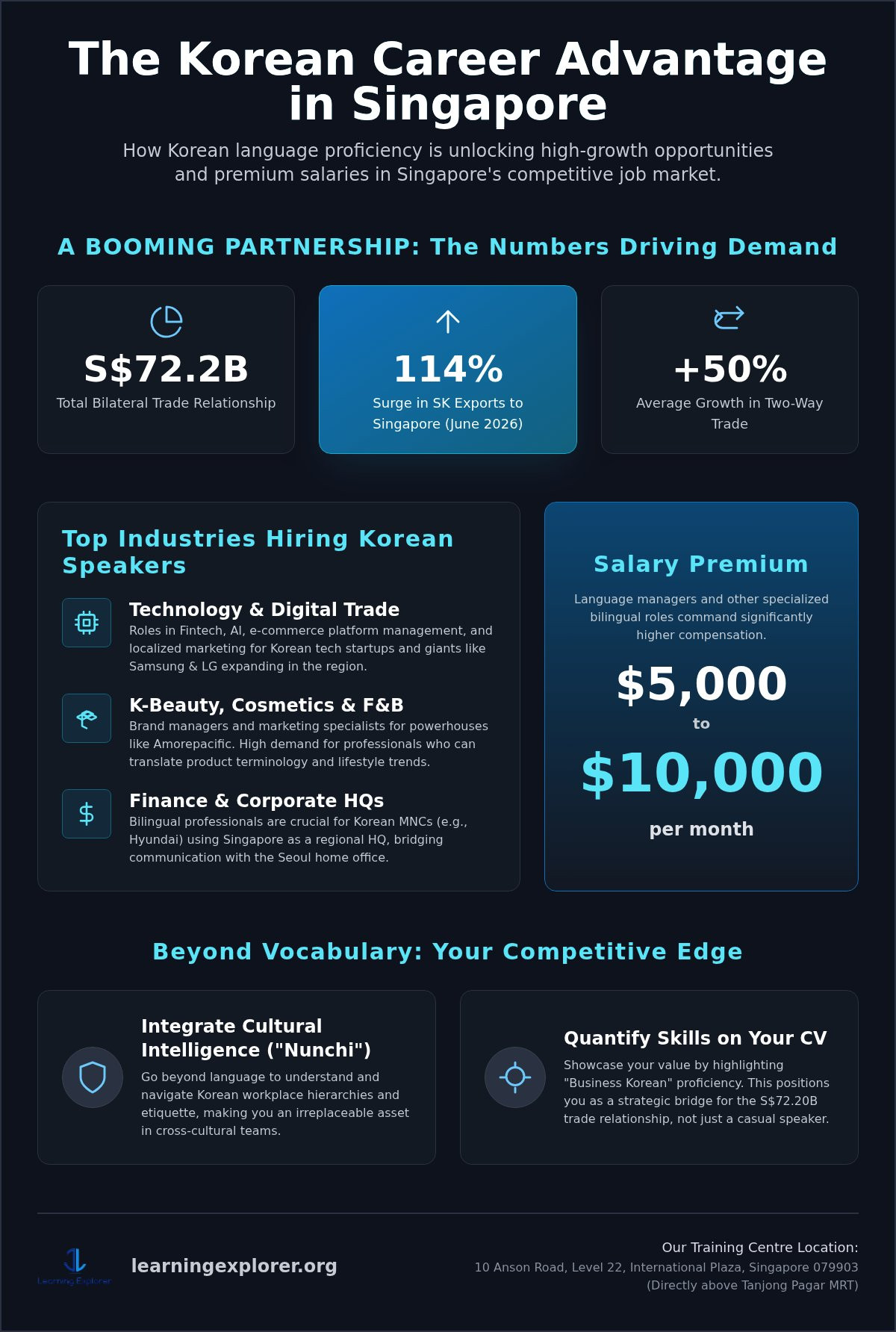
Did you know that South Korean exports to Singapore surged by a staggering 114% in June 2026 alone? If you feel like your career has hit a plateau, you aren’t alone. Many professionals find themselves wondering if they should invest time in a new skill or if their efforts will actually pay off. You might even worry that Korean is better suited for entertainment than the boardroom. However, the data tells a different story. Many ambitious individuals are now asking, is learning korean useful for a career in singapore, and the answer lies in the massive trade growth and the increasing presence of Korean MNCs in our city.
We understand the pressure of staying relevant in a competitive market. This guide promises to show you how Korean proficiency can unlock high-growth opportunities in tech, beauty, and finance sectors. We’ll highlight roles where language managers can earn up to $10,000 per month and explain how to apply these skills directly at our training center at 10 Anson Road, level 22, International Plaza, Singapore 079903, right above Tanjong Pagar MRT. You’ll discover which industries are hiring, gain the confidence to enroll in a course, and learn practical ways to navigate a Singaporean office using your new language skills.
Key Takeaways
- Understand how the 2026 trade surge between Singapore and South Korea creates a high-demand market for bilingual professionals across the region.
- Identify the specific roles in tech, beauty, and finance where Korean speakers can command significantly higher monthly salaries and career progression.
- Evaluate if is learning korean useful for a career in singapore by examining its critical role in bridging communication gaps within major Korean MNCs.
- Gain a competitive edge by integrating cultural intelligence and “Nunchi” into your professional toolkit to navigate complex workplace hierarchies with ease.
- Learn practical strategies to quantify your language skills on your CV and kickstart your professional growth at our training center located right above Tanjong Pagar MRT.
The Value of Korean Proficiency in Singapore’s 2026 Job Market
The “Korean Career Advantage” isn’t about knowing the lyrics to the latest K-pop hit. It’s about being the strategic bridge for a S$72.20 billion trade relationship. As of mid-2026, exports from Singapore to South Korea have jumped by nearly 60%, making bilingual professionals more valuable than ever. When you ask, is learning korean useful for a career in singapore, you have to look at the hard data. This isn’t just a hobby; it’s a calculated move for professionals who want to occupy a high-value niche in the local labor market.
Understanding the nuances of Singapore-South Korea diplomatic relations provides the foundation for why this partnership is thriving. While Hallyu fans appreciate the culture, “Business Korean” professionals command the room by navigating corporate etiquette and technical terminology. This bilingualism creates a unique profile that is difficult to replace, especially as trade imports from South Korea increased by over 33% by May 2026.
To better understand this concept, watch this helpful video:
Singapore as a Gateway for Korean MNCs
Giants like Samsung, LG, and Hyundai don’t just see Singapore as a market; they see it as a regional headquarters. These firms prioritize local talent who can communicate with the Seoul home office without a translator. The second round of negotiations to upgrade the Korea-Singapore Free Trade Agreement in July 2026 has paved the way for deeper cooperation in green energy and supply chains. Additionally, the “Silicon Island” ecosystem is now home to a wave of Korean startups that require staff who understand both the Singaporean business environment and Korean work culture.
Salary Premiums and Career Mobility
Bilingualism often comes with a tangible financial reward. In sectors like fintech and AI, companies offer language allowances or higher base salaries to secure fluent speakers. For instance, language manager roles in 2026 are commanding between $5,000 and $10,000 per month. Proficiency also smooths the path for internal transfers, allowing you to move between global offices with ease. Investing in a course at our center at 10 Anson Road, level 22, International Plaza, Singapore 079903, directly above Tanjong Pagar MRT, provides a clear path forward. For a mid-career professional in 2026, the ROI of learning Korean is measured by the immediate access to high-growth sectors that remain inaccessible to monolingual peers.
Top Singapore Industries for Korean Speakers
The employment landscape in the Lion City has undergone a significant transformation. While manufacturing once anchored the bilateral partnership, the focus has shifted toward high-tech innovation, digital trade, and creative services. If you’re asking is learning korean useful for a career in singapore, look at the recent surge in digital partnership agreements. These frameworks have created a massive demand for professionals who can manage e-commerce platforms and localized marketing for Korean brands expanding into Southeast Asia. Enrolling in a course at the best language school in Singapore helps you transition from basic phrases to the professional vocabulary required in these fast-paced corporate environments.
The ‘K-Beauty’ and Cosmetics Powerhouse
Beauty isn’t just skin deep in the Singaporean economy. It’s a massive industry where brands like Amorepacific use Singapore as a strategic hub for the entire region. The Korean food and beverage market is also flourishing, with a projected volume of US$16.4 billion by 2025, often overlapping with lifestyle and retail sectors. Brand managers who understand Korean product terminology and cultural trends have a distinct advantage. You aren’t just selling a product; you’re translating a lifestyle trend for a local audience. By bridging the gap between Seoul’s innovative developers and the Singaporean consumer base, you become an indispensable asset in supply chain and retail management roles.
Finance, Fintech, and Venture Capital
The financial sector offers some of the most lucrative opportunities for bilingual professionals. We’ve seen a rise in Korean investment in Singaporean fintech startups, particularly in AI and cloud computing. Relationship managers in private banking now need Korean fluency to serve high-net-worth clients who are moving capital into the region. The data shows that a Language Manager can earn between $5,000 and $10,000 per month, while AI Training Operations Specialists in fintech can start at $5,500. Technical Korean is also becoming vital in the semiconductor and electronics sectors as supply chains become more integrated. If you want to tap into these high-growth sectors, starting a Conversational Korean Course can provide the foundational fluency you need to stand out.
The demand for Korean speakers isn’t limited to traditional roles. As South Korea continues to export its technological and cultural innovations, Singaporean professionals who can navigate both languages will find themselves at the forefront of the 2026 job market. Whether it’s managing a creative team or overseeing a venture capital portfolio, your ability to communicate directly with Korean partners reduces administrative friction and increases your overall professional impact. To put Korean in the broader regional context, it’s worth exploring what is the most useful language for business in Southeast Asia as you plan your long-term career strategy.
Beyond Vocabulary: Cultural Intelligence as a Career Superpower
Fluency is a great tool, but cultural intelligence (CQ) is the real differentiator in the 2026 job market. In a Korean corporate setting, silence often speaks louder than words. This is where “Nunchi” comes in, which is the traditional Korean art of sensing others’ thoughts and feelings to build harmony. When professionals ask, is learning korean useful for a career in singapore, they often overlook these “soft” skills that drive hard results. Mastering the nuances of body language and social cues allows you to respond appropriately before a conflict even arises, making you an invaluable asset to any team.
Using the correct honorifics isn’t just about following old rules; it’s about signaling that you understand the stakes of a partnership. It reduces the administrative burden of constant clarification because you’re already aligned with the expected communication style. In high-stakes negotiations, this cultural alignment is often more important than pure grammatical perfection. It shows your Korean stakeholders that you respect their heritage and are committed to a long-term professional relationship. If you’re wondering if is learning korean useful for a career in singapore, consider how much faster you can build trust when you speak the language of respect.
Mastering the ‘K-Work’ Hierarchy
Singaporean branch offices of Korean MNCs often maintain a strong “Sunbae-Hoobae” (Senior-Junior) dynamic. Understanding Korean workplace hierarchy and language prevents common faux pas, such as speaking out of turn or failing to acknowledge seniority during a pitch. Etiquette extends far beyond the office walls to business dinners and networking sessions. Knowing how to pour a drink or accept a business card with both hands shows you aren’t just an employee, but a partner who values their corporate DNA. Acting as a cultural bridge between local and Korean teams reduces friction and accelerates project timelines, positioning you for rapid promotion.
Building Rapport Through Conversational Nuance
Just as with conversational mandarin in Singapore, Korean relies heavily on high-context communication. What isn’t said is often as vital as the words spoken. Textbook Korean won’t always prepare you for the rapid-fire dialogue of a Singaporean boardroom. Real-world business Korean focuses on the nuance of professional relationships. Small talk about shared interests, conducted in their native tongue, can solidify million-dollar partnerships. It transforms a cold transaction into a long-term alliance, moving you from being a “vetted” candidate to a trusted, visionary ally.
Showcasing Korean Skills to Singaporean Employers
Having the skill is only half the battle; the other half is proving its value to a hiring manager. If you want to confirm that is learning korean useful for a career in singapore, look at how you present yourself on paper. Employers in the CBD aren’t looking for casual hobbyists; they’re looking for bilingual assets who can reduce communication friction. Move beyond basic phrases by building a strategic professional brand. Join the Korean Chamber of Commerce in Singapore (KorCham) to network with industry leaders and understand the specific needs of local Korean firms.
Resume and Interview Strategy
Don’t just list “Korean” under a generic skills header. Quantify your ability by using specific terms like “Business Proficient” for those who can handle technical discussions, or “Conversational” for those managing daily office interactions. Frame your language skills as a problem-solving tool. Explain how your proficiency helps a firm expand into the Seoul market or manage vendor relations more efficiently. On your LinkedIn profile, list your language milestones as separate achievements to show a clear trajectory of growth. During a Korean-led interview, practice your formal speech (Jondetmal) to demonstrate respect and cultural awareness from the very first greeting.
Professional Training vs. Self-Study
Free apps are excellent for vacation vocabulary, but they often fall short of the professional-grade Korean required in high-stakes boardrooms. Professional language courses in Singapore provide the structured curriculum needed to master formal business terminology. Self-study lacks the immediate, native-speaker feedback essential for accent neutralization and nuanced speech patterns. If you’re starting from scratch, enrolling in an intensive Korean course for beginners in Singapore gives you the fast-track foundation needed to progress quickly into business-level proficiency. Choosing a reputable language school in Singapore also opens doors to a community of professionals, offering networking opportunities that digital platforms simply cannot replicate. You need an environment where you can practice real-world scenarios with experts who understand the Singaporean business context. Ready to elevate your career? Explore our Business Korean training today to bridge the gap between learning and earning.
Accelerate Your Career at Learning Explorer’s CBD Language Centre
Transforming your career trajectory requires more than just intent; it requires the right environment. We understand that as a busy professional in the CBD, your time is your most valuable currency. You don’t just want to learn; you want to excel. If you’ve spent time researching is learning korean useful for a career in singapore, you’ve seen the growth in bilateral trade and the rise of high-paying roles in fintech and beauty. Now, it’s time to bridge the gap between your current plateau and those future opportunities. Our specialized curriculum is designed specifically for the corporate landscape of 2026, focusing on the language you’ll actually use in meetings, emails, and networking sessions.
Strategically located at International Plaza, our center sits directly above Tanjong Pagar MRT. This makes it easy for you to attend a session before work, during lunch, or right after your final meeting of the day. You’ll learn from bilingual native speakers who don’t just teach grammar; they provide the cultural context of the Singaporean office. Whether you prefer the focus of private sessions, the energy of a group, or the speed of an intensive format, we have a solution that fits your schedule. We offer flexible learning formats to ensure your professional development never feels like an administrative burden.
The Learning Explorer Professional Edge
Forget rote memorization and endless drills. We prioritize practical usage through interactive environments that simulate real-world business scenarios. Our small group sizes ensure you get the speaking practice you need to feel confident in front of stakeholders. This engagement is the creative catalyst for better outcomes in your daily tasks. For organizations looking to upskill their entire team, we offer customized corporate training solutions that align with your specific industry goals, ensuring every employee can navigate the “K-Work” hierarchy with ease. If you’re evaluating the business case for team-wide language training, our guide on calculating ROI on corporate language programs in Singapore provides the exact framework and evidence you need to secure budget approval.
Join a Community of Professionals
When you step into our center, you aren’t just entering a classroom; you’re joining a network. Our students come from top MNCs across the Tanjong Pagar area, providing a unique space for peer-to-peer networking. We’ve seen countless success stories of professionals who used their Korean proficiency to pivot into regional roles or secure internal transfers. If you’re still asking is learning korean useful for a career in singapore, consider the success of our alumni who now lead regional teams in the tech and beauty sectors. Visit our center at International Plaza to start your journey and see how we can help you turn your career goals into a reality.
Master the Language of Innovation
The 2026 job market rewards those who can bridge the gap between global hubs. We’ve shown how the 114% surge in trade and the rise of tech MNCs have redefined professional success in our city. Whether you’re aiming for a salary premium in fintech or looking to lead a creative team in the K-beauty sector, your path is now clear. By now, you know that is learning korean useful for a career in singapore because it transforms you into a high-value regional asset with a unique competitive edge.
You don’t have to navigate this journey alone. Our native-speaker instructors and flexible class schedules ensure you can balance your professional growth with your daily responsibilities. By mastering both the vocabulary and the “Nunchi” required for the boardroom, you’ll reduce communication friction and increase your overall impact. Don’t let your career plateau when a world of opportunity is just one course away. Take the first step toward your next promotion and join a community of visionary professionals today.
Book Your Korean Trial Lesson at Our Tanjong Pagar Centre Today!
We’re here to help you turn your ambition into a reality. Your future in Singapore’s most innovative sectors starts now.
Frequently Asked Questions
Is learning Korean useful for a career in Singapore if I don’t work for a Korean company?
Yes, it’s highly beneficial. Many Singaporean firms in fintech and e-commerce partner with Korean vendors or target Korean consumers. Knowing the language helps you manage these cross-border supply chains and third-party relationships more effectively. It also makes you a prime candidate for local startups looking to expand into the East Asian market. You become a vital cultural bridge even in non-Korean corporate environments, reducing friction in regional projects and high-value trade deals.
How long does it take to reach a professional level of Korean for business?
Most professionals reach a conversational business level in about 12 to 18 months of consistent study. This timeline depends on your starting point and the intensity of your chosen course. At Learning Explorer, we focus on practical usage, which accelerates your ability to handle office meetings and emails. Regular practice with our native-speaker instructors ensures you master the specific honorifics required for a professional setting, helping you stand out in the competitive 2026 job market.
Is Korean harder to learn than Mandarin or Japanese for Singaporeans?
Korean is often considered more accessible than Mandarin because it uses Hangeul, a phonetic alphabet, rather than thousands of complex characters. While the grammar shares similarities with Japanese, the logical structure of Hangeul allows beginners to read and write within hours. For those already familiar with Mandarin or Japanese, the shared vocabulary and sentence structures often make the learning process significantly faster. This makes Korean a high-ROI skill for local professionals seeking East Asian opportunities.
Can I learn Korean while working full-time in Singapore?
Absolutely. Many of our students are busy professionals working in the CBD. We offer flexible learning formats, including private sessions and group classes, to suit your specific schedule. Our center is conveniently located at International Plaza, right above Tanjong Pagar MRT, making it easy to attend lessons after your work day. This accessibility ensures you can maintain your professional development without adding extra administrative burdens to your already busy routine or sacrificing your personal time.
What are the most in-demand job roles for Korean speakers in Singapore?
Demand is highest in high-tech innovation and creative sectors. Specific roles include AI Training Operations Specialists in fintech, Language Managers for digital platforms, and Brand Managers in the K-beauty industry. Many professionals also find that is learning korean useful for a career in singapore when applying for regional supply chain or retail management positions. These roles often offer salary premiums for bilingual candidates who can navigate complex trade relationships and support regional expansion efforts.
Do I need a formal certification to prove my Korean skills to employers?
While certifications like TOPIK are recognized, many Singaporean employers prioritize your actual ability to communicate in a business context. Demonstrating your proficiency during an interview or highlighting your training at a reputable school is often more impactful. We help you quantify your skills on your CV, transitioning from a basic learner to “Business Proficient.” This practical evidence of your capability often carries more weight than a piece of paper in high-stakes corporate environments where results matter.
Are there networking groups in Singapore for Korean-speaking professionals?
Yes, the Korean Chamber of Commerce in Singapore (KorCham) is a primary hub for networking. Additionally, our language center provides a community of fellow learners from top MNCs in the Tanjong Pagar area. Engaging with these groups allows you to practice your conversational skills while staying updated on industry trends. It’s a great way to confirm that is learning korean useful for a career in singapore by meeting others who have successfully pivoted into new industries using their language skills.