Imagine walking into a high-stakes boardroom at 10 Anson Road, level 22, International Plaza, Singapore 079903, only to realize your polite greeting unintentionally offended a Senior Director because you used the wrong honorific. It’s a common fear for many professionals, as the nuances of understanding korean workplace hierarchy and language often feel like an invisible barrier to your career growth. You likely already know that respect is the cornerstone of Korean business culture, but knowing exactly where you stand and how to speak accordingly is a complex art that requires more than just a dictionary.
We’re here to help you turn that anxiety into a professional asset. This guide promises to help you master the relationship between social rank and speech so you can thrive in any Korean corporate environment. You’ll learn to decode confusing job titles, select the correct speech levels, and grasp the unspoken etiquette that builds genuine rapport with stakeholders. We’ll also look at how 2026 workplace shifts, like the Yellow Envelope Act and new labor protections, are influencing modern office dynamics. By the end, you’ll communicate with the confidence and cultural awareness needed to drive better outcomes for your career.
Key Takeaways
- Learn how Neo-Confucian values still shape modern office dynamics and distinguish between traditional seniority and the “Kkondae” phenomenon.
- Gain clarity on understanding korean workplace hierarchy and language by mastering the shift between honorific Jondaemal and informal Banmal to avoid professional friction.
- Decode the standard Korean corporate ladder, from entry-level Sawon to executive Hoejang, ensuring you always address your colleagues with the correct level of respect.
- Master the art of “Nunchi” and essential seating protocols to demonstrate high cultural awareness during high-stakes meetings and business dinners.
- Discover how learning from bilingual native instructors can bridge the gap between Singaporean professional norms and Korean corporate expectations.
What is Korean Workplace Hierarchy? Defining the Vertical Office
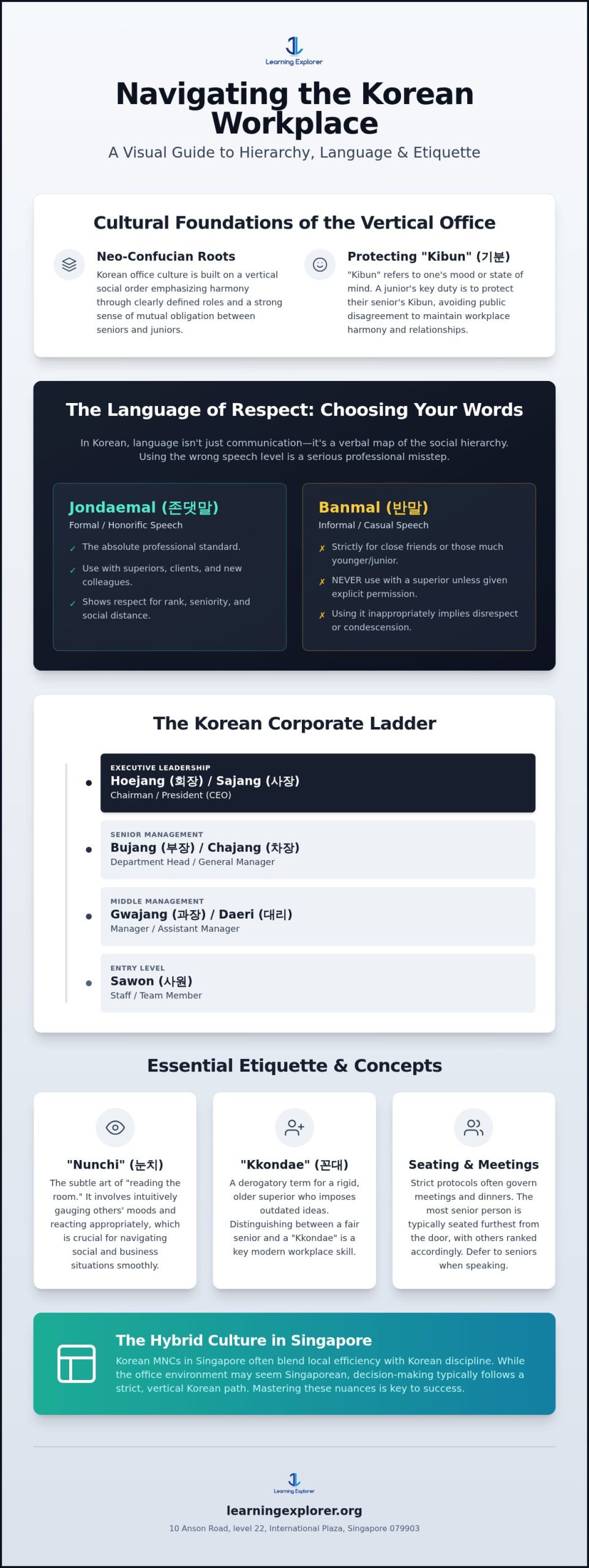
Success in a Seoul-based firm or a local Korean subsidiary requires more than just technical skills; it demands a deep appreciation for a vertical social order. This structure is heavily influenced by the historical roots of Neo-Confucianism, which emphasizes harmony through clearly defined roles and filial piety. In the modern office, this translates to a system where everyone has a specific place. Gaining a mastery of understanding korean workplace hierarchy and language allows you to move past the surface level of “boss and employee” to see the intricate web of mutual obligations that keep the organization running smoothly.
A central concept in this vertical world is “Kibun,” which refers to a person’s face, mood, or state of mind. In a hierarchical setting, a junior’s primary responsibility is to protect and maintain the Kibun of their senior. Damaging a supervisor’s Kibun by questioning them publicly or ignoring protocol can lead to a breakdown in professional relationships. This differs significantly from the typically more horizontal or meritocratic Singaporean office, where open debate is often encouraged regardless of rank. In a Korean environment, maintaining the social fabric is often just as important as the task at hand.
You may hear the term “Kkondae” used in modern office discourse. This is a derogatory slang term for an older person or superior who uses their rank to force outdated ideas on others. While the Culture of South Korea is evolving and many younger leaders are pushing for “horizontal” cultures, the traditional respect for seniority remains a powerful force. Distinguishing between a demanding but fair leader and a Kkondae is a vital skill for any professional.
The Core Pillars: Seniority and Rank
In traditional Korean settings, age often carries more weight than individual experience. This is reinforced by “Gi-su,” or the year you entered the company or graduated. Those in the same Gi-su form a tight-knit cohort, while those even one year senior are treated with distinct deference. However, this hierarchy is not just about giving orders. It creates a “big brother” or “big sister” dynamic where seniors feel a profound sense of responsibility to mentor and protect their juniors, often guiding them through both professional and personal challenges.
Hierarchy in the Singapore Context
For those working in the Singapore CBD, the experience is often a “hybrid” culture. Korean MNCs operating locally frequently blend Singaporean efficiency with Korean discipline. You might find that while the office looks Singaporean, the decision-making process follows a strict vertical path. Mastering these nuances is essential for anyone pursuing Korean for careers in Singapore, as it helps you build the trust and rapport necessary to thrive in a competitive, multi-cultural environment.
The Language of Respect: Connecting Hierarchy to Speech Levels
Language in Korea is much more than a tool for communication; it’s a verbal map of the social landscape. When you’re understanding korean workplace hierarchy and language, you’ll find that your choice of verb endings signals your immediate awareness of power dynamics. Jondaemal (honorific speech) is the absolute professional standard. In contrast, Banmal (informal speech) is strictly reserved for close personal friends or those of significantly lower rank. Using the wrong level isn’t just a simple grammar slip. It’s often perceived as a direct professional threat to a superior’s authority or an act of condescension toward a peer. Even if you’re a foreigner, making an effort to use honorifics shows you respect the local corporate order.
Surprisingly, even in modern “English-only” offices, the underlying hierarchical logic remains firmly in place. While the vocabulary might be English, the order of speaking, the deference shown during disagreements, and the use of honorific suffixes like “Susi-eo” in written requests still follow traditional rules. Scholarly research on Korean hierarchical language demonstrates that these speech acts are inseparable from social status. You’ll often see emails where English names are paired with Korean titles to maintain this balance. If you’re working in Singapore’s financial district, you’ve likely noticed this blend of cultures in daily business correspondence.
Mastering Jondaemal in Business Meetings
In a professional setting, you’ll navigate two main forms of Jondaemal. The “-yo” ending is polite and common for daily office chatter. The “-nida” ending is formal and preferred for presentations or high-stakes negotiations. When addressing superiors, always use their job title followed by the honorific suffix “-nim,” such as “Bujang-nim” (Department Head). Never use a superior’s name alone. It’s considered highly disrespectful in any business context. For non-native speakers, sticking consistently to the formal “-nida” style provides a linguistic safe zone that ensures your respect is never questioned by senior stakeholders.
The Nuances of Honorific Infixes
True fluency involves “raising” the listener while “lowering” yourself through humble speech. This is often achieved through the infix “-si-“, which is inserted into verbs to show respect to the person performing the action. A common mistake for professionals in Singapore is direct-translating English phrases like “Can you do this?” into Korean. This can sound blunt or even demanding. Inserting “-si-” transforms the sentence into a respectful inquiry. If you’re looking to refine these skills, our Business Korean Course offers practical drills to help you master these nuances and build stronger rapport with your team.
Korean Job Titles and Ranks Explained
In a Korean office, your job title is your identity. Unlike Singaporean or Western cultures where “you” is a standard pronoun, using a direct second-person pronoun in a Korean professional setting can be seen as aggressive or even offensive. Instead, titles function as pronouns. You address your colleagues by their rank to maintain the social order. Gaining a deep understanding korean workplace hierarchy and language means knowing exactly which title to use for everyone from the new associate to the board chairman.
While traditional firms still cling to rigid structures, the landscape is shifting. Some modern tech startups and innovative firms are moving toward a “horizontal” culture. They often replace complex ranks with a universal “-nim” suffix or even English names to encourage faster communication. However, most established corporations and their Singaporean branches still operate on the classic tier system. Knowing these ranks helps you navigate the “unspoken rules” of the office and ensures you never accidentally disrespect a senior partner during a high-stakes negotiation. The same principle of industry-specific Korean knowledge applies across sectors; for example, professionals in retail and cosmetics benefit from understanding how these hierarchical norms shape supplier relationships when they learn Korean for the beauty and cosmetics industry sg.
Staff Level Hierarchy (The Working Tier)
The working tier is where the bulk of daily operations happen. It’s essential to attach the honorific suffix “-nim” to these titles when speaking to or about someone of equal or higher rank. The standard progression includes:
- Sawon (Associate): This is the entry-level position for new graduates.
- Daeri (Assistant Manager): Typically achieved after two to four years of service.
- Gwajang (Manager): A mid-level role that often leads a small team.
- Chajang (Senior Manager): A bridge between middle management and department leadership.
- Bujang (Department Head): The highest staff rank before entering the executive tier.
Executive Level Hierarchy (The Decision Makers)
Once you reach the executive level, the stakes for correct address become even higher. These leaders often oversee large-scale Singaporean-Korean joint ventures and expect a high level of formal deference. The executive ranks generally follow this order:
- Isa (Director): The first step into the executive boardroom.
- Sangmu (Vice President): A senior executive role with significant departmental oversight.
- Jeonmu (Senior Vice President): High-level leaders often involved in corporate strategy.
- Sajang (President/CEO): The top operational leader of the company.
- Hoejang (Chairman): Often the owner or the head of a large conglomerate (Chaebol).
If you’re coordinating meetings with partners in Singapore, remember that these titles carry weight. Addressing a “Sajang-nim” correctly can set a positive tone for the entire partnership. It shows that you value their position and the effort they’ve invested in their career.
Practical Etiquette for Navigating Korean Corporate Culture
Mastering the nuances of understanding korean workplace hierarchy and language requires observing physical cues just as much as listening to words. In a Korean office, respect isn’t just spoken; it’s performed through seating choices, dining habits, and the careful management of conflict. If you’re working in a high-pressure environment like the Singapore CBD, these small gestures often determine how quickly you’re integrated into the team’s inner circle. Ignoring these “unspoken rules” can lead to friction, even if your verbal Korean is technically perfect.
One of the most critical skills you’ll need is the ability to handle disagreements without “breaking” the hierarchy. Openly contradicting a superior in a meeting is often seen as a direct attack on their authority. Instead, adopt a “Yes, but…” approach. Acknowledge their point first to protect their “Kibun” (face), then offer your perspective as a supplementary suggestion rather than a correction. This allows the senior to consider your input without losing status in front of the group.
The Art of Nunchi: Reading the Room
Nunchi is often described as the “eye-measure” or the art of sensing others’ feelings and the overall atmosphere. In a professional setting, having high Nunchi means knowing when to speak and, more importantly, when to stay silent. Before you voice an opinion or take an initiative, observe the reactions of your superiors. Are they leaning in or pulling away? Is the room’s energy tense or relaxed? Developing this social radar helps you navigate complex office politics and avoid awkward social blunders. If you want to sharpen these cultural instincts, consider enrolling in our Conversational Korean Course to practice real-world business scenarios.
Business Cards and Physical Respect
Physical etiquette starts with the exchange of business cards. Always use two hands to give and receive cards, ensuring the text is facing the recipient so they can read it immediately. Never slide a card across a table or tuck it into your back pocket; treat it as an extension of the person themselves. This “two-handed rule” applies to everything from pouring drinks to passing documents. At a “Hoesik” (company dinner), junior staff should ensure the glasses of their seniors are never empty. When drinking in front of a superior, it’s polite to turn your head slightly to the side as a sign of deference. These gestures, combined with a respectful bow at the correct angle, demonstrate that you truly value the professional bond.
Seating arrangements also follow a strict logic. The “upper seat” (Sang-seok) is typically the spot furthest from the door or the one with the best view of the room. In a car, the seat behind the front passenger is reserved for the most senior person. Paying attention to these details shows your colleagues that you’ve done the work to understand their culture. If you’re ever unsure, our instructors at 10 Anson Road, level 22, International Plaza, Singapore 079903, can guide you through these specific protocols during your training sessions.
Mastering Professional Korean at Learning Explorer
Navigating the complex layers of a foreign corporate culture is a taxing daily task for many professionals. You’ve seen how understanding korean workplace hierarchy and language is the key to unlocking professional success, but theory alone isn’t enough to build true confidence. At Learning Explorer, we act as your knowledgeable guide, transforming the labor of seeking cultural answers into the satisfaction of discovery. Our conversational Korean course doesn’t just teach you vocabulary; it integrates deep cultural training that mirrors the real-world demands of the modern office.
One of our greatest strengths is our team of bilingual native-speaker instructors. They don’t just speak the language; they live and breathe the professional landscape of both Korea and Singapore. This dual perspective is invaluable for CBD-based professionals who need to bridge the gap between local efficiency and traditional Korean discipline. Whether you’re a solo learner or looking for customized corporate training solutions for your entire team, we provide the creative catalyst for better professional outcomes.
Why a Structured Course Beats Self-Study
Many learners fall into the trap of “K-Drama Korean,” where they inadvertently pick up Banmal (informal speech) from their favorite shows. Using these casual phrases in a meeting with a Bujang-nim could be a career-stunting mistake. A structured environment ensures you get real-time feedback on your honorific pronunciation and verb endings. Precision matters. If you’re just starting out, exploring an intensive Korean course for beginners in Singapore can help you build the right foundation from day one, ensuring you never develop bad habits that are difficult to unlearn. You’ll also join a vibrant community of fellow professionals, building a network of peers who share your goal of mastering understanding korean workplace hierarchy and language in a supportive, expert-led setting.
Visit Our Center in the Heart of the CBD
We respect your limited time, which is why our center is strategically located at 10 Anson Road, level 22, International Plaza, Singapore 079903. Situated directly above Tanjong Pagar MRT, we offer the ultimate convenience for evening classes after a busy day at the office. You won’t have to commute far to access high-quality, vetted materials and expert instruction. Choosing the right language school in Singapore is the first step toward reducing your administrative burdens and increasing your engagement with Korean stakeholders. Join us and experience a learning journey that is as visionary and mission-driven as your own career goals.
Step Into Your Future with Cultural Confidence
Mastering the nuances of understanding korean workplace hierarchy and language is a transformative step for any professional looking to thrive in a globalized market. You’ve learned that success isn’t just about what you say, but how you position yourself within the delicate balance of seniority, rank, and respect. From decoding complex job titles to reading the room through “Nunchi,” these cultural tools reduce your daily friction and build lasting trust with your Korean partners. These skills are no longer just optional; they’re the foundation of effective leadership in a 2026 corporate environment.
Don’t let the fear of a linguistic misstep hold you back from achieving your career goals. At Learning Explorer, we provide an interactive and fun learning environment led by bilingual, native-speaker instructors who understand the specific challenges you face. Our center at International Plaza is designed to be your reliable ally, offering the expert guidance needed to turn cultural confusion into professional mastery. Our convenient CBD location makes it easy to transition from your workday to a session of inspired discovery.
Start Your Korean Language Journey at Learning Explorer Today and gain the creative catalyst you need for better outcomes. We’re here to help you communicate with authority and kindness every step of the way.
Frequently Asked Questions
Is it rude to use English names in a Korean workplace?
Using English names is generally acceptable in modern tech startups or global firms, but it can be seen as disrespectful in traditional corporate environments. Always observe your colleagues first. If everyone uses titles like “Bujang-nim,” you should follow suit. In Singapore-based Korean firms, a hybrid approach is common. When in doubt, ask your HR or a trusted peer about the specific office protocol to avoid accidental offense.
What is the correct way to address a colleague of the same rank?
To address a colleague of the same rank, use their full name followed by the suffix “-ssi” for a polite yet neutral tone. Alternatively, you can use their job title followed by “-nim,” such as “Daeri-nim,” if you want to show extra professional respect. Avoid using just their first name, as this implies a level of intimacy that might not be appropriate for the workplace. This balance is a key part of understanding korean workplace hierarchy and language.
Do I need to bow every time I see my manager at the office?
You don’t need to perform a deep bow every time you pass your manager. A formal bow is typically reserved for the first meeting of the day or when someone is arriving or leaving. For subsequent encounters in hallways or the breakroom, a polite “Mok-rye,” which is a slight nod of the head while maintaining eye contact, is perfectly acceptable. This demonstrates respect without disrupting the flow of the workday.
How do I say “No” to a superior in Korean without being disrespectful?
Saying a direct “No” to a superior is often considered too blunt. Instead, use softeners like “Gureisumnida, man…” (That is true, but…) or suggest that a task might be “difficult” (oryeopseumnida) rather than impossible. This allows the superior to save face while still receiving your feedback. Providing a logical alternative or asking for clarification on priorities is a professional way to navigate disagreements without challenging the established vertical order of the office.
What should I do if a senior colleague uses informal language (Banmal) with me?
If a senior colleague uses informal Banmal with you, it’s usually a sign of their higher status or a gesture of closeness. However, you must continue to respond using formal Jondaemal. Switching to informal speech just because they did is a major breach of etiquette. Maintain your professional distance by sticking to polite verb endings. This consistency shows that you have a firm grasp of understanding korean workplace hierarchy and language and respect the seniority system.
Are Korean workplace hierarchies becoming more relaxed in 2026?
Korean workplace hierarchies are becoming more flexible in 2026, driven by new labor laws like the Yellow Envelope Act and expanded parental leave. Many companies are adopting “horizontal” communication styles to attract younger talent. Despite these shifts, the underlying values of respect and seniority remain influential. You’ll likely encounter a mix of modern flexibility and traditional structure, especially in firms operating within the Singapore CBD where global and local norms frequently intersect.
How long does it take to learn basic business Korean for office use?
Learning basic business Korean for office use typically takes about three to six months of consistent, structured study. During this time, you can master essential greetings, common job titles, and the basic honorific verb endings needed for daily interactions. Achieving true fluency in complex negotiations takes longer, but a few months of dedicated practice at our center at 10 Anson Road, level 22, International Plaza, Singapore 079903, will give you the confidence to handle routine professional tasks.
Can I learn Korean honorifics through a conversational course?
Yes, you can definitely learn honorifics through a conversational course. At Learning Explorer, our Conversational Korean Course integrates honorifics from day one because they are inseparable from natural speech. You’ll practice real-world scenarios, such as introducing yourself to a director or asking a manager for feedback. This practical approach ensures you don’t just learn grammar rules in isolation but understand how to apply them correctly to build rapport and demonstrate cultural awareness in the office.