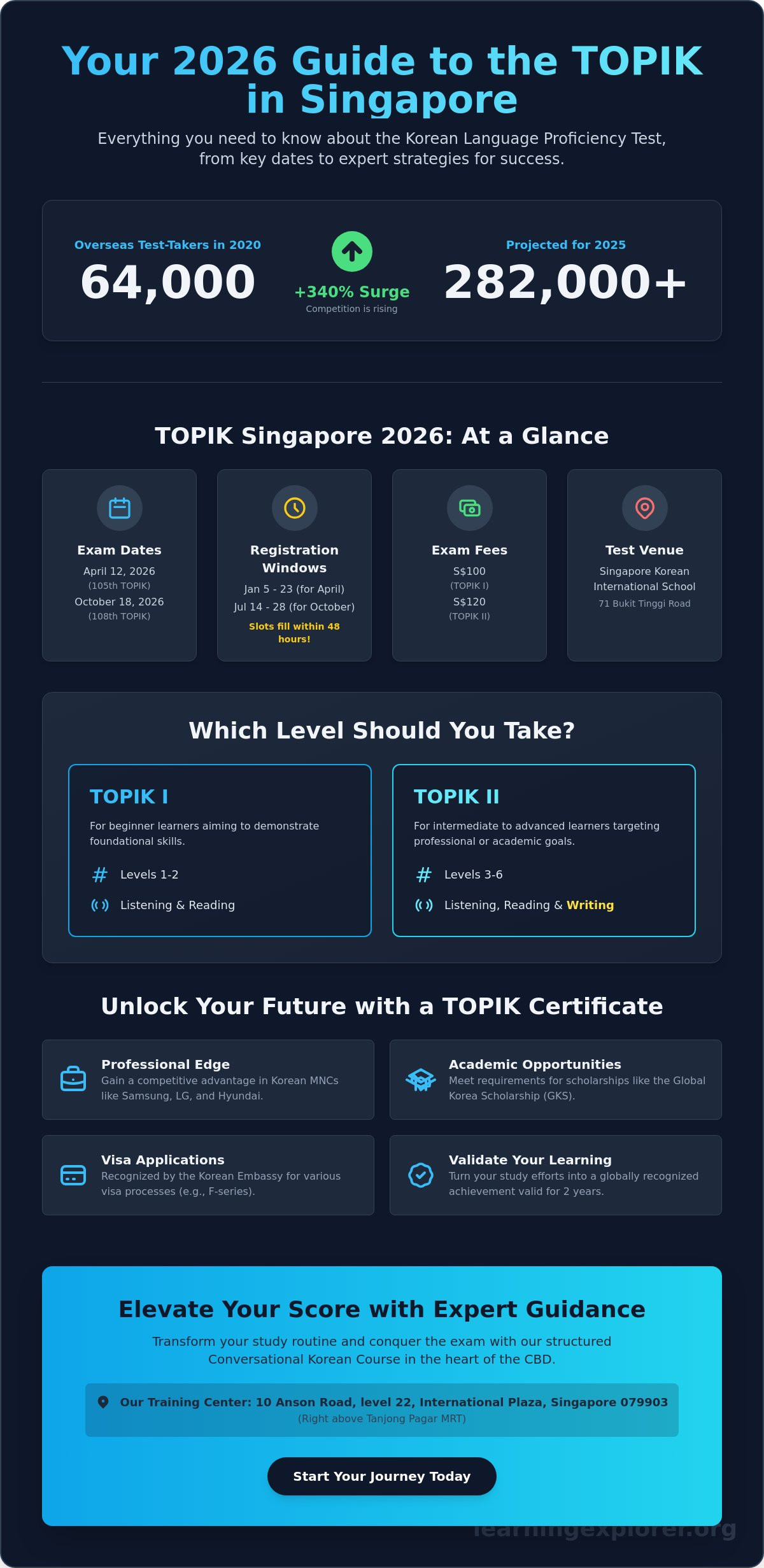
The number of overseas test-takers for the official Korean exam skyrocketed from 64,000 in 2020 to over 282,000 by 2025. This massive surge means securing your spot for the korean language proficiency test singapore is more competitive than ever. Whether you’re aiming for a professional visa or finally want to validate years of casual learning with a formal certificate, the pressure to perform is real.
We understand the anxiety of missing tight registration windows or feeling overwhelmed by the complex TOPIK II writing section. You don’t have to tackle these hurdles alone. This guide promises to simplify your journey by providing the exact 2026 test dates, registration steps, and expert strategies to boost your score. We’ll cover everything from the April and October testing cycles to finding a high-quality Conversational Korean Course at our center at 10 Anson Road, level 22, International Plaza, Singapore 079903, located right above Tanjong Pagar MRT. Let’s turn your study efforts into a recognized achievement and get you ready for success.
Key Takeaways
- Mark your calendar for the 2026 TOPIK exam dates in April and October and learn how to navigate the tight registration windows with ease.
- Discover the critical differences between TOPIK I and TOPIK II to ensure you register for the right level of the korean language proficiency test singapore.
- Master the “2,000 words” rule and other expert preparation strategies designed to conquer the challenging writing section in TOPIK II.
- Learn how a structured Conversational Korean Course in the CBD can transform your study routine and provide the creative catalyst for better results.
- Unlock professional opportunities and visa benefits by securing a globally recognized certificate through a streamlined and strategic approach.
What is the TOPIK? Understanding the Korean Language Proficiency Test
The Test of Proficiency in Korean (TOPIK) isn’t just another language assessment. It’s the official, gold-standard certification managed by the National Institute for International Education (NIIED), a branch of South Korea’s Ministry of Education. If you’re planning to take the korean language proficiency test singapore, this is the only credential that carries weight with government bodies and academic institutions worldwide. It offers a clear, standardized measure of your ability to communicate, whether you’re just starting your journey or reaching for near-native fluency.
The test structure is designed to be comprehensive and challenging. It evaluates your listening and reading comprehension across all levels to ensure you can handle real-world situations. For those aiming for the intermediate or advanced stages, the TOPIK II includes a rigorous writing component. This specific section often causes the most anxiety among local learners, but it’s also what distinguishes a truly proficient speaker from a casual one. For Singaporeans, this certificate serves as a vital bridge to opportunities that require more than just basic survival phrases.
Why Singaporeans are Taking the TOPIK in 2026
Local interest in Korean culture has evolved far beyond K-dramas and pop music. In 2026, more professionals are using the TOPIK to gain a competitive edge in major Korean MNCs like Samsung, LG, or Hyundai. Having this certificate on your resume proves you have the grit to master a complex language and understand the nuances of Korean corporate culture. It’s also a mandatory requirement for students applying for the Global Korea Scholarship (GKS), which opens doors to prestigious Korean universities. For many, it’s the ultimate way to validate their progress in a conversational Korean course, turning a passionate hobby into a professional asset that lasts a lifetime.
Validity and Recognition of Your Results
Your hard work yields a result that’s typically valid for exactly two years from the date your scores are announced. This timeframe is crucial for planning your next career move or academic application. The Korean Embassy in Singapore recognizes these results for various visa processes, including the F-series visas. Local employers also rely on these scores to verify linguistic competency during the hiring process. Because the test is only held twice a year at the Singapore Korean International School, timing your preparation is essential. You want to ensure your certificate is active and valid when you’re ready to submit that university application or job offer.
TOPIK Singapore 2026: Exam Dates, Fees, and Registration
Planning your schedule around the korean language proficiency test singapore is the first step toward certification success. For 2026, the National Institute for International Education has confirmed two primary testing windows. The 105th TOPIK is scheduled for April 12, 2026, while the 108th TOPIK will take place on October 18, 2026. Both examinations are held at the Singapore Korean International School, located at 71 Bukit Tinggi Road. This venue remains the sole official test center in the country, so it’s vital to familiarize yourself with the location well before your exam day.
Investing in your future doesn’t have to be complicated. The registration fees for 2026 remain consistent with previous cycles. For beginners taking the TOPIK I (Levels 1-2), the fee is S$100. Intermediate and advanced learners sitting for the TOPIK II (Levels 3-6) will pay S$120. These fees are non-refundable in most cases. Double check your target level before completing the transaction to avoid administrative headaches later.
2026 Registration Deadlines You Can’t Miss
Don’t let the dates slip by. For the April exam, the registration window opens on January 5 and closes on January 23, 2026. If you’re aiming for the October session, you must register between July 14 and July 28, 2026. While these windows seem generous, reality is different. Slots for the korean language proficiency test singapore are extremely limited. They often fill up within the first 48 hours of opening. We recommend setting an alarm for 9:00 AM on the first day of registration to secure your seat. Missing this window means waiting another six months for the next opportunity.
How to Register: A Step-by-Step Walkthrough
The process is entirely digital. First, visit the SKIS official portal during the active window. You’ll need to upload a clear, digital passport-sized photo that meets NIIED’s strict requirements: white background, no hats, and recent. After filling in your personal details, complete the online payment. Once your payment is verified, you’ll receive a confirmation email. Keep this safe; it’s your ticket into the exam hall. If you’re feeling nervous about the test itself, consider joining a Conversational Korean Course at our center at 10 Anson Road, level 22, International Plaza, Singapore 079903, located right above Tanjong Pagar MRT, to sharpen your skills before the big day.
TOPIK I vs. TOPIK II: Which Level Should You Take?
Choosing between TOPIK I and TOPIK II is a strategic decision that depends on your current proficiency and future goals. The korean language proficiency test singapore uses a tiered system where your total score determines your final grade. TOPIK I is the entry point for beginners, covering levels 1 and 2. It tests your listening and reading skills through a 200-point exam. If you can handle basic survival tasks like ordering food or introducing yourself, this is your starting line.
TOPIK II is a different beast entirely. It spans levels 3 through 6 and introduces a 100-point writing paper alongside listening and reading, for a total of 300 points. The leap from Level 2 to Level 3 is often where students feel the most pressure. You aren’t just being tested on what you know; you’re being tested on how you apply it in complex, academic, and professional contexts. Understanding this distinction helps you avoid the frustration of registering for a level that doesn’t align with your current abilities.
Choosing the Right Level for Your Goals
Your choice should mirror your ambitions. Take TOPIK I if you’ve recently completed basic language courses in Singapore and want to benchmark your progress. It’s a fantastic confidence booster. However, if you’re eyeing undergraduate programs in Seoul, you’ll typically need at least TOPIK II Level 3. Professional roles in major Korean firms usually demand Level 4 or higher to verify you can handle business negotiations and complex reports. Align your preparation with these benchmarks to ensure your certificate opens the right doors.
The Challenge of the TOPIK II Writing Section
The writing paper is the primary reason many students find TOPIK II daunting. It consists of two short-answer questions and two essays: one descriptive and one argumentative. The real hurdle isn’t just the vocabulary; it’s the grammar. You must master ‘Plain Form’ (haera-che), a specific sentence ending used in formal writing. This differs significantly from the polite ‘yo’ endings you use in daily life. Many Singaporean learners excel at verbal practice but struggle with this transition to academic structure. Bridging this gap requires moving beyond simple sentences to constructing logical, cohesive arguments. Don’t let the writing section intimidate you. With focused practice on formal structures, you can turn this challenge into a scoring opportunity.
Effective Preparation Strategies for Singaporean Learners
Success in the korean language proficiency test singapore requires more than just watching dramas without subtitles. You need a structured roadmap that transitions from casual listening to academic precision. Start your journey by taking a diagnostic test to identify your current proficiency baseline. This prevents you from wasting time on concepts you already know and highlights the specific grammar points that need your attention. Focus heavily on the “2,000 words” rule, which prioritizes high-frequency TOPIK vocabulary found in almost every exam cycle.
Time management is your greatest ally during the actual test. Practice with past year papers under strict exam conditions to get used to the mounting pressure of the clock. While a conversational Korean course builds your confidence in speaking, you must balance it with formal grammar study to handle the nuance of the Reading and Writing sections. This dual approach ensures you don’t just speak the language, but you understand the structural rules that examiners look for when grading your papers.
Exam Day Logistics: Getting to SKIS
Many candidates underestimate the journey to the Singapore Korean International School. Located at 71 Bukit Tinggi Road, the venue is tucked away in a quiet residential area and isn’t directly next to an MRT station. To avoid unnecessary stress, utilize the dedicated shuttle bus service that typically runs from Beauty World MRT (Exit A) on exam mornings. Plan to arrive at least 30 minutes before your paper starts. Latecomers are strictly barred from entry, and there are no exceptions for traffic delays or transport hiccups. Being early allows you to settle your nerves and focus on the task ahead.
Top Resources for Self-Study and Practice
Equip yourself with the right tools to maximize your study hours. The official TOPIK Guide books and the “TOPIK in 30 Days” series are excellent for structured learning. For on-the-go practice, mobile apps like “TOPIK One” offer convenient listening exercises during your daily commute. The official NIIED TOPIK website remains the best digital platform for downloading authentic past examination papers for free. If you want to accelerate your progress with professional guidance, join our Conversational Korean Course at 10 Anson Road, level 22, International Plaza, Singapore 079903, located right above Tanjong Pagar MRT.
Elevate Your Score with Learning Explorer in the CBD
The journey toward mastering the korean language proficiency test singapore often feels like a solitary uphill climb. You’ve navigated the registration deadlines and decoded the differences between levels, but the final hurdle is the actual performance. We believe that professional support shouldn’t be a luxury; it’s a strategic necessity for those balancing high-pressure careers with ambitious personal goals. Our center is conveniently located at 10 Anson Road, level 22, International Plaza, Singapore 079903, directly above Tanjong Pagar MRT. This central location ensures that your learning fits seamlessly into your workday, reducing the administrative burden of travel and allowing you to focus entirely on your progress.
Our courses are led by native-speaker instructors who possess a deep, intuitive understanding of the TOPIK structure. They don’t just teach the language; they teach the test. By keeping our group sizes small, we guarantee that you receive personalized feedback on your writing and grammar. This level of attention is nearly impossible to replicate in a self-study environment or a massive lecture hall. It’s the difference between guessing your mistakes and receiving a clear, actionable roadmap for improvement.
Why Prep with Us Instead of Self-Study?
Self-study often leaves learners stranded in the “intermediate plateau,” where conversational skills don’t quite translate into academic success. Our structured curriculum bridges this gap by moving you from basic sentence patterns to the complex argumentative essays required in TOPIK II. We conduct mock exams under timed conditions to desensitize you to the pressure of the clock. This practice builds the specific stamina needed to tackle the reading and listening sections without mental fatigue. You’ll also gain expert guidance on Korean formal etiquette and the specific exam vocabulary that native speakers use in academic settings.
Join a Supportive Community of Learners
Learning a language is an emotional journey as much as an intellectual one. When you join our classes, you connect with a vibrant community of fellow students in Singapore who share your 2026 goals. This environment transforms the labor of seeking materials into the satisfaction of guided discovery, where every lesson feels like a creative catalyst for your next breakthrough. We pride ourselves on being a reliable ally that understands the taxing nature of your professional life. Contact us today to find the right Korean language school Singapore experience for you and take the first step toward a transformative result.
Secure Your Korean Language Future in 2026
You’ve now got the full roadmap for the korean language proficiency test singapore. From tracking those vital registration windows in January and July to choosing between the beginner-friendly TOPIK I or the career-boosting TOPIK II, you’re equipped to succeed. Remember that mastering the writing section requires moving beyond casual apps to structured, formal practice. Navigating the logistics of the SKIS venue is much easier when you’ve prepared your strategy well in advance.
Don’t let administrative hurdles or exam anxiety hold you back from your academic or professional dreams. Our center, located right above Tanjong Pagar MRT, offers an interactive and fun adult learning environment designed for busy professionals. You’ll work with certified native-speaker instructors who provide the personalized feedback necessary to conquer complex grammar and formal writing. Start your journey to TOPIK success with Learning Explorer today! We’re here to turn your dedicated study hours into a recognized achievement that lasts a lifetime. You’ve got this.
Frequently Asked Questions
How do I register for the TOPIK test in Singapore for 2026?
Register online through the Singapore Korean International School (SKIS) website during the designated 2026 application windows. For the April exam, you must apply between January 5 and January 23. For the October session, the window opens on July 14 and closes on July 28. You’ll need to upload a digital passport-sized photo and complete your payment online to secure your seat. Slots are limited and often fill up within the first few days.
What is the difference between TOPIK I and TOPIK II?
TOPIK I is designed for beginners and covers Grades 1 and 2, while TOPIK II is for intermediate to advanced learners covering Grades 3 to 6. The primary structural difference is that TOPIK II includes a writing paper in addition to listening and reading sections. TOPIK I is scored out of 200 points, whereas TOPIK II has a total of 300 points due to the added writing component.
Where is the TOPIK test held in Singapore?
The examination is held at the Singapore Korean International School (SKIS), located at 71 Bukit Tinggi Road. This is the only official venue for the korean language proficiency test singapore. Since the campus isn’t located directly next to an MRT station, it’s wise to plan your travel early. Many candidates utilize the shuttle bus services often provided from Beauty World MRT (Exit A) on the morning of the exam.
Can I take the TOPIK exam online in Singapore?
No, the TOPIK exam in Singapore is currently conducted only as a paper-based test (PBT) at the designated physical venue. While Internet-Based Testing (IBT) is being expanded in other regions to improve accessibility, Singaporean candidates must still attend the test in person at SKIS. Always check the official SKIS registration portal for any updates regarding digital testing formats for future examination cycles.
How much does it cost to take the Korean proficiency test in Singapore?
The registration fee for TOPIK I is S$100, and the fee for TOPIK II is S$120 for the 2026 testing cycle. These fees are confirmed by the official test provider in Singapore and must be paid during the online registration process. Ensure you select the correct level before paying, as these fees are typically non-refundable and non-transferable once the application window has officially closed.
How long are TOPIK test results valid for?
TOPIK certificates are valid for exactly two years from the date the results are officially announced. For the April 2026 exam, results are released on May 29, meaning your certificate will remain valid until May 2028. If you’re using the results for a visa application or university admission, double check that your certificate won’t expire before your submission date. You’ll need to retake the exam if it expires.
What happens if I miss the registration deadline for the TOPIK?
You cannot register once the deadline has passed, as the system does not allow late applications or walk-in candidates. Registration windows for the korean language proficiency test singapore are very strict and often close earlier than scheduled if all available slots are taken. If you miss the January or July windows, you’ll have to wait for the next testing cycle, which occurs six months later.
Is there a passing mark for the TOPIK exam?
There isn’t a single passing mark; instead, your total score determines which Grade you achieve. For TOPIK I, scoring 80 points or more earns you Grade 1, while 140 points or more earns Grade 2. For TOPIK II, Grade 3 starts at 120 points, Grade 4 at 150, Grade 5 at 190, and Grade 6 requires 230 points or higher. If you don’t reach the minimum points for Grade 1 or 3, you won’t receive a certificate.