What if your next trip to Bangkok resulted in a signed partnership instead of a polite, confused smile because you finally mastered the nuance of a single tone? You likely agree that the intricate Thai script looks more like a complex painting than an alphabet, and those five distinct tones feel intimidating when you’re already balancing a 50-hour work week. It’s completely natural to worry about sounding “unnatural” to native speakers as you look for the best way to learn thai in the heart of the CBD.
This guide promises to show you the most effective path to fluency, helping you transition from “searching” to “finding” true linguistic confidence by 2026. At our training center located at 10 Anson Road, level 22, International Plaza, right above Tanjong Pagar MRT, we simplify the learning process to fit your professional lifestyle. We’ll preview modern conversational techniques, explore how to build better relationships with Thai business partners, and provide the curated excellence you need to master basic reading for daily signs. Discover how to streamline your progress and deliver results that will empower your next adventure.
Key Takeaways
- Understand the strategic benefits of Thai proficiency for both business and travel as economic ties between Singapore and Thailand continue to strengthen in 2026.
- Discover the most effective way to learn thai by mastering the five core tones and navigating a grammar system that features no complex verb conjugations.
- Learn why Singaporean learners often find Thai more accessible than expected, especially when drawing parallels between Thai tones and Mandarin phonetics.
- Identify high-frequency conversational phrases and polite particles that will empower you to communicate confidently and respectfully from your very first lesson.
- Explore how our native-speaker instructors at International Plaza—located right above Tanjong Pagar MRT—provide the spark for a seamless and engaging learning experience.
Why Learning Thai is a Strategic Move for Singaporeans in 2026
Singapore’s relationship with Thailand has evolved into a powerhouse partnership. As we move into 2026, bilateral trade between these two nations remains a cornerstone of the ASEAN economy. Choosing to learn thai isn’t just about picking up a new hobby; it’s about gaining a competitive edge in a region that’s rapidly digitalizing. The Thai language serves as a vital tool for anyone looking to bridge the gap between Singaporean efficiency and Thai cultural nuances. It’s the spark that turns a standard business interaction into a long-term partnership.
To better understand how you can begin your journey, watch this helpful video:
The Business Advantage in the ASEAN Region
Singaporean companies are expanding their footprint in Thailand’s Eastern Economic Corridor at an impressive rate. You’ll find growing opportunities in high-tech manufacturing, sustainable tourism, and fintech sectors. Speaking the language allows you to build genuine rapport with stakeholders. It shows a deep respect for their culture that English alone cannot convey. Bilingualism is a key trait for leaders at our language school. Our center at 10 Anson Road, level 22, International Plaza, Singapore 079903, sits right above Tanjong Pagar MRT. We focus on practical skills that help you navigate complex business etiquette and streamline your professional communication.
Enhancing Your Travel Experience Beyond the Tourist Path
Most Singaporeans love a quick “BKK Weekend” for shopping and food. However, the real magic happens when you step away from the crowded malls of Sukhumvit. Basic Thai skills transform you from a tourist into a traveler. You can negotiate prices fairly at local markets in Chiang Mai or find hidden gems in the rural provinces of Isan. Learning how to learn thai effectively means you can connect with locals on a deeper level. A Conversational Thai Course is the perfect preparation for your next trip. It helps you order food with confidence and navigate transport systems in provinces where English isn’t common.
Beyond the boardroom and the beach, studying Thai keeps your mind sharp. It’s a tonal language that challenges your brain in unique ways, promoting mental agility. You’ll gain a fresh perspective on Southeast Asian history and traditions. It’s a rewarding pursuit that offers both professional growth and personal fulfillment. Start your journey today and discover the curated excellence of a language that opens doors across the region.
A Beginner’s Reference to the Thai Language: Tones, Script, and Grammar
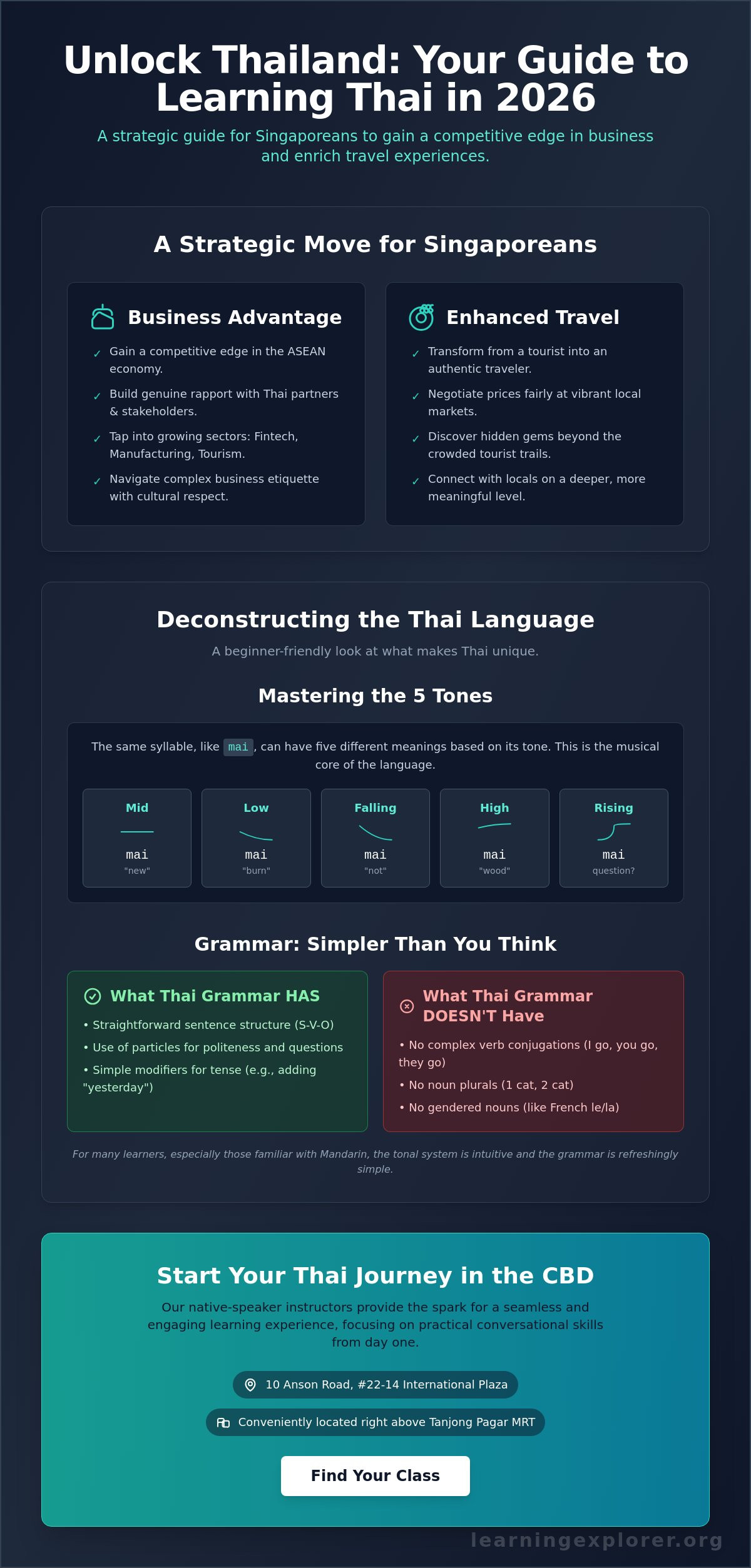
Thai, known natively as Phasa Thai, serves as the national language of Thailand and is a central member of the Kra-Dai language family. For Singaporeans looking to learn thai, the language offers a fascinating structural departure from Western tongues. While the script looks complex at first glance, the grammar is refreshingly straightforward. You won’t find verb conjugations, plurals, or gendered nouns here. Because Singapore and Thailand share strong economic ties, mastering these linguistic basics provides a significant edge in regional trade and tourism. Thai tones are the musicality of the language that dictates meaning.
Mastering the Five Tones Without the Stress
The most distinctive feature of Thai is its tonal system. You’ll work with five specific tones: mid, low, falling, high, and rising. These aren’t random sounds; they’re logical patterns that define the vocabulary. For instance, the syllable “mai” can mean “new,” “burn,” “wood,” “not,” or act as a question marker depending on your pitch. It’s a system that requires precision. We emphasize the importance of native-speaker instructors to help you mimic these sounds accurately from day one. Practicing with an expert ensures you develop a clear accent that’s easily understood in Bangkok or Chiang Mai. You can access this specialized guidance at our center at 10 Anson Road, level 22, International Plaza, Singapore 079903, located right above Tanjong Pagar MRT.
Decoding the Thai Script: Where to Start
The Thai script consists of 44 consonants and 32 vowels. It’s a phonetic system, which means once you’ve memorized the basic rules, you can pronounce almost any word you see. One unique hurdle for beginners is the lack of spaces between words. Thai writers only use spaces to indicate the end of a sentence or a significant pause. You’ll adapt to this by learning to recognize common word endings and vowel placements, which often wrap around the consonants.
We suggest starting with “Thai Karaoke” or phonetic transliteration. This method lets you start speaking immediately while your brain gradually adjusts to the alphabet. Transitioning from these phonetic guides to the actual script is a gradual, rewarding learning experience that empowers you to read menus, street signs, and documents. As you gain confidence, the script becomes a reliable tool for perfect pronunciation. If you’re eager to begin, view our upcoming schedules to find a class that fits your routine.
Is Thai Hard? Comparing Thai to Other Popular Languages
Many beginners feel intimidated by the unique script of the Thai language. However, once you look past the alphabet, you’ll find a logical system that makes it an easy language to learn for many Singaporeans. Compared to English or European languages, Thai removes the stress of complex grammar rules and rigid structures. It’s built for efficiency, allowing you to communicate effectively without years of memorizing conjugation tables.
Thai vs. Mandarin: The Tonal Connection
If you already speak Mandarin, you’ve got a massive head start when you decide to learn thai. Mandarin uses four tones, while Thai uses five: mid, low, falling, high, and rising. Because your ears are already trained to distinguish meaning through pitch, you’ll find the transition intuitive. Both languages also share a Subject-Verb-Object (SVO) sentence structure. You won’t have to flip your brain upside down to form a basic sentence, as the word order feels familiar and predictable.
Grammar Simplicity: Why Thai is Surprisingly Easy
Thai grammar is a breath of fresh air for those tired of memorizing verb tables. There are no verb conjugations. In English, you deal with “go,” “went,” and “gone.” In Thai, the word for “go” (pai) stays exactly the same regardless of who is doing it or when it happened. You simply add a time marker like “yesterday” or “tomorrow” to change the context. Thai grammar is often described as “Lego-like” because you simply stack words together to build meaning. There are no plurals, no genders, and no complex articles like “the” or “a.”
Singaporeans will also recognize familiar sounds through various loanwords. You’ll hear “computer,” “internet,” and “taxi” pronounced with a distinct Thai accent. Beyond modern tech, many formal Thai words come from Pali and Sanskrit. These are the same roots found in many Buddhist or Hindu terms common in local culture. This overlap helps you build a vocabulary faster than you might expect. While the script remains the primary hurdle for most, students at our center at 10 Anson Road, level 22, International Plaza, Singapore 079903, located right above Tanjong Pagar MRT, typically master basic reading within 10 to 12 weeks of consistent practice. Once you unlock the script, the simplicity of the spoken language truly shines through.
Practical Strategies for Mastering Thai in Singapore
Mastering a new language requires more than just memorizing a dictionary. It demands a roadmap that balances theory with real-world application. To learn thai effectively while living in Singapore, you need to integrate the language into your daily routine through structured steps and local immersion.
- Step 1: Start with high-frequency conversational phrases. Focus your first week on greetings and polite particles. These small words build an immediate bridge of respect with native speakers.
- Step 2: Use mobile apps for daily vocabulary building. Tools like Ling or ThaiPod101 help you recognize the five distinct Thai tones. Dedicate 10 minutes every morning to keep the sounds fresh in your mind.
- Step 3: Immerse yourself in Thai media. Watch trending dramas on Netflix or listen to Thai pop playlists on Spotify. This helps you catch the natural rhythm and “melody” of speech that textbooks often miss.
- Step 4: Join a structured group class. Learning alongside peers provides the social motivation needed to stay consistent. A certified teacher can correct your pronunciation in real-time, preventing bad habits from forming.
- Step 5: Visit Thai enclaves in Singapore. Head to Aperia Mall or Golden Mile Tower. Ordering your Som Tum in Thai provides a low-stakes environment to test your skills.
The Power of Polite Particles (Krap and Ka)
Politeness is the heartbeat of Thai culture. You can make your speech instantly more respectful by adding gender-based endings to every sentence. If you identify as male, use “Krap”; if you identify as female, use “Ka.” These particles don’t have a direct translation, yet they transform a blunt statement into a courteous interaction. Using them consistently shows you value the cultural nuances of the language you’re working to master.
Finding Practice Partners in the Heart of Singapore
Singapore offers a vibrant landscape for language learners to connect. Look for Thai food fairs or cultural festivals organized by the Royal Thai Embassy. For those who prefer a guided environment, joining a structured course is the most reliable way to find dedicated practice partners. Research shows that consistent 90-minute weekly sessions are far more effective than occasional “cramming” sessions. These regular touchpoints ensure your brain stays wired for Thai throughout the week.
Our training center is conveniently located at 10 Anson Road, level 22, International Plaza, Singapore 079903. Being situated right above Tanjong Pagar MRT makes it easy for busy professionals to drop in after work. This central location serves as a hub where you can move from “searching” for answers to “finding” true fluency with the help of a knowledgeable guide.
Ready to start your journey? Discover how our curated curriculum can help you learn thai and build lasting confidence.
Start Your Thai Journey at Learning Explorer in the CBD
Choosing to learn thai shouldn’t feel like another administrative burden on your calendar. At Learning Explorer, we’ve streamlined the experience for busy professionals who want to master a new language without the stress. Our center provides a supportive environment where you can transition from simple greetings to meaningful conversations. We focus on curated excellence, ensuring every minute spent in our small-group sessions translates into real-world fluency. By limiting our class sizes, we guarantee that every student receives personalized feedback. This format fosters a community of learners who support each other’s growth while maintaining a high standard of instruction.
Our interactive curriculum is built specifically for adult learners. We prioritize active participation over rote memorization. You will engage in role-play scenarios that mirror real-life interactions in Bangkok or Chiang Mai. This practical approach helps you retain information longer and builds the confidence needed to speak Thai in social or business settings. We understand the grit required to balance a career with personal development, and we are here to provide the spark that makes your learning journey enjoyable.
Certified Native Instructors Who Understand Singaporeans
Our instructors are native speakers who understand the unique linguistic background of Singaporean learners. They bridge the gap between English and Thai, explaining complex tonal structures and grammar rules in a way that makes sense. You’ll gain deep cultural insights, from the proper “Wai” etiquette to the nuances of regional dialects. This approach ensures we deliver “lessons your students will love” because they are relevant, engaging, and immediately applicable. Our teachers act as knowledgeable guides, helping you avoid common pitfalls while celebrating your progress. They bring the authentic spirit of Thailand into the heart of the CBD, making every lesson a cultural experience.
Flexible Formats for Your Busy Schedule
We offer diverse learning paths to fit your lifestyle. Whether you prefer the focused attention of private tutoring, the social energy of group classes, or the rapid progress of intensive Thai courses, we have a solution. Our center at International Plaza maintains a professional yet encouraging atmosphere that inspires confidence. Beyond Thai, we are recognized as a leading English language school Singapore that applies the same high standards to all our language programs. If you’re also looking to expand your multilingual credentials, our DELE Preparation Course offers a structured path to internationally recognized Spanish certification. Book a trial session today to experience our interactive curriculum firsthand and see why our students consistently achieve their goals.
Convenience is key to consistency. Our training center is located at 10 Anson Road, level 22, International Plaza, Singapore 079903. Since we are situated right above Tanjong Pagar MRT, you can step out of the office and into your classroom in minutes. We’ve eliminated the noise of traditional learning to help you find the rhythm of true communication. Join us and discover how we simplify the path to Thai mastery through expert guidance and a central location that respects your time.
Start Your Transformation into a Confident Thai Speaker
Mastering a new language opens doors to the 10 countries within the ASEAN economic bloc, where Thailand remains a dominant player. By 2026, Singaporeans who understand the nuances of Thai tones and script will hold a distinct competitive edge in regional trade and tourism. You don’t have to navigate the complexity of grammar alone. Our curated curriculum simplifies the learning process, turning what seems like a daunting challenge into a series of achievable milestones. Choosing to learn thai with a structured approach ensures you build a foundation that lasts.
At Learning Explorer, we provide the spark that turns curiosity into fluency. Our center at 10 Anson Road, level 22, International Plaza, Singapore 079903 is situated right above Tanjong Pagar MRT, making it easy to fit lessons into your busy professional schedule. You’ll benefit from small, interactive group sizes and guidance from certified native-speaker instructors who understand the grit required to master a second language. We’ve streamlined everything so you can focus on the joy of communication. Discover our Conversational Thai Course at International Plaza today! It’s time to deliver the results you’ve always wanted and enjoy lessons you’ll truly love.
Frequently Asked Questions
Is Thai a difficult language for English speakers to learn?
Thai ranks as a Category IV language according to the Foreign Service Institute, which means it requires more effort than European languages but remains accessible. You’ll find the grammar surprisingly simple because there are no complex verb conjugations or noun genders to memorize. The primary challenge lies in mastering the five distinct tones and the unique script. Focus on these early to build a solid foundation as you learn thai.
How long does it take to become conversational in Thai?
Most beginners reach a basic conversational level after 150 to 200 hours of structured study. If you dedicate five hours a week to your lessons, you can expect to handle daily interactions within 10 months. Achieving professional fluency typically requires 1,100 hours of total practice. Consistent exposure to native speakers significantly accelerates this timeline for adult learners who practice daily.
Do I need to learn the Thai script to speak the language?
You don’t need to master the script immediately to start speaking Thai effectively. Many introductory programs use phonetic systems to help you communicate right away. However, learning to read the 44 consonants and 32 vowels eventually clarifies tone rules that phonetics can’t fully capture. It’s a powerful way to transition from searching for words to finding your natural voice in the language.
What is the best way to practice Thai tones if I live in Singapore?
Immerse yourself in local communities at Golden Mile Tower or participate in language exchange groups that meet monthly in the CBD. You can also join interactive sessions at our training center located at 10 Anson Road, level 22, International Plaza, Singapore 079903, which is conveniently situated right above Tanjong Pagar MRT. Practicing with peers helps you refine your pitch and builds the confidence needed for real world conversations.
Are there business-specific Thai courses available for corporate teams?
Specialized corporate programs empower teams to navigate the Thai market, which saw over S$42 billion in bilateral trade with Singapore in recent years. These courses streamline your learning by focusing on professional etiquette, negotiation phrases, and industry-specific terminology. We design these paths to reduce the stress of international expansion and foster stronger regional partnerships through clear, professional communication.
What are the main differences between Thai and Mandarin?
Thai and Mandarin both utilize tones to distinguish meaning, but they differ significantly in their phonetic structure. Thai uses five tones compared to the four primary tones found in Mandarin. While Mandarin utilizes characters to represent concepts, Thai uses an alphabetic script where letters represent sounds. Thai grammar follows a Subject-Verb-Object pattern, making the sentence structure feel familiar to most English speakers.
Can I learn Thai online or is a physical classroom better?
Choosing between online and physical classes depends on your schedule and preferred learning style. Online platforms offer a seamless way to learn thai from home, saving you travel time in a busy city like Singapore. Physical classrooms provide the spark of immediate peer interaction and real time correction from instructors. Many students in 2026 find that a hybrid approach offers the best balance of flexibility and academic rigor. If you’re considering expanding your language portfolio alongside Thai, exploring a structured DELE Preparation Course in Singapore is an excellent way to pursue internationally recognized Spanish certification on a similarly flexible schedule.