What if the biggest barrier to your next promotion in the CBD isn’t your technical skill, but a simple lack of conversational confidence? You likely feel that your schedule is too tight for complex grammar or the grit of traditional rote learning. It’s a common struggle, as 72% of Singaporean professionals report they want to upskill but fear the time commitment. Finding an easy language to learn shouldn’t feel like another administrative burden. Instead, it should be the spark that transforms your daily interactions and streamlines your career growth.
We understand the daily challenges of balancing a high-pressure job with personal development. Whether you’re looking for a way to recharge through family-friendly adventures like those shared by Celtic Quest Fishing or seeking a new career edge, we’ve curated this 2026 guide to help you find a language that fits your lifestyle and empowers your professional resume. You’ll discover how to choose a path that feels natural and provides a seamless transition from searching to speaking. We will break down the most accessible options for English speakers in Singapore and show you how to gain conversational fluency right from our center at 137 Cecil Street, Level 7, Cecil Building, conveniently located in the CBD.
Key Takeaways
- Understand how “linguistic distance” affects your progress and how FSI categories help you identify an easy language to learn based on your native English skills.
- Explore a curated list of the top five languages that offer the fastest path to fluency, blending global Romance languages with regional options perfect for Singapore.
- Discover how Singapore’s unique multicultural landscape and high density of native speakers can accelerate your speaking confidence through daily real-world practice.
- Learn a practical two-step framework to audit your schedule and define your personal goals, ensuring you choose a learning path that fits your career and lifestyle.
- Streamline your journey with interactive lessons at our center right above Tanjong Pagar MRT, where we transform complex grammar into a fun, seamless experience.
Understanding Linguistic Distance: What Makes a Language Easy?
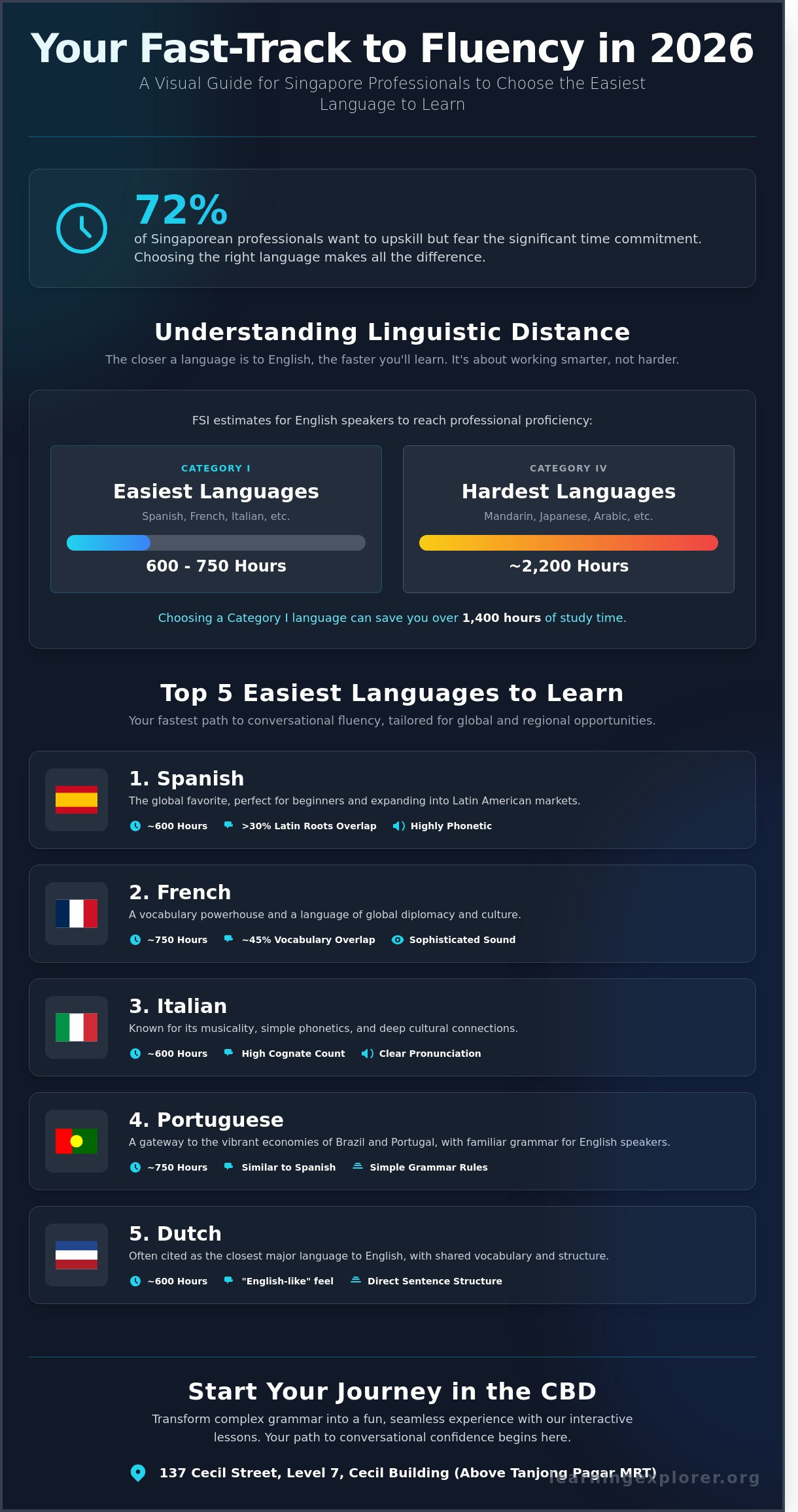
When you start your journey to find an easy language to learn, the first concept to grasp is linguistic distance. This metric determines how much effort you’ll need to bridge the gap between your mother tongue and your target language. By Understanding Linguistic Distance, you can see why a native English speaker might find Spanish simpler than Arabic. If you are learning the latter to prepare for a trip to the Pyramids, you should check out Sola Travel for expert guidance on Egyptian excursions. The Foreign Service Institute (FSI) categorizes languages into levels based on the time required for diplomats to reach proficiency. Category I languages, like French or Italian, typically require 600 to 750 class hours, while Category IV languages like Mandarin can take up to 2,200 hours.
To better understand this concept, watch this helpful video:
True “easiness” rests on three specific pillars. First, vocabulary overlap allows you to recognize words immediately. Second, grammatical simplicity removes the stress of complex conjugation or noun genders. Third, phonetic regularity ensures you can read what you see without guessing the sounds. Choosing an easy language to learn doesn’t mean you’re skipping the work; it means you’re streamlining your progress toward meaningful conversations.
The Role of Cognates and Grammar Structure
Cognates are your best friends in language learning. These are words that share a common origin and look or sound similar across different tongues. For instance, the word “doctor” is virtually identical in English and Spanish. When you choose a language with high lexical similarity, you already know thousands of words before your first lesson. Additionally, languages that lack complex case systems or gendered nouns simplify the transition. Using a familiar Latin alphabet also reduces the initial cognitive load, letting you focus on speaking rather than decoding scripts.
Why Motivation Beats Difficulty Every Time
Your personal drive often outweighs technical difficulty. A “hard” language you feel passionate about will always feel easier than a “simple” one that bores you. In Singapore, the relevance factor plays a massive role in your success. Seeing Japanese on menus in Orchard Road or hearing Malay in your local hawker center accelerates your retention. This real-world exposure transforms abstract rules into living communication. Combining this natural curiosity with a supportive learning experience
The Top 5 Easiest Languages to Learn for English Speakers in 2026
Choosing an easy language to learn starts with understanding linguistic proximity. Your brain naturally looks for patterns, and picking a language that shares roots with English can significantly shorten your study time. The U.S. Department of State tracks these patterns through their language difficulty rankings, which categorize languages based on how many weeks it takes to reach proficiency. For most English speakers, Category I languages require roughly 24 to 30 weeks of dedicated study to reach a conversational level.
Spanish: The Global Favorite for Beginners
Spanish is widely considered the most accessible easy language to learn because it’s highly phonetic. You pronounce words exactly as they’re written, which eliminates the spelling frustration often found in English. Over 30% of English vocabulary stems from Latin roots, so you’ll recognize words like “hospital,” “actor,” and “radio” immediately. In 2026, Singapore’s business landscape continues to expand toward Latin American markets, making this a strategic choice. You can expect to reach basic conversational proficiency in about 600 class hours. Once you’ve built that foundation, validating your skills with a formal qualification through a structured DELE Preparation Course is an excellent way to demonstrate your proficiency to employers and partners.
French and Italian: Romance Languages Simplified
French and Italian offer a sophisticated blend of cultural depth and structural simplicity. French is a vocabulary powerhouse; historians estimate that over 45% of English words have French origins. This makes reading a French newspaper surprisingly intuitive for a beginner. Italian, on the other hand, is celebrated for its musicality and consistent grammar rules that rarely deviate into confusing exceptions. These languages remain incredibly popular for Singaporeans involved in the luxury goods sector, fine dining, or the arts. Both languages typically require 600 to 750 hours of structured study to master the basics.
Malay and Indonesian: The Regional Advantage
Malay and Indonesian provide a unique “home court” advantage for those living in the Lion City. These languages are remarkably streamlined because they don’t use verb conjugations, plural forms, or grammatical genders. They also utilize the Latin alphabet, so you won’t need to learn a new script. If you’ve spent any time in Singapore, you already have a head start with loanwords like “makan” or “sayang” that appear in daily local speech. These regional languages offer immediate practical benefits for business travel or weekend trips across the Causeway. Most learners can achieve basic social proficiency in as little as 150 to 200 hours of focused practice.
For those planning to drive across the border to practice their new skills, Radiant VEP Solutions offers expert assistance for Singapore vehicle owners applying for the Malaysian Vehicle Entry Permit, ensuring your travel is as smooth as your conversation.
While these languages are designed for success, your progress depends on the quality of your guidance. Enrolling in a dedicated language school provides the expert feedback and community support needed to turn basic phrases into fluent conversations. You can find our main campus at 10 Anson Road, level 22, International Plaza, Singapore 079903. Our center is located right above Tanjong Pagar MRT, making it a convenient stop to empower your global communication skills after your workday ends.
Why Singapore Provides a Unique Advantage for Language Learners
Singapore acts as a massive classroom where the walls have been removed. You don’t need to travel thousands of miles to find an easy language to learn because the city’s multicultural fabric brings native speakers to you every day. This density is a hidden gem for students. Whether you’re grabbing a coffee or commuting, the opportunity for real-world practice is everywhere. It simplifies the transition from theory to conversation, making your progress feel natural rather than forced.
Cultural Immersion Without Leaving the Little Red Dot
Practice happens in the wild here. Visit a Spanish tapas bar in Telok Ayer or browse Indonesian markets in Geylang Serai to test your skills in a low-pressure environment. This organic interaction removes the grit of traditional study. Singaporeans already possess a bilingual foundation, which makes them more adaptable to picking up a third tongue. If you feel hesitant, join a local meetup to overcoming your fear of speaking english or any new language in a supportive environment. These gatherings turn learning into a social spark. They empower you to move beyond textbooks and deliver results in actual conversations. It’s the kind of immersion that creates lessons your students will love, even if you are the student yourself.
Career Synergy in the Singapore CBD
Your professional growth often depends on how well you connect with global partners. For MNC employees working in Cecil Building or International Plaza, mastering a new tongue is a strategic power move. According to the Foreign Service Institute language difficulty rankings, “Category I” languages require significantly fewer hours to master. This makes them a particularly easy language to learn for busy professionals who need to see a return on their time investment quickly.
Streamline your learning by choosing a center conveniently located at 10 Anson Road, level 22, International Plaza, Singapore 079903. Being situated right above Tanjong Pagar MRT means you can transition from a high-stakes meeting to a language class in minutes. This proximity helps you stay consistent despite a demanding schedule. In a competitive job market, speaking a second or third language differentiates your profile. It transforms you from a local candidate into a global asset. Networking becomes seamless when you speak the language of your international clients. You’ll find that clear communication is the ultimate tool to inspire confidence in your business partners and simplify complex negotiations. For professionals with regional ambitions extending to Thailand, our structured program to learn Thai in Singapore is an excellent way to gain a competitive edge in one of Southeast Asia’s fastest-growing markets.
How to Start Your Language Journey: A Practical Selection Framework
Choosing an easy language to learn starts with a clear strategy. You don’t need to spend months researching; you just need a framework that respects your time and goals. This approach transforms a daunting task into a series of achievable wins.
- Step 1: Define your “Why.” Are you planning a 15-day trip to Tokyo or looking to close business deals in Jakarta? Identifying your motivation keeps you focused during the initial learning curve.
- Step 2: Audit your schedule. Be honest about your availability. If you enjoy social interaction, group classes offer a sense of community. If your schedule is unpredictable, private tuition provides the personal flexibility you need.
- Step 3: Test the waters. Most reputable schools offer trial sessions. Use these to gauge the teaching style and the “vibe” of the classroom.
- Step 4: Surround yourself with the language. Use your commute for podcasts or change your phone settings to your new language. This creates a seamless transition from “studying” to “living” the language.
Assessing Your Daily Routine and Learning Style
Identify how you process information before committing to a course. Visual learners often thrive with character-based systems like Japanese Kanji, while auditory learners might find the rhythmic sounds of Spanish more intuitive. If you work in the city, look for weekly evening classes near Tanjong Pagar MRT. This location makes it easy to transition from the office to the classroom without a long commute. Finding a provider of language courses singapore residents trust is vital. They should offer flexible formats that fit into a busy professional life at 10 Anson Road, level 22, International Plaza, Singapore 079903.
Setting Realistic Milestones for Fluency
Avoid burnout by breaking your journey into manageable 10-week modules. This structure provides a clear finish line and a sense of achievement. Focus on functional fluency first. Aim to order a coffee or introduce yourself before diving into complex literary grammar. This approach makes any easy language to learn feel even more accessible. Success means showing up consistently for each session rather than aiming for immediate perfection. When you prioritize progress over mastery, you’ll find the spark that makes learning truly enjoyable. If your goals include navigating Bangkok’s business scene with confidence, exploring how to learn Thai through our structured beginner’s program can open remarkable new professional doors.
Ready to transform your communication skills and boost your confidence? Discover our curated language programs today and find the perfect fit for your schedule.
Finding Your Perfect Learning Experience at Learning Explorer
We focus on delivering lessons your students will love. Our team simplifies complex grammar into manageable learning objects. This allows you to see progress from your very first hour. We prioritize a supportive atmosphere where you can practice without fear. By choosing a dedicated school, you move from searching for resources to finding curated excellence. Our mission is to empower you with the tools needed for real-world communication.
Certified Native-Speaker Instructors in Tanjong Pagar
Your journey is guided by our team of certified native-speaker instructors. These educators are bilingual and possess a deep understanding of the Singaporean context. They know how to explain concepts in a way that resonates with local learners. We maintain small group sizes, often limited to 6 to 10 students, to ensure that every participant gets ample speaking time. You won’t be lost in a crowded hall. Instead, you’ll engage in meaningful dialogue that builds your confidence. Our curated curriculum standards ensure that every lesson is aligned with high-quality outcomes. We use professional materials designed to streamline your path to fluency.
Flexible Formats for Busy Singaporean Professionals
We recognize the grit required to balance a career with personal growth. Learning Explorer offers private, group, and intensive classes at 10 Anson Road, Level 22, International Plaza, Singapore 079903. These flexible formats cater to both corporate teams and individual adult learners. We aim to reduce administrative stress by providing a seamless enrollment experience. Our school acts as a reliable educational ally, helping you plan your progress effectively. Starting a new habit is often the most difficult step. With our expert guides, the transition becomes a natural part of your routine. Discover the joy of a new skill and inspire yourself to reach new heights today.
Start Your Transformation at International Plaza Today
Finding an easy language to learn is about more than just grammar; it’s about leveraging Singapore’s unique multicultural landscape. In 2026, learners who choose languages like Spanish or Indonesian can reach professional proficiency in as little as 600 hours according to FSI data. Our city’s status as a global hub means you’ll find endless opportunities to practice your new skills in real-world settings. You don’t have to navigate this path alone when you have a dedicated partner to streamline the process.
At Learning Explorer, we provide the spark you need to move from searching to speaking. Our native-speaker certified instructors deliver an interactive curriculum aligned with global standards, ensuring every lesson is one you’ll love. We’ve designed our programs to simplify your learning journey and reduce the stress of starting something new. It’s time to empower your personal growth with a supportive community that understands your goals.
Visit us at 10 Anson Road, level 22, International Plaza, Singapore 079903. We’re conveniently located right above Tanjong Pagar MRT for your ease of access. Discover your next language and book a trial class at International Plaza today!
We’re excited to help you find your voice and inspire confidence in every conversation you have.
Frequently Asked Questions
Which language is the absolute easiest to learn for English speakers?
Dutch is the easiest language for English speakers to master. According to the Foreign Service Institute, it requires 600 to 750 class hours for proficiency. Its vocabulary and grammar share deep roots with English. This makes it an exceptionally easy language to learn if you already speak English fluently. You’ll find many words are nearly identical, which streamlines your progress and builds immediate confidence.
Is it easier to learn Spanish or French in Singapore?
Spanish is typically easier to learn than French for most students in Singapore. Spanish features a phonetic writing system where 100 percent of words are pronounced exactly as they’re spelled. French involves complex silent letters and 13 different vowel sounds. While both are Category I languages, Spanish offers a more predictable path for beginners who want to see quick results without struggling over pronunciation hurdles.
How long does it take to become conversational in an easy language?
You can reach a basic conversational level in roughly 150 to 200 hours of focused study. For an easy language to learn, this usually translates to 6 months of consistent practice. The Foreign Service Institute notes that achieving full professional proficiency takes about 24 to 30 weeks of intensive training. Starting with clear goals helps you stay motivated as you move from simple greetings to meaningful classroom discussions.
Can I learn an “easy” language like Malay entirely through an app?
You cannot achieve full fluency in Malay using only an app. While digital tools help you memorize vocabulary, they lack the cultural nuance and real-time feedback found in a physical classroom. Malay is a fantastic easy language to learn because it uses the Latin alphabet and has no verb conjugations. However, practicing with a native speaker at our center at 10 Anson Road, level 22, International Plaza, Singapore 079903, ensures your pronunciation is accurate.
What is the best language to learn for my career in Singapore?
Mandarin Chinese remains the most impactful language for career growth in Singapore. China has been Singapore’s largest trading partner since 2013, making bilingualism a vital professional asset. Learning Mandarin opens doors in finance, logistics, and regional trade. If your work involves regional expansion, Japanese or Bahasa Indonesia are also excellent choices that provide a significant competitive edge in the local job market.
Is it too late for an adult to start learning a new language?
It’s never too late to start, and adults actually possess cognitive advantages that children lack. Research shows that adult learners use meta-linguistic awareness to understand grammar rules 30 percent faster than younger students. Your life experience allows you to connect new concepts to existing knowledge quickly. We design our curriculum to respect your time and leverage these adult learning strengths to ensure every lesson feels productive.
How do I know if a language school in Singapore is right for me?
A right-fit school offers native-speaking teachers and a location that fits your schedule. Look for a center that provides structured curriculum management and curated resources rather than random worksheets. Our facility is conveniently located right above Tanjong Pagar MRT, making it easy to drop in after work. Ensure the environment feels supportive and professional so you can focus entirely on your personal transformation and language goals.
What happens if I find the “easy” language difficult?
If you struggle, it usually means you need to adjust your learning strategy rather than giving up. Every student hits a plateau, but a knowledgeable guide can help you find the spark to continue. We simplify complex grammar and provide the grit needed to overcome obstacles. If a specific method isn’t working, we pivot to different learning objects to ensure you find the path that feels seamless and rewarding. For Spanish learners specifically, working toward a recognized qualification through a dedicated DELE Preparation Course can reignite your motivation by giving you a concrete, measurable goal to work toward.