The most advanced Mandarin class isn’t always the best place to start. If you’re choosing a mandarin course singapore learners can fit around work or family, the right match depends on what you want to say and what you already know. A beginner may want to feel more confident in everyday exchanges, while someone with prior experience may be looking to speak more naturally in familiar situations.
It’s understandable to be unsure whether group, private or intensive lessons will suit you. Each format offers a different learning experience, and regular practice needs to fit your routine. Above all, lessons should give you useful opportunities to speak, rather than overwhelm you with material that doesn’t serve your goal.
This guide explains how to compare course priorities and formats, decide whether conversational or business Mandarin better fits your aims, and ask practical questions before enrolling. You’ll also find ways to assess your current level and preferred pace, so you can choose a realistic next step towards speaking Mandarin in the situations that matter to you.
Key Takeaways
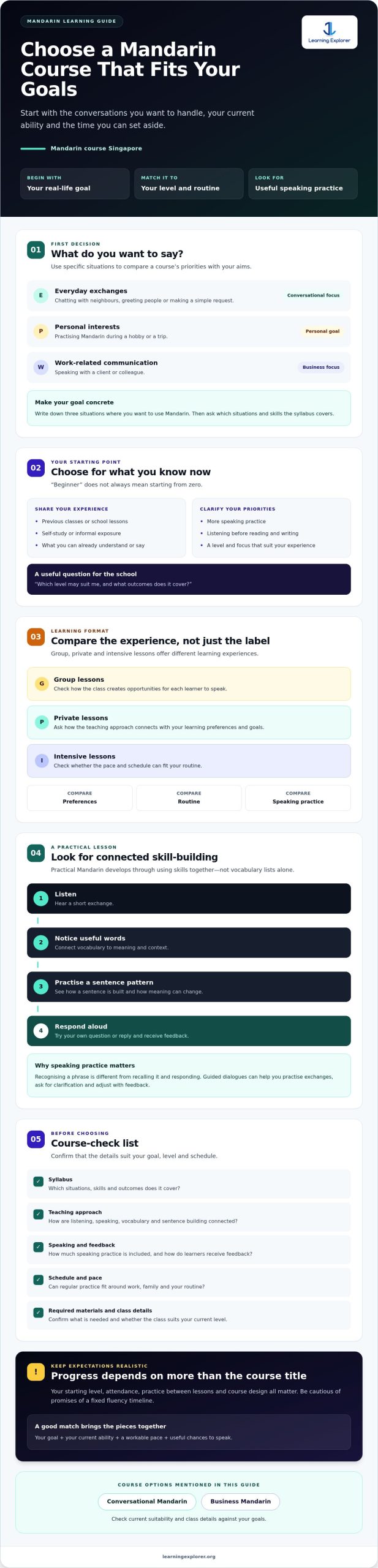
- Start with the conversations you want to handle, from everyday exchanges to work-related situations.
- Look for structured practice that connects listening, speaking, vocabulary and sentence building.
- Compare group, private and intensive formats based on your learning preferences and routine.
- Before choosing a mandarin course singapore, check the syllabus, teaching approach, schedule and required materials.
- Explore Learning Explorer’s Conversational Mandarin and Business Mandarin options, then confirm current suitability and class details.
What should a Mandarin course in Singapore help you achieve?
Choosing a class can be difficult when your goals differ and course formats aren’t easy to compare. A mandarin course singapore learners consider should provide structured instruction and guided practice that connect to what they want to do with the language. Before comparing courses, think about the situations you want to manage, rather than relying on a course title alone.
Your goal might be everyday conversation, personal enrichment or communication at work. A suitable starting point depends on your current ability, the situations you want to handle and the time you can set aside for study. A course provides structure, but progress also depends on practice, so be cautious of promises of a fixed fluency timeline.
For a local perspective on the variety of Mandarin spoken here, read about Singaporean Mandarin. This can help you think about the language context you may encounter in Singapore while comparing your goals with a course syllabus.
Here’s a short example of Mandarin in a Singapore setting:
Conversational Mandarin or Business Mandarin: which goal fits?
Conversational learning generally focuses on everyday exchanges, such as greeting people or making simple requests, although the details depend on the syllabus. Business Mandarin focuses on work-related communication. Ask the provider which workplace situations and skills its course covers. To compare options, write down three situations where you want to use Mandarin. Specific examples make it easier to see whether the course priorities match your needs.
- Everyday: chatting with neighbours or making a request.
- Personal: practising Mandarin during a hobby or trip.
- Work: speaking with a client or colleague.
What should beginners clarify before choosing?
Beginner doesn’t always mean starting from zero. Tell the school about any previous learning, including self-study, school lessons or informal exposure, and explain what you can already understand or say. You may follow spoken Mandarin but want more speaking practice, or prefer to prioritise listening over reading and writing. These needs vary by learner. Ask which level may suit you and what outcomes it covers. If you have some experience, share it before enrolling so you can check whether the level and focus seem appropriate.
How does a structured Mandarin course build practical ability?
Practical Mandarin develops through connected skills, not vocabulary lists alone. A lesson might begin with listening to a short exchange, then move on to identifying useful words, practising a sentence pattern and using it in a spoken response. This gives new language a purpose and helps you notice how meaning changes with context.
Speaking practice matters because recognising a phrase is different from recalling it and responding in a conversation. Regular participation gives you chances to try, adjust and receive feedback. The Straits Times has reported on common learning difficulties, including confusion between similar Chinese characters among pupils. Learners’ needs differ, but clear explanations and timely correction can help address misunderstandings before they become habits.
Progress varies with your starting level, attendance, practice between lessons and course design. When comparing a mandarin course singapore learners can take, ask how the class balances guided instruction with active use of the language. That answer can tell you more about the learning experience than the course title alone.
How can lessons help you practise speaking?
Guided dialogues let learners rehearse useful exchanges in a supported setting, such as greeting someone, asking a question or responding to a request. Useful practice goes beyond repeating a model sentence. It can help you form your own question, try a response and ask for clarification when you don’t understand. Ask how much speaking practice a particular class includes and how learners receive feedback.
What makes Mandarin easier to practise between classes?
Build a small routine you can repeat during the week. Listen to a short piece of Mandarin, repeat a phrase aloud, then use it in a sentence of your own. Keep the routine manageable and connect it to situations you want to handle.
Review vocabulary in context instead of relying only on isolated lists. For example, revisit a word alongside the sentence or dialogue where you first encountered it. Before enrolling, check which practice materials are included and whether you’ll need to find anything separately. You can explore Mandarin course information and ask how the learning approach supports your goals.
Group, private or intensive Mandarin classes: how do you compare them?
The format affects how lessons fit into your week and how you take part. Group, private and intensive Mandarin classes each have a different structure to explore. Compare them based on your preference for interaction, individual focus and available study time, then check the provider’s current course details.
| Format | Interaction | Personalisation | Scheduling and learner fit |
|---|---|---|---|
| Group | A shared learning setting where peer interaction may be part of practice. | Ask how lessons address learners’ different needs. | May suit learners who enjoy studying alongside others. Check class times and how conversation practice is organised. |
| Private | Ask how individual lessons are conducted and how you’ll practise speaking. | Worth exploring if individual focus is a priority. | Check available times and whether the lesson structure suits your goals. |
| Intensive | Ask how participation and practice are structured across the course. | Confirm how the content relates to your learning priorities. | May suit learners who prefer concentrated study, if the pace and schedule fit their routine. |
Use this comparison as a starting point, not a promise about a particular classroom experience. Ask what each format currently includes and whether it aligns with your level, schedule and intended use of Mandarin.
When might a group Mandarin class suit you?
A group class offers a shared learning setting, where other learners may provide chances to hear different attempts and practise exchanges. The experience depends on how the class is designed, so ask how learners practise conversation and receive instructor feedback. Consider your own preference as well: would learning alongside others encourage you, or would you rather focus on individual support?
When should you consider private or intensive lessons?
Private study may be worth exploring if individual attention matters to you. An intensive format may suit you if you prefer concentrated study. Before deciding, consider how much time you can realistically commit and what pace feels manageable. Confirm schedules, course structure and suitability directly with the provider. Don’t assume a format is available at a time or pace that works for you.
Learning Explorer offers group, private and intensive learning formats for Mandarin. To compare options against your goals and routine, Explore Mandarin learning options and confirm current course details with the school.
What should you check before enrolling in a Singapore Mandarin course?
A little preparation makes it easier to compare options and avoid surprises after you enrol. Use this checklist to assess whether a mandarin course singapore learners are considering suits their goals and practical needs:
- Clarify your goal. Identify the situations where you want to use Mandarin, such as everyday conversation or workplace communication.
- Check your level. Ask how the school identifies an appropriate starting point, especially if you’ve studied before or have informal experience.
- Compare formats. Consider whether group, private or intensive learning matches your preferences and available study time.
- Review the logistics. Confirm the current schedule, location, route and any materials you may need.
- Ask about next steps. Check how to enrol and what information the school needs to recommend a suitable course.
Before committing, ask to review the syllabus and understand the teaching approach. Confirm the current schedule, required materials, fees and enrolment requirements directly with the provider. These details can change, so avoid relying on older listings or assumptions.
Which questions should you ask a Mandarin school?
Ask specific questions: how does the school determine a learner’s starting level, what speaking and listening practice does the course include, and what outcomes is it designed to support? Then confirm current schedules, materials, fees and enrolment requirements. Clear answers help you judge whether the course matches your priorities instead of choosing on its title alone.
How can you tell whether a course fits your routine?
Compare class times and location with your regular work, family and travel commitments. A class that looks suitable on paper may be difficult to attend consistently if travelling there or fitting it into your week is a challenge. Learning Explorer’s centre is at 10 Anson Road, level 22, International Plaza, Singapore 079903, directly above Tanjong Pagar MRT. Check the route from your usual starting point and confirm the current class schedule with the school.
Consider your preferred learning environment, too. Group lessons offer a shared setting; private study may suit learners seeking individual focus, while intensive learning may appeal if concentrated study fits your routine. Ask about the structure and suitability of each option before deciding.
For focused learner guidance, look for Mastering Conversational Mandarin in Singapore alongside the practical checks above. To discuss your level, goals and preferred format, explore Mandarin course options with Learning Explorer and confirm current details directly.
Explore Mandarin courses in Singapore with Learning Explorer
Once you’ve identified what you want to do with Mandarin, compare course content with those aims. Learning Explorer offers a Conversational Mandarin Course and a Business Mandarin Course. The conversational option may be relevant if your focus is everyday communication; the business option may suit learners seeking work-related language development. Check the current syllabus and level fit with the school before enrolling, as course details can change.
Both offerings are available in group, private and intensive formats. These are options to consider, not a guarantee that every format will suit every learner. Ask about current schedules, course structure and suitability for your level, then weigh the options against your preferred pace and routine.
Choose between conversational and workplace Mandarin
Think about where you’ll use the language. If you want to build confidence in everyday exchanges, ask whether the Conversational Mandarin Course covers situations relevant to you. If your goal is work-related communication, ask how the Business Mandarin Course syllabus supports that aim. Share your current ability and the situations you want to handle so the school can explain which course may fit.
Start with a short list of specific goals, such as following a conversation, responding to a question or communicating with colleagues. You don’t need to have every detail figured out. Clear examples help you ask focused questions about course content and level.
Take a practical next step
Learning Explorer’s training centre is in Singapore’s Central Business District at 10 Anson Road, level 22, International Plaza, Singapore 079903, directly above Tanjong Pagar MRT. If you’re considering in-person classes, check the route from home or work and how the location fits your regular commitments.
Before getting in touch, note your Mandarin experience, goals and preferred learning format. Then ask about current schedules, course details and which option may suit your needs. A conversation with the school can help narrow down your choices before you decide.
For a broader perspective on comparing language-learning options, look for Language Courses in Singapore: The Ultimate 2026 Guide to Fluency. When you’re ready, share your goals, current level and preferred format with Learning Explorer to discuss a practical next step towards finding a suitable mandarin course singapore.
Choose a Mandarin learning path that fits your goals
Start by identifying the situations where you want to use Mandarin. Compare your current level and priorities with the course syllabus, then consider how group, private or intensive learning could fit your routine. Regular speaking practice matters, too, so ask how lessons help you use the language, not just study it.
If you’re comparing a mandarin course singapore learners can take, Learning Explorer offers Conversational Mandarin and Business Mandarin courses, with group, private and intensive formats to explore. Confirm which course and format suit your level, along with current schedules and details, before deciding.
The training centre is in Singapore’s CBD, directly above Tanjong Pagar MRT, which may be useful when planning your journey to class. Note your goals, previous Mandarin experience and preferred format, then explore Mandarin courses with Learning Explorer and ask about a suitable next step.
You don’t need to have everything figured out before you begin. A clear goal and a few practical questions can help you choose with confidence and build Mandarin skills at a pace that works for you.
Frequently Asked Questions
How do I choose a Mandarin course in Singapore?
Match the course goal, level and format to the situations where you want to use Mandarin. When comparing a mandarin course singapore learners can take, check the syllabus, teaching approach, speaking practice and schedule. Consider whether you prefer group learning, private lessons or a more concentrated format. Ask how the school identifies a suitable starting level and confirm current course details before enrolling.
Is Mandarin difficult for English speakers to learn?
Some parts may feel unfamiliar, but the level of challenge varies from learner to learner. Mandarin tones and characters can take focused practice, while useful phrases and sentence patterns can be learned step by step. Set priorities based on your goals: you might focus first on listening and speaking, or include reading and writing. Structured lessons and regular practice can help you work through specific challenges without feeling you need to master everything at once.
Can beginners join a Mandarin course in Singapore?
Beginners can explore Mandarin courses, but check whether the provider currently offers a suitable starting level. Share any previous experience, including school study, self-study or informal exposure, since you may know more than you think. Ask how the school assesses your level and what the course is designed to cover. Learning Explorer offers Conversational Mandarin and Business Mandarin courses, but confirm current levels and suitability directly before enrolling.
What is the difference between conversational and business Mandarin?
Conversational Mandarin generally focuses on everyday communication, while Business Mandarin is intended for work-related language development. Specific topics and outcomes depend on the provider’s syllabus, so review current course details rather than relying on the course name alone. Think about where you want to use Mandarin, such as social exchanges or workplace conversations, and ask which course level and content best match those situations.
Are group or private Mandarin classes better?
Neither format is best for everyone. Group classes provide a shared learning setting where peer interaction may be part of practice. Private lessons may be worth considering if individual focus is important to you. Learning Explorer also offers intensive learning formats. Compare how each option supports speaking practice, fits your schedule and suits your preferred pace. Confirm current class structure and availability with the provider before deciding.
How long does it take to learn conversational Mandarin?
There’s no single timeline for learning conversational Mandarin. Progress depends on your starting level, attendance, practice between classes, course design and what you mean by conversational ability. Handling a familiar exchange is a different goal from speaking comfortably across a wide range of situations. Ask the school what the course covers and set practical milestones, such as introducing yourself or asking and answering everyday questions.
Where can I take Mandarin classes near Tanjong Pagar MRT?
Learning Explorer’s training centre is at International Plaza, directly above Tanjong Pagar MRT in Singapore’s Central Business District. The location may be convenient if you travel through the area for work or other commitments. Check the route from your usual starting point and confirm current class schedules with the school. Learning Explorer offers Mandarin courses in group, private and intensive formats; ask which options currently suit your goals.
Does Learning Explorer offer Mandarin courses for work?
Yes. Learning Explorer offers a Business Mandarin Course for learners seeking work-related language development, as well as a Conversational Mandarin Course for everyday communication goals. Ask the school to explain the current Business Mandarin syllabus, level options and learning formats so you can assess whether they fit your needs. Group, private and intensive formats are available, but confirm current schedules and suitability directly before enrolling.