What if practising Spanish meant spending less time memorising and more time having the conversations you actually want to have? If you’re weighing private Spanish classes in Singapore against app-based study or group lessons, the right format can make practice more relevant. One-to-one lessons give you dedicated speaking time, room to ask questions as they arise and a pace suited to your current level.
It’s normal to worry about making mistakes or progressing slowly, especially when app exercises don’t prepare you for real conversation. Guided practice can help you build confidence step by step, using situations that matter to you, from travel to everyday chats. Learning Explorer offers private Spanish lessons with bilingual, native-speaker instructors, alongside its Conversational Spanish Course.
In this article, you’ll learn what private lessons can help you practise, how to compare learning formats and what to consider when choosing a path. You’ll also find practical ways to make Spanish study purposeful and build confidence in real-life conversations.
Key Takeaways
- Private Spanish lessons can focus on your goals, whether you’re learning for travel, conversation, work or enjoyment.
- Balance instructor guidance with active speaking and practice shaped around your current needs.
- Compare private and group classes by the individual attention, peer interaction and shared learning each provides.
- Make practice purposeful: choose a real-life goal, share your starting point, speak actively and review what you’ve learned.
- Explore private Spanish classes in Singapore at Learning Explorer, with bilingual, native-speaker instructors.
Why Choose Private Spanish Classes in Singapore?
Private Spanish classes are one-to-one lessons shaped around your needs, current level and communication goals. Instead of following a group’s pace, you can focus lesson time on the skills and situations that matter to you. That might mean preparing for a trip, feeling more at ease in everyday conversation, exploring a personal interest or communicating at work.
Dedicated speaking time is a practical benefit. You can practise aloud and ask questions without waiting for a turn in a group discussion. Your instructor can also adjust the practice as you go, spending more time on a phrase or grammar point when it feels unclear. Private tuition doesn’t guarantee a particular pace of progress. Your results depend on your goals, starting point, attendance and the time you set aside to practise between lessons.
What can one-to-one Spanish lessons help you practise?
Lessons can start with useful exchanges: introducing yourself, asking and answering everyday questions, and expressing preferences. You might practise explaining what you’d like to eat, describing a routine or sharing an opinion. These focused exercises connect vocabulary and grammar with speaking, rather than leaving new material on the page.
Your questions and recurring difficulties can help shape what you work on next. If you keep hesitating over a particular phrase, your instructor can revisit it and help you practise using it in context. Tell your instructor what you want to communicate, then use that priority to guide the lesson. This learner-centred approach reflects the individual factors involved in the process of learning a second language.
Who may benefit from a private Spanish class?
Beginners may value a supportive setting where they can try speaking, make mistakes and ask for clarification without feeling rushed. Starting with a manageable focus, such as greetings or simple introductions, can make practice feel less daunting.
Busy adults may appreciate having lesson time directed towards their priorities, rather than spending it on topics that don’t match their immediate needs. Returning learners can use one-to-one practice to refresh familiar vocabulary, revisit areas they’ve forgotten and start using Spanish in conversation again.
If you’re considering private Spanish classes in Singapore, begin by identifying a real situation where you’d like to use Spanish. That gives you a clear point of focus and helps make each lesson relevant, whether you’re starting with the basics or building on what you already know.
What Happens in a Private Spanish Lesson?
A private Spanish lesson is guided practice shaped around your current level, questions and learning goals. It isn’t simply an instructor talking while you listen. You take an active role by answering, asking for clarification, trying new expressions and explaining what you want to work on. This gives the instructor a chance to respond to your needs and keep practice relevant.
Depending on your priorities, lesson activities may include vocabulary building, listening comprehension, pronunciation practice and conversation. For instance, you might listen to a short exchange, pick out a useful phrase, then practise saying it in your own words. These skills support one another: understanding a phrase is useful, and saying it aloud gives you practice using it in conversation.
How do instructors tailor Spanish lessons to your goals?
Start by sharing what you want Spanish for. Your priorities might include everyday conversation, travel or a personal interest. Your instructor can use that context, along with your current level and questions, to guide practice. If a phrase is unclear or the same difficulty keeps coming up, mention it. Specific feedback can help you understand what to adjust and communicate more clearly over time.
Work can also be a motivation. A report from the Federal Reserve Bank of Dallas explores the economic benefits from its large Spanish and English bilingual population. The report focuses on the United States, not Singapore, and offers one perspective on the professional value of bilingual communication. For your lessons, make work-related practice specific to the conversations you want to handle.
How can speaking practice build confidence?
Begin with short exchanges, such as greeting someone, answering a simple question or expressing a preference. Repeating familiar patterns can make speaking feel less new. Gradually changing a detail gives you a chance to use the language more flexibly. You don’t need to get every word right before you speak.
Treat mistakes as useful information. A pronunciation correction or a reminder about word choice gives you something clear to practise next. Between lessons, try saying new expressions aloud and using each in a simple sentence. Brief, focused practice can help reinforce what you’ve worked on, though your progress depends on your starting point, consistency and goals.
If this approach fits your priorities, explore Learning Explorer’s Spanish learning options and consider how private Spanish lessons can support your practice.
Private or Group Spanish Classes in Singapore: Which Fits You?
Both formats can support Spanish learning, but the experience differs. Private tuition focuses the instructor’s attention on one learner, while group classes bring learners together for shared activities and peer interaction. Neither format is automatically faster or more effective. The best fit depends on how you like to practise, how comfortable you feel speaking and what you want lesson time to cover.
| What to compare | Private lessons | Group classes |
|---|---|---|
| Interaction | One-to-one exchange with the instructor | Interaction with the instructor and fellow learners |
| Focus | Practice can centre on your priorities and questions | Activities are shared across the group |
| Learning environment | A dedicated setting for individual practice | A social setting for learning alongside peers |
When might private Spanish lessons suit you better?
One-to-one lessons may suit you if you have specific priorities, such as practising particular conversation skills, revisiting challenging material or getting more opportunities to speak directly with an instructor. Individual attention makes it easier to raise questions as they come up and spend lesson time on the areas that matter to you. If you feel hesitant speaking in a larger group, private practice may also feel like a more comfortable place to begin.
Research can offer useful context, but it’s important to consider what it covers. A University of Toronto summary of research on tutoring reports that tutoring can support academic achievement. That research is not specific to Spanish learning, so it shouldn’t be read as a promise about language outcomes. Use it as one perspective, then consider which setting will help you participate consistently.
When could a Spanish group class be a better fit?
A group class can appeal if you enjoy learning with others. Peer activities let you hear different voices, take turns in conversation and respond to another learner’s ideas. Shared practice can make class feel social and give you chances to learn from how others approach an exercise.
Choose based on your preferences, not an assumption that one format is best. If direct instructor attention and individual practice matter most, private tuition may suit you. If peer interaction helps you stay engaged, a group could feel more natural. For learners considering private Spanish classes in Singapore, this comparison can clarify what they want from each lesson before choosing a format.
How to Get More from Private Spanish Lessons in Singapore
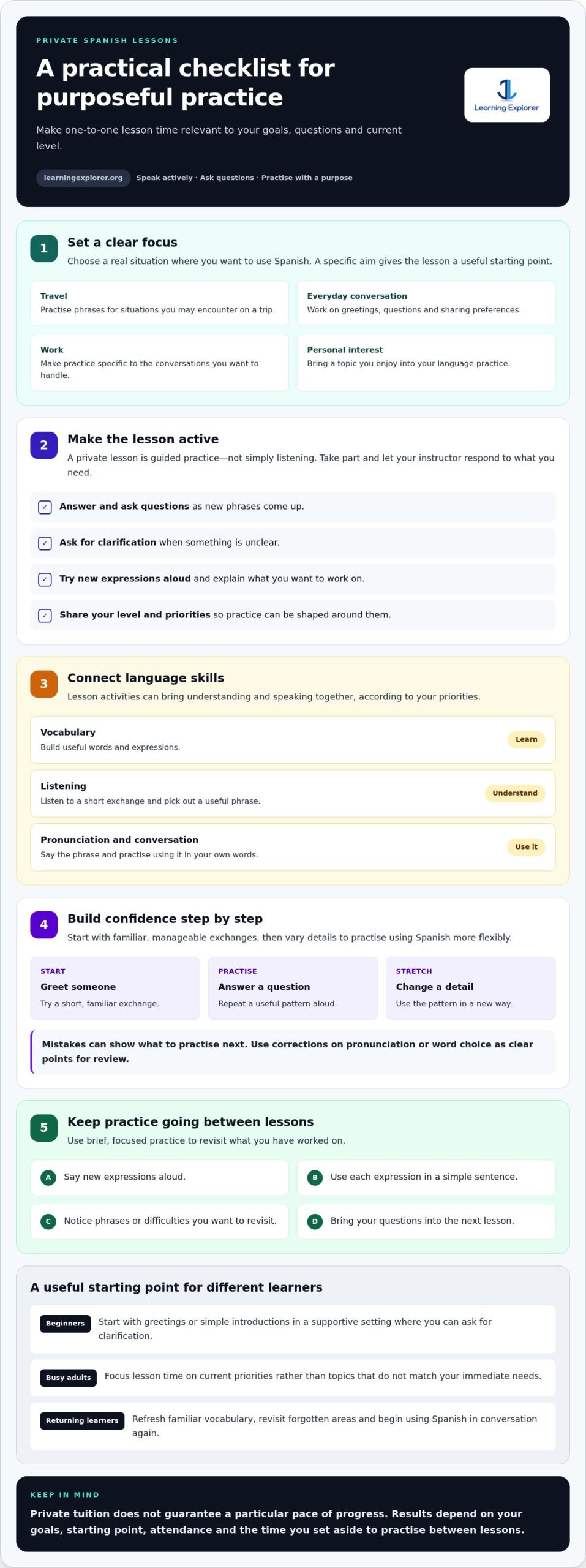
Make each lesson purposeful by giving it a clear focus. You don’t need a perfect study plan. A practical goal, an honest sense of your starting point and active participation can help your instructor shape practice around what you want to learn.
Use this simple sequence to guide your learning:
- Identify a goal. Choose a realistic situation where Spanish would be useful, such as making conversation while travelling or talking about an interest.
- Share your starting point. Mention what you’ve studied before, what feels familiar and what you find challenging.
- Practise actively. Try speaking, ask questions and bring expressions you want to understand or use.
- Review your learning. Note what feels clearer and what you’d like to revisit in a future lesson.
This isn’t a fixed lesson sequence. Think of it as a flexible way to keep your priorities visible and make guided practice more relevant.
How should you prepare for your first Spanish lesson?
Before your lesson, think about your experience with Spanish and the situations you hope to handle. Write down a few questions, topics you’re interested in or phrases you’ve come across and want to understand. If you’re a beginner, that’s enough: simply describe what you hope to learn. You don’t need a long list or technical terms to explain your goals.
A short note on your phone can help you remember what you want to discuss. Include a goal and a question, such as which expressions you’d like to practise or what has felt difficult in your self-study. Sharing these details gives your instructor useful context for guiding the session.
How can you practise Spanish between lessons?
Keep independent practice brief and connected to what you covered in class. Review a few vocabulary items or expressions, say them aloud and use each in a simple sentence of your own. For example, take a phrase from the lesson and change one detail to make it relevant to your day. The aim is to revisit and use what you’ve learned, not to replace instructor guidance with solo study.
Notice where you pause or feel unsure. Add those points to a short question list and bring it to a future lesson. This turns practice into useful feedback: you’ll have specific material to work through with your instructor instead of trying to remember every difficulty later.
Choose a goal for your next session, then explore private Spanish lessons in Singapore with Learning Explorer.
Learn Spanish with Private Classes at Learning Explorer Singapore
Learning Explorer offers Spanish courses in Singapore, including private lessons for learners who want focused practice around their individual goals. If you’re considering private Spanish classes, think about the skills you want to develop and the situations where you hope to use the language. Sharing those priorities gives your learning a clear starting point.
Lessons are taught by certified native-speaker instructors who are bilingual. Whether you’re new to Spanish or returning after a break, start with your current experience and explain what you’d like to work on. As your interests and questions develop, your instructor can help guide your practice. You don’t need to arrive with a complete study plan.
What makes Learning Explorer a practical option for Spanish learners?
Private lessons provide a focused setting for working on your individual learning goals. You might want to build conversational skills, develop useful vocabulary or revisit a point that has been difficult to understand. Share what matters most to you and use it to guide your practice. The aim is relevant instruction shaped around your priorities, not a promised pace or outcome.
Learning Explorer’s Spanish courses offer a local option for learners in Singapore, with private lessons among the available learning formats. Bilingual instructors bring native-speaker expertise and can explain language in both languages. This can be useful when you want to ask questions and make sense of new material at your current level.
How can you take the next step toward learning Spanish?
Start with two simple notes: what experience you already have with Spanish and what you’d like to practise. Your goal could be broad, such as feeling more comfortable in conversation, or connected to a particular interest. If you’re a beginner, you don’t need to prepare anything elaborate. A clear description of what you hope to learn is a useful first step.
As you explore your options, consider whether individual attention and goal-focused practice suit the way you like to learn. Learning Explorer’s Spanish courses and private lesson format offer a place to begin with your current experience and priorities.
Explore Spanish learning options at Learning Explorer and take your next step towards practising Spanish with guidance.
Take Your Next Step in Spanish
The right learning format starts with what you want to achieve. Private lessons can focus practice on your priorities, while group classes offer opportunities to learn alongside peers. Clear goals, active participation and regular review can make your learning more purposeful.
Learning Explorer offers Spanish courses with a private lesson format, taught by certified native-speaker instructors who are bilingual. If private Spanish classes in Singapore are what you’re considering, begin by thinking about your current experience and the conversations you’d like to practise.
Start with a goal that matters to you. Explore private Spanish classes at Learning Explorer and find a learning approach that feels relevant to you. Every new conversation starts somewhere, and you can build from where you are.
Frequently Asked Questions
Are private Spanish classes worth it for beginners?
They can be a useful option for beginners who want focused guidance and room to ask questions. In a one-to-one lesson, you can start with basic introductions, simple everyday expressions or pronunciation, then build practice around what feels unfamiliar. You don’t need to speak confidently before you begin. Your progress depends on your starting point, goals, attendance and practice, so focus on manageable steps rather than expecting instant fluency.
Can I learn conversational Spanish through private lessons?
Yes, private lessons can include guided conversation practice shaped around your needs. You might work on greeting someone, answering simple questions, expressing preferences or keeping an everyday exchange going. Share the situations you want to handle so lesson practice reflects those priorities. Speaking confidence develops with participation and continued practice, so use new expressions aloud between lessons and bring back questions about anything that still feels difficult.
How are private Spanish classes different from group classes?
Private classes focus instruction and interaction on one learner, while group classes include opportunities to practise with peers. One-to-one lessons may suit you if you want individual attention or have specific topics to work on. Groups may appeal if you enjoy shared activities and hearing other learners speak. Neither format is automatically better or faster. Consider where you feel comfortable participating and what kind of interaction helps you stay engaged.
Do I need to know Spanish before taking private lessons?
No, you can start private Spanish lessons as a complete beginner. You don’t need to memorise vocabulary or learn grammar in advance. Begin by sharing what you hope to do with Spanish, such as having simple conversations or preparing for travel. If you’ve studied before, mention what you remember and what you’d like to revisit. This gives your instructor a helpful starting point for guiding practice at your current level.
How often should I take private Spanish lessons?
There isn’t one ideal frequency for every learner. Consider your goals, schedule and how much time you can set aside to review between lessons. A regular rhythm you can maintain may help you revisit material and keep learning connected, but avoid choosing a pace that feels difficult to sustain. Your attendance, starting point and independent practice all influence how your learning develops over time.
Where can I take private Spanish classes in Singapore?
Learning Explorer offers Spanish courses, including private lessons, at its Singapore CBD training centre: 10 Anson Road, level 22, International Plaza, Singapore 079903, directly above Tanjong Pagar MRT. Lessons are taught by certified native-speaker instructors who are bilingual. The location is convenient if you travel through Tanjong Pagar. Consider your learning goals and current experience as you explore private Spanish classes in Singapore.
What should I practise between Spanish lessons?
Review vocabulary and expressions from your lesson, say useful phrases aloud and try using them in simple sentences. For example, take a new expression and adapt it to describe a preference or ask a basic question. Keep a short note of words or situations that leave you unsure, then bring those questions to your next lesson. Independent practice reinforces guided learning; it doesn’t need to replace instructor feedback or become a long daily task.