Last Monday, a traveler named Wei Ming discovered that his dream trip to Ho Chi Minh City felt like he was watching a movie with the sound muted because he couldn’t speak a word of the local tongue. He felt a sharp wave of anxiety at the thought of managing local markets or getting the tones wrong in a simple greeting. When looking for the best resources for vietnamese for travel singapore based explorers often feel overwhelmed by the choice between Northern and Southern dialects. It’s normal to want your holiday to be more than just pointed gestures and translation apps.
This guide will help you master the most impactful, vetted Vietnamese phrases and pronunciation tips to transform your next trip into an immersive cultural experience. You’ll learn how to order food with confidence, manage the current 20,374.94 VND exchange rate, and navigate the digital arrival card requirements introduced in April 2026. We will explore essential vocabulary for transport and the simple linguistic shifts that turn a standard tour into a meaningful journey. If you’re ready to start your learning journey, come find us at 10 Anson Road, level 22, International Plaza, Singapore 079903, situated directly above Tanjong Pagar MRT.
Key Takeaways
- Avoid “tourist pricing” at iconic locations like Ben Thanh Market by mastering essential phrases for haggling and polite negotiation.
- Navigate complex menus with ease and order authentic local delicacies like Banh Mi and Ca Phe Sua Da without any confusion.
- Leverage the “Singlish” advantage to demystify the six Vietnamese tones and improve your pronunciation through familiar phonetic patterns.
- Discover the most efficient strategies for learning vietnamese for travel singapore residents can use to turn a standard tour into a deep cultural exchange.
- Build genuine connections with locals by focusing on the high-frequency nouns and verbs that matter most for transport and daily interactions.
Essential Vietnamese for Travel: Why Singaporeans Should Learn the Basics
Vietnam has rapidly become a preferred hub for Singaporean weekend getaways and expanding business ventures. With a convenient 30-day visa exemption for Singapore passport holders, cities like Ho Chi Minh City and Hanoi are just a short flight away. While many travelers rely on English, investing time in the Vietnamese language basics significantly enriches your journey. It transforms your trip from a standard sightseeing tour into a deep cultural exchange. For those looking for vietnamese for travel singapore based resources, the focus should be on building bridges and showing genuine respect to the local community.
To better understand this concept, watch this helpful video:
Basic language skills act as a practical tool for daily navigation. In bustling hubs like Ben Thanh Market, speaking a few phrases can prevent “tourist pricing” and help you manage the current 20,374.94 VND exchange rate with confidence. Beyond the financial savings, there’s a profound psychological benefit. Locals deeply appreciate even small attempts at their language, often responding with increased warmth. Relying solely on translation apps can create a digital barrier, whereas a simple “Cảm ơn” creates a connection that no software can replicate.
Vietnam vs. Singapore: Cultural Nuances in Communication
Understanding the concept of “saving face” is crucial when visiting Vietnam. Interactions are often more indirect than the punchy communication style common in Singapore. While “Xin Chào” is the standard greeting, it’s just the starting point of a polite interaction. The Vietnamese honorifics system, which uses titles based on age and gender, might seem complex at first. However, mastering a few basic titles shows immense respect for local traditions and helps you blend in seamlessly with the local community.
The Business Traveler’s Edge
For entrepreneurs and professionals, language skills provide a competitive advantage in Hanoi or HCMC. Using Vietnamese greetings for business meetings helps build immediate trust and rapport with partners. It signals a commitment to the local market and respect for their heritage. Consequently, more professionals in Singapore’s CBD are seeking structured training to gain this professional edge. This small investment in learning pays off through smoother negotiations and stronger professional bonds. Many of these same professionals also recognize that pairing their Vietnamese studies with spoken english classes near me searches helps them build the executive communication confidence needed for high-stakes international business interactions. For those expanding their regional language portfolio even further, exploring business mandarin for beginners sg is another powerful step toward unlocking greater career leverage across Asia’s most dynamic markets.
How to Master Key Vietnamese Phrases for Dining, Shopping, and Transport
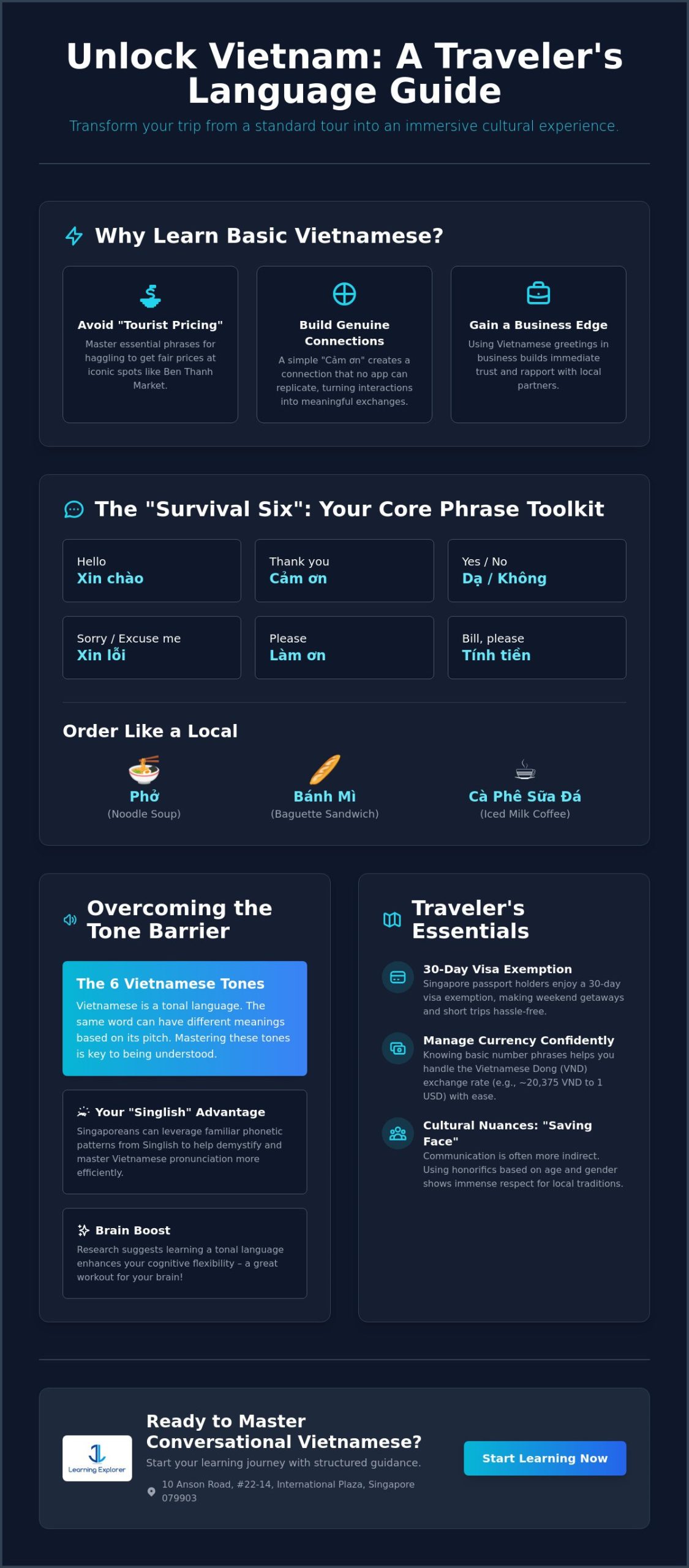
Stepping off the plane in Vietnam is a sensory explosion. To move beyond the role of a passive observer, you need a toolkit of functional language. When preparing for vietnamese for travel singapore residents often prioritize the “Survival Six” phrases. These are the versatile building blocks for every interaction: Xin chào (Hello), Cảm ơn (Thank you), Dạ/Không (Yes/No), Xin lỗi (Sorry), Làm ơn (Please), and Tính tiền (Bill, please). Mastering these creates an immediate shift in how you are perceived by locals, moving you from a stranger to a respected guest.
Engaging with a new phonetic system also offers surprising mental advantages. Scientific research on the benefits of learning a tonal language suggests that training your ears to distinguish between different pitches can actually enhance cognitive flexibility. This means your efforts to get the tones right for a bowl of Phở or a Bánh Mì are doing more than just filling your stomach; they’re sharpening your brain. It’s a rewarding challenge that pays dividends throughout your journey.
Dining Out: More Than Just ‘Delicious’
Ordering food is the highlight of any Vietnamese trip. To order like a pro, specify your preferences clearly. If you aren’t a fan of coriander, say “Không rau mùi.” For vegetarians, “Tôi ăn chay” is your essential phrase. When you’ve finished your meal, catch the server’s eye and say “Tính tiền” politely. Remember local etiquette: never leave your chopsticks sticking upright in a rice bowl. This resembles incense burnt for the dead and is considered bad luck. Instead, rest them across the top of the bowl or on a provided stand. These small gestures show deep respect for local customs.
The Art of the Deal: Market Phrases
Haggling is a social dance in Vietnam. Start by asking “Bao nhiêu?” (How much?). If the price seems high, a lighthearted “Đắt quá!” (Too expensive!) followed by a smile usually opens the door for negotiation. Understanding numbers is vital for handling the large denominations of Vietnamese Dong. Focus on the first ten numbers first. Once you know Một (1) through Mười (10), the rest follow a logical pattern. This knowledge ensures you aren’t constantly fumbling with your phone calculator while standing in a busy alleyway.
Communicating with Grab drivers is the final piece of the travel puzzle. While the app handles the destination, knowing “Rẽ trái” (Turn left), “Rẽ phải” (Turn right), and “Dừng lại ở đây” (Stop here) gives you control over your journey. If you want to build these skills before your flight, consider exploring a conversational Vietnamese course designed for busy learners. These practical sessions focus on high-impact vocabulary that you can use the moment you land, ensuring a smoother transition into the local rhythm.
Overcoming the Tone Barrier: A Beginner’s Guide to Vietnamese Pronunciation
Vietnamese is a melodic, tonal language where the pitch of your voice determines the meaning of every syllable. A single word can take on six distinct meanings depending on whether your voice rises, falls, or stays flat. While this sounds intimidating, mastering these tones is the secret to moving beyond basic tourist interactions. When researching vietnamese for travel singapore residents often worry about being misunderstood. However, the goal isn’t perfect fluency; it’s about achieving enough tonal accuracy to be understood by a local vendor or taxi driver.
Singaporeans possess a unique linguistic edge when approaching these sounds. Our daily use of Singlish involves a variety of pitch markers and sentence-final particles that mirror the rhythmic nature of Vietnamese. You already use different tones to convey mood or emphasis in local dialects. This existing “ear” for inflection makes it easier to distinguish between the sharp rising tone and the low, heavy tone. Practice by using your hand to “draw” the tone in the air as you speak. Moving your hand upward for a rising tone or downward for a falling one creates a physical connection to the sound, helping your brain lock in the correct pitch.
Diacritics are the small marks above or below letters in written Vietnamese. They aren’t just decorative; they are your road map for pronunciation. Even if you can’t speak a full sentence yet, learning to recognize these marks allows you to read street signs and menus with surprising accuracy. This skill reduces the burden of navigating a foreign city and increases your confidence when exploring neighborhoods off the beaten path.
Southern vs. Northern Dialects: Which Should You Learn?
The dialect you choose depends heavily on your destination. The Northern dialect, centered in Hanoi, is often considered the “standard” and sounds more crisp. In contrast, the Southern dialect of Ho Chi Minh City is more rhythmic and relaxed. While speakers from both regions can understand each other, the vocabulary and pronunciation of certain consonants differ. If your journey focuses on the south, consider joining a Vietnamese pronunciation class for Southern dialect to master the specific “Saigon” lilt that locals find so endearing.
Common Pronunciation Pitfalls for English Speakers
The initial “Ng” sound is a classic hurdle for many learners. It’s the same sound found at the end of the English word “singing,” but placed at the start of a word like “Ngon” (delicious). Vowel clusters also require focus. A name like “Nguyen” often sounds like “Win” or “Nwen” rather than the three-syllable “New-jen” often heard in Western media. Focus on keeping your vowels short and punchy. By avoiding these common traps, you’ll find that locals are much more likely to engage in the genuine connections you’re seeking.
Practical Language Tips for Your First Trip from Singapore to Vietnam
Preparation is the catalyst for a successful journey. While previous sections focused on the “what” of the language, this section focuses on the “how” of your preparation. When planning for vietnamese for travel singapore residents often benefit from a structured, step-by-step approach that prioritizes utility over academic perfection. Follow these five steps to build your confidence before you touch down at Tan Son Nhat or Noi Bai airport.
- Step 1: Prioritize high-frequency vocabulary. Focus on twenty essential nouns and ten versatile verbs like mua (buy), đi (go), and muốn (want). These are the workhorses of travel communication.
- Step 2: Calibrate your ears with audio. Spend fifteen minutes a day listening to native speakers. This helps your brain recognize the melodic rise and fall of the tones, making them less jarring when you hear them in a crowded market.
- Step 3: Seek native feedback. Tones are difficult to self-correct. Practicing with a native speaker ensures you don’t develop pronunciation errors that are hard to fix later.
- Step 4: Design a personalized cheat sheet. Create a list of phrases specific to your itinerary. If you’re visiting the mountains of Sapa, your needs differ from someone lounging on the beaches of Da Nang.
- Step 5: Embrace the learning curve. Vietnamese people are famously encouraging toward those who try to speak their tongue. A small mistake often leads to a shared laugh and a more memorable interaction.
Leveraging Technology for Language Support
Modern tools are excellent for reducing administrative burdens during your trip. Use the camera feature on translation apps to decode street signs or official notices regarding the digital arrival card requirements introduced in April 2026. Remember that AI often struggles with the subtle nuances of tonal pitch in real-time conversation. While technology helps you survive, a human teacher helps you thrive by providing the tonal accuracy that apps simply cannot replicate. For those seeking a professional edge, our conversational Vietnamese course provides the expert guidance needed to master these complexities.
The ‘Immersion’ Mindset
You don’t need to leave the Little Red Dot to start your immersion. Visit Vietnamese enclaves in areas like Joo Chiat to practice ordering your favorite dishes in the local tongue. Listen to V-Pop or watch Vietnamese cinema to get used to the natural rhythm of speech. Set realistic goals for your first trip. Aim for functional communication rather than perfect grammar. If you can successfully navigate a taxi ride or ask for the bill, you have already achieved a significant victory. This proactive approach ensures you’re ready to engage the moment you land.
Master Conversational Vietnamese at Learning Explorer Singapore
While self-study apps and phrasebooks provide a starting point, mastering a tonal language requires a more structured approach. “Winging it” often leads to frustration when a slight shift in pitch changes your request for “noodles” into a request for “a horse.” When preparing for vietnamese for travel singapore learners find that professional guidance is the most efficient way to ensure their pronunciation is accurate before they touch down. Our courses are designed to move you quickly from the labor of seeking translations to the satisfaction of genuine discovery.
Our native-speaker instructors are bilingual experts who deeply understand the specific challenges faced by Singaporean learners. They recognize how our local linguistic habits can either help or hinder your progress. By providing immediate, real-time feedback on your tones, they help you build the muscle memory needed for clear communication. Whether you need an intensive travel workshop for a last-minute getaway or a long-term conversational course for deeper mastery, we provide the tools to help you succeed. You can find our training center conveniently located at 10 Anson Road, level 22, International Plaza, Singapore 079903, situated directly above Tanjong Pagar MRT.
A Curriculum Designed for Real-World Use
We prioritize interactive and high-impact learning modules that mirror the situations you’ll actually face in Vietnam. Instead of dry grammar drills, you’ll engage in role-playing exercises that cover everything from navigating busy street food stalls to negotiating business deals. For those traveling for work, our basic Vietnamese for entrepreneurs in Singapore is a top choice for building professional rapport. We maintain small group sizes to ensure every student receives personalized pronunciation feedback, ensuring no one gets lost in the crowd.
Join a Community of Language Explorers
Learning alongside other Singapore-based travelers and professionals creates a supportive and mission-driven atmosphere. You’ll share tips on the best places to visit in Da Nang or the latest digital arrival card updates for Ho Chi Minh City while practicing your new skills. Our students have access to high-quality, vetted materials that simplify complex linguistic rules into bite-sized, scannable chunks. This organized approach respects your limited time and creates a sense of momentum from your very first session. Visit us at International Plaza to start your linguistic journey and transform your next trip into a truly immersive cultural experience.
Unlock a Deeper Connection on Your Next Vietnamese Adventure
Your journey through Vietnam shouldn’t be limited by a language barrier. By mastering the survival phrases we’ve discussed and understanding the nuances of regional dialects, you’ve already taken the first step toward a more meaningful travel experience. We’ve explored how small efforts in pronunciation can prevent tourist pricing and build genuine rapport with locals. When you invest in high-quality vietnamese for travel singapore based training, you trade the frustration of being misunderstood for the joy of cultural discovery.
Ready to speak with confidence? Our interactive and fun curriculum is led by certified native-speaker instructors who understand the adult learner’s needs. We’re situated in a convenient CBD location right above Tanjong Pagar MRT, making it easy to fit lessons into your busy schedule. Book Your Conversational Vietnamese Trial Class at Learning Explorer Today!
Take the leap today. Transforming your next holiday into an unforgettable cultural exchange is just one class away. We can’t wait to see you thrive on your next trip and experience the true heart of Vietnam.
Frequently Asked Questions
Is Vietnamese difficult for Singaporeans to learn?
Vietnamese presents unique challenges like its six tones, but Singaporeans often have a linguistic advantage. Our daily use of Singlish and exposure to various local dialects gives us a natural ear for pitch and inflection. You’ll find that the grammar is actually quite simple, with no complex verb conjugations or gendered nouns to memorize.
How long does it take to learn basic Vietnamese for a trip?
You can master functional travel phrases in approximately 10 to 16 hours of structured learning. This duration is usually enough to gain confidence in greetings, ordering food, and handling the current 20,374.94 VND exchange rate. Following a vetted curriculum ensures you focus on the most impactful vocabulary rather than getting lost in unnecessary theory.
Can I get by with just English in major cities like Hanoi and Ho Chi Minh City?
While you can survive using English in major tourist hubs, relying on it limits your experience. When using vietnamese for travel singapore based explorers find they can avoid “tourist pricing” and navigate local markets with much more ease. Speaking even a little of the local tongue transforms you from a standard tourist into a respected guest.
What are the most important phrases for a first-time visitor to Vietnam?
Focus on mastering the “Survival Six” phrases to cover most daily interactions. These include Xin chào (Hello), Cảm ơn (Thank you), Bao nhiêu? (How much?), Tính tiền (Bill, please), Xin lỗi (Sorry), and Làm ơn (Please). These simple building blocks allow you to navigate restaurants, markets, and transport with minimal stress.
Should I learn the Northern or Southern dialect of Vietnamese?
Your choice should depend on where you plan to spend the most time during your trip. The Northern dialect is the “standard” version used in Hanoi, while the Southern dialect is the rhythmic lilt heard in Ho Chi Minh City. While they are mutually intelligible, learning the specific sounds of your destination helps you blend in more effectively.
Are there Vietnamese language schools near the Singapore CBD?
Yes, our training center is located at 10 Anson Road, level 22, International Plaza, Singapore 079903, directly above Tanjong Pagar MRT. This central location is ideal for professionals looking to fit language learning into a busy work schedule. We provide a supportive environment designed to reduce the administrative burden of learning a new language.
How can I practice my Vietnamese pronunciation before my trip?
Use audio resources to calibrate your ears to the melodic nature of the tones before you depart. You can also visit Vietnamese food enclaves in Singapore to practice ordering your favorite dishes in a real-world setting. For the most accurate results, work with a native instructor who can provide immediate feedback on your pitch and tonal accuracy.
What is the best way for a busy professional to learn Vietnamese fast?
Enrolling in a Conversational Vietnamese Course with native instructors is the most efficient method. This targeted approach prioritizes high-frequency nouns and verbs used in travel and business. It allows you to move quickly from the labor of seeking translations to the satisfaction of genuine discovery without wasting time on academic jargon.