Your product’s technical specs won’t close a deal in Tokyo as quickly as a respectful bow and a flawless business card exchange. You likely feel the weight of the upcoming 2026 exhibition season, perhaps worrying that a lack of formal Keigo will make you appear unprofessional. It’s natural to feel anxious about losing high-value leads simply because you can’t bridge the communication gap. We know that mastering Japanese for attending trade shows in Japan is the ultimate signal of “Shinrai,” or trust, which is the foundation of every successful business relationship.
This guide prepares you to master the essential phrases and cultural protocols required to secure deals on the exhibition floor. You’ll learn how to initiate meaningful conversations and understand the subtle nuances of Japanese business follow-up. We’ll help you move from the stress of the unknown to the satisfaction of building real connections at major events like Manufacturing World Osaka. Whether you’re visiting us at 10 Anson Road, level 22, International Plaza, Singapore 079903, or studying remotely, our goal is to give you the confidence to turn every handshake into a lasting partnership.
Key Takeaways
- Understand how attempting the language builds “Shinrai” (trust), signaling your long-term commitment to potential Japanese partners.
- Master the specific vocabulary and business-level Japanese for attending trade shows in Japan to deliver a concise, professional company pitch.
- Learn the precise protocols for “Meishi Koukan” (business card exchange) to ensure you make a respectful and lasting first impression.
- Discover the essential “O-rei” follow-up email structure that helps you secure leads within the vital 24-hour post-event window.
- Identify why industry-specific language training provides a strategic edge over generic translation apps for high-stakes 2026 exhibitions.
Why Japanese Language Proficiency is a Strategic Advantage at Trade Shows
In Japan, business isn’t just about the contract; it’s about the person behind it. Mastering even foundational phrases demonstrates a profound respect for Japanese management culture. This effort signals to exhibitors that you’re a serious, long-term partner rather than a passing visitor. When you attempt the language, you build “Shinrai,” or trust, which is the essential currency of the Japanese exhibition floor.
Many exhibitors at massive 2026 events like FaW TOKYO or Manufacturing World Osaka feel hesitant to engage deeply in English. By using basic Japanese for attending trade shows in japan, you immediately lower their anxiety. This allows you to peek behind the “Tatemae,” or the polite public face, and begin to understand their “Honsho,” which represents their real intentions. Recognizing these subtle linguistic cues helps you identify which leads are truly worth pursuing.
To better understand how these cultural nuances impact your success, watch this helpful video:
The ROI of Basic Japanese for Singaporean Missions
Hiring a full-time interpreter for a three-day mission at Tokyo Big Sight is a significant expense that eats into your marketing budget. Learning key business phrases reduces this administrative burden and allows your team to work more independently. It also accelerates the “Relationship Phase” of the Japanese business cycle. In the Japanese corporate context, your level of linguistic effort correlates directly with your perceived professional reliability and the depth of business trust you can establish.
Moving Beyond Translation Apps
Handheld translation apps are useful for finding a train station, but they often fail in high-stakes professional settings. They create a physical barrier, forcing you to look at a screen instead of your potential partner. Real connection happens through eye contact and the warmth of a correctly pronounced greeting. Technology cannot replicate the sincerity found in a face-to-face interaction. Preparing your team at our center at 10 Anson Road, level 22, International Plaza, Singapore 079903, ensures you lead with human connection rather than a digital interface. Mastering Japanese for attending trade shows in japan gives you a personal touch that technology simply cannot match.
Essential Japanese Phrases for Navigating the Exhibition Floor
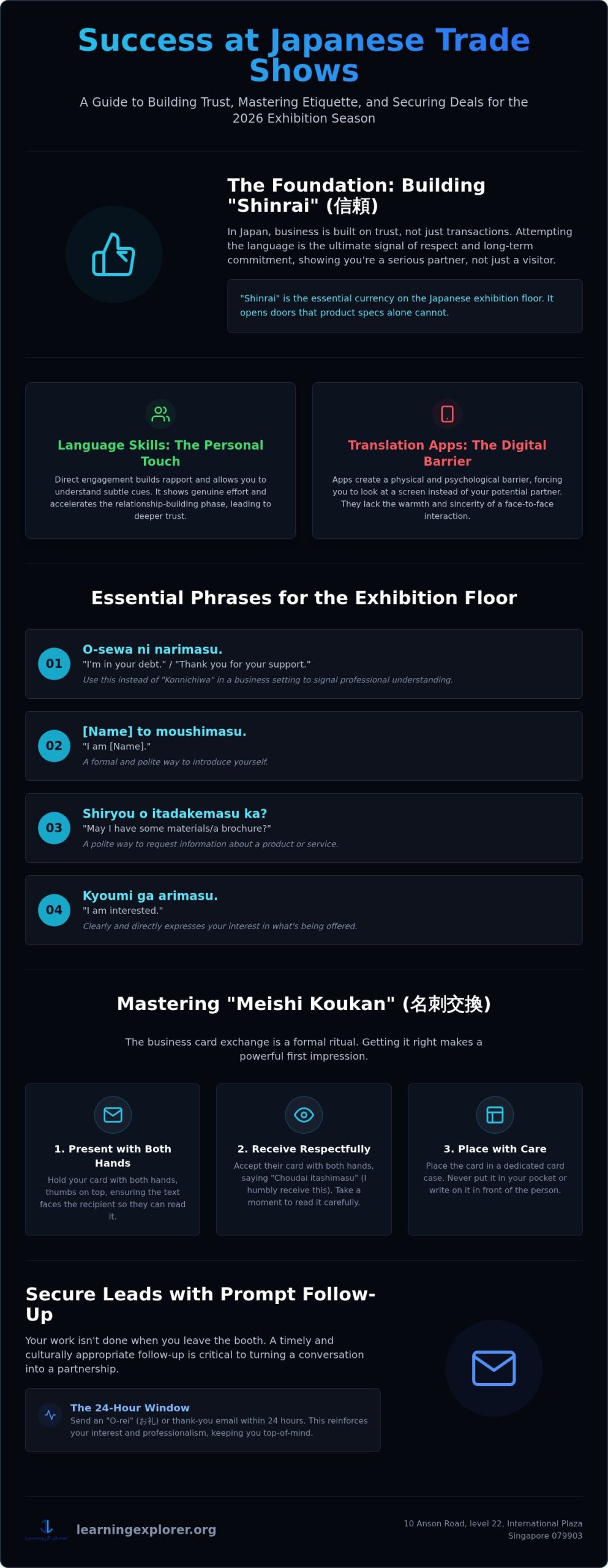
Success at a trade show depends on your ability to initiate contact smoothly and professionally. While “Konnichiwa” is a friendly start, using “O-sewa ni narimasu” (I’m in your debt) signals that you understand the expectations of a corporate environment. This phrase is a staple of business culture, used to acknowledge a shared professional context even if you’ve never met. Learning these specific examples of japanese for attending trade shows in japan ensures you aren’t just another tourist in the crowd. It shows you’ve done the work to respect their local customs and professional standards.
You’ll need a punchy introduction to keep the momentum going during a busy expo. Start with “[Name] to moushimasu” (I am [Name]) followed by “[Company] no [Position] desu” to identify yourself clearly. When you spot a product that fits your procurement needs, ask “Shiryou o itadakemasu ka?” to request brochures or catalogs. If the product aligns with your 2026 goals, say “Kyoumi ga arimasu” (I’m interested). Be careful with “Kento shimasu” (I’ll consider it); as noted in Forbes’ business etiquette tips, this often serves as a polite way to end a conversation without making a commitment. Understanding these subtleties prevents you from misinterpreting a lead’s level of interest.
Mastering the Booth Approach
Booth staff are often juggling multiple visitors simultaneously. Use “O-isogashii tokoro, sumimasen” (Sorry to disturb you while you’re busy) to politely catch their attention without being intrusive. If their technical explanation is too fast or complex, ask “Mousukoshi kuwashiku oshiete itadakemasu ka?” to request more detail. Understanding polite refusals is equally vital for your efficiency on a crowded floor. If an exhibitor says “Muzukashii desu” (It’s difficult), they’re likely giving you a soft “no.” Recognizing this early saves you time and prevents awkward social friction that could damage your brand’s reputation.
Logistical Phrases for Large Venues
Navigating massive halls like Tokyo Big Sight or Makuhari Messe for events like Japan IT Week requires clear directions to stay on schedule. If you’re looking for a specific partner, ask “[Company name] no bu-su wa doko desu ka?” to find their exact location. To secure a more formal follow-up later in the week, use “Uchiawase no yoyaku o shitai desu” (I’d like to book a meeting). Practicing these interactions in a Business Japanese Course helps you handle these high-pressure moments with ease. Our training center located conveniently above Tanjong Pagar MRT focuses on these exact professional scenarios, giving you the tools to turn a brief encounter into a lasting business relationship.
Business Etiquette and Non-Verbal Communication Protocols
In Japan, your actions speak as loudly as your words. While learning specific japanese for attending trade shows in japan is vital, pairing those phrases with the correct physical protocols is what truly builds “Shinrai.” Mastering these non-verbal cues ensures you don’t accidentally offend a potential partner during a high-stakes exchange. According to the U.S. International Trade Administration guide to Japanese business customs, formality and group harmony are central to every interaction. This begins with “Ojigi,” or bowing. At a trade show booth, a 15-degree bow, known as eshaku, is standard for greetings. A 30-degree bow, or keirei, shows deeper respect during a formal introduction or when expressing gratitude.
The Step-by-Step Business Card Ritual
Meishi Koukan, the exchange of business cards, is a sacred ritual on the exhibition floor. Follow these steps to demonstrate your professionalism. First, present your card with both hands, holding the top corners so you don’t cover the logo or your name. Ensure the text faces the recipient so they can read it immediately. Second, receive their card with both hands and a small bow. Take a moment to read it carefully; this shows you value their role and company. Third, never slide the card into your pocket immediately. During a sit-down meeting at a booth, place the cards on the table in front of you, arranged according to the seating order of your hosts. This helps you remember names and shows ongoing respect for the individuals present.
Reading the Room: Non-Verbal Cues
Don’t fear the “Japanese Silence.” In many Western contexts, silence feels awkward, but in Japan, it signifies that your counterpart is carefully considering your proposal. It’s a sign of respect, not a lack of interest. Avoid intense, unblinking eye contact, as this can feel aggressive or confrontational. Instead, maintain a soft focus and a pleasant expression. Keep your posture upright and professional, even in the crowded aisles of Tokyo Big Sight. If you’ve scheduled a meeting with a high-priority lead, bringing a small “O-miyage,” or gift, from Singapore can be a powerful gesture. Choose high-quality, nicely wrapped snacks that can be shared among a team. Presenting these tokens with both hands while using your japanese for attending trade shows in japan creates a memorable and positive impression that technology simply cannot replicate.
Beyond the Booth: Language for Networking and Follow-ups
The real work often begins after the exhibition lights dim. In Japan, the “Nijikai” or second-party is where rigid professional shells soften, allowing for the authentic bonding that leads to long-term contracts. Transitioning your language from the stiff formality of the booth to the semi-formal atmosphere of an Izakaya is a skill in itself. Mastering the right japanese for attending trade shows in japan ensures you remain professional while demonstrating the warmth necessary for a true partnership. It shows your hosts that you are not just a visitor, but a colleague who respects the social fabric of their industry.
Socializing with Potential Partners
Business meals in Japan follow a specific rhythm that rewards the prepared executive. Always wait for the host to offer the first “Kanpai” (cheers) before taking a sip of your drink. Be mindful of seating arrangements; the “Kamiza” (honored seat) is furthest from the door, while the “Shimoza” (lower seat) is nearest. For “Seken-banashi,” or small talk, stick to safe, positive topics. Your impressions of Japanese cuisine or your travel experience to the venue are excellent choices. If you need to politely decline another round of drinks, a simple “Kyou wa juubun itadakimashita” (I’ve had enough today) works perfectly without causing social friction.
Drafting the Perfect Follow-up Email
The “O-rei” email is a non-negotiable step in Japanese corporate culture. Unlike Western follow-ups that might wait a week, this thank-you message must land in their inbox within 24 hours of your meeting. Your subject line should be clear and professional, such as “[Trade Show Name] Thank you – [Your Company Name].” This ensures the recipient can quickly identify you among hundreds of other contacts they met that day. Promptness is viewed as a direct reflection of your company’s operational efficiency and reliability.
Standard formulas are expected in these messages. Open with “O-sewa ni natte orimasu” to acknowledge the ongoing connection. Explicitly reference a specific point from your conversation at the booth to prove you were listening and that you value their time. End the message with “Kongo tomo, yoroshiku o-negai itashimasu,” which translates to “Please look forward to our future relationship.” This phrase is the gold standard for signaling long-term intent and professional reliability. It bridges the gap between a single meeting and a lasting business alliance.
To ensure your team can handle these critical post-show interactions with poise, enroll in our Business Japanese Course today. Our native-speaking instructors at our center above Tanjong Pagar MRT help you master the nuances of corporate correspondence and social etiquette for your 2026 trade mission. We focus on these high-stakes scenarios to ensure you leave Japan with secured leads rather than just a stack of business cards.
Preparing for Your Japan Trade Mission from the Singapore CBD
Preparing for a high-stakes trade mission requires more than a casual glance at a translation app. Apps cannot simulate the pressure of a crowded booth at Makuhari Messe or provide the nuanced feedback needed for professional success. For Singaporean executives, intensive, face-to-face training is the only way to ensure your team is ready for the 2026 exhibition season. Our native-speaking bilingual instructors act as your reliable allies, simulating real-world trade show scenarios to build your confidence before you even board your flight.
Customization is the key to efficiency. Whether your industry is semiconductors, finance, or green technology, we focus on the specific vocabulary you’ll encounter on the floor. Learning the right japanese for attending trade shows in japan means mastering the terms your technical partners use. This targeted approach ensures you don’t waste time on irrelevant tourist phrases and instead focus on the language that closes deals. Our training methodology is designed to be the creative catalyst for your international success.
Leveraging CBD-Based Japanese Lessons
For busy professionals working in the heart of the city, evening Japanese lessons near Raffles Place offer the perfect balance of convenience and rigor. If you have a three-month window before your trip, a private class provides a high-intensity sprint tailored to your specific role. Alternatively, group classes allow your entire team to practice networking dynamics together. We also focus on Mastering Keigo, ensuring your honorifics are appropriate for high-level procurement meetings. Our center is situated directly above Tanjong Pagar MRT, making it easy to fit essential prep into a demanding schedule.
Your Pre-Departure Checklist
Before you depart for Tokyo or Osaka, finalize your bilingual business cards. Ensure the Japanese side is professionally translated and reflects your role accurately. Practice your “Jiko-shoukai” (self-introduction) until it feels fluid and natural. This 30-second pitch is your most used tool on the exhibition floor and must be delivered with confidence. Book a consultation at our International Plaza center for a tailored corporate curriculum that meets your specific mission goals. Mastering japanese for attending trade shows in japan is a strategic investment that transforms your presence from a visitor to a valued partner.
Secure Your Success on the 2026 Exhibition Floor
The 2026 exhibition season offers immense opportunities for those who can bridge the cultural gap. Success in Japan is rooted in “Shinrai,” or trust, which you build by mastering both technical vocabulary and the subtle rituals of business etiquette. From the perfect business card exchange to the timely “O-rei” follow-up email, your linguistic effort signals a long-term commitment that technology alone cannot convey. Preparing your team with the right japanese for attending trade shows in japan transforms every interaction into a potential partnership.
Don’t let the language barrier stand between you and your next major deal. Our native-speaker instructors provide a corporate-aligned curriculum that simulates high-stakes trade show scenarios, ensuring you’re ready for any professional challenge. Visit our center above Tanjong Pagar MRT to begin your preparation. We’re here to reduce your administrative burden and increase your engagement with the Japanese market.
Master Business Japanese for your next mission at Learning Explorer and navigate the floor with total confidence. You have the vision; we provide the communication tools to make it a reality.
Frequently Asked Questions
Do I really need to speak Japanese at a trade show in Tokyo?
Basic Japanese is essential for building trust with booth staff who may be hesitant to speak English. Using japanese for attending trade shows in japan demonstrates respect and a long-term commitment to the market. While major venues like Tokyo Big Sight have English signage, the real business happens in face-to-face interactions. Mastering foundational greetings allows you to move past polite public faces and engage in more meaningful technical discussions with potential partners.
How long does it take to learn basic business Japanese for a trip?
You can master foundational business phrases in approximately three months of consistent study. This timeframe allows you to practice your self-introduction and essential booth approach etiquette until it is fluid. For high-stakes 2026 missions, an intensive private course provides the most efficient path to proficiency. Focusing on industry-specific vocabulary ensures you are ready for the technical demands of the exhibition floor while reducing the stress of the language barrier.
What is the most important etiquette rule for a Japan trade mission?
The business card exchange, or Meishi Koukan, is the most critical ritual in Japanese corporate culture. You must present your card with both hands and receive the other person’s card with equal care. Treating their card as an extension of their professional identity is vital for building trust. Never write on a card or put it away immediately; instead, place it on the booth table to show ongoing respect for your hosts.
Can I use English business cards in Japan?
You can use English cards, but having a bilingual version with Japanese on the reverse side is highly recommended for 2026 exhibitions. It shows you’ve prepared specifically for the Japanese market and respects local norms. Ensure your title and company name are translated accurately to avoid any confusion during introductions. This small preparation significantly enhances your professional standing and helps you stand out among hundreds of other international visitors at the show.
Should I hire an interpreter for my booth at Tokyo Big Sight?
Hiring an interpreter can be helpful for complex negotiations, but it doesn’t replace the need for your own language skills. Learning japanese for attending trade shows in japan allows you to build a direct, personal connection that a third party cannot replicate. Relying solely on interpreters can create a social barrier that slows down the relationship-building process. Even basic proficiency shows a level of sincerity that Japanese partners deeply value for long-term trust.
What is the best way to follow up with a Japanese contact after a show?
Send a formal “O-rei” (thank you) email within 24 hours of your meeting. This immediate follow-up is a standard expectation in Japanese business and signals your professional reliability. Reference a specific detail from your conversation at the booth to show you were attentive. Closing with a phrase that looks forward to future cooperation helps solidify the rapport you built during the show and keeps the momentum going for your next 2026 mission.
Are there specific Japanese phrases for the semiconductor industry?
Yes, every industry has its own specialized vocabulary that goes beyond standard conversational Japanese. Learning terms related to procurement, manufacturing specs, or financial regulations is crucial for success at 2026 trade events. Our native-speaking instructors focus on creating tailored curricula that address these industry-specific needs. This targeted approach ensures your communication is precise and professional when you are discussing complex technical products with potential Japanese distributors or manufacturers during your exhibition visit.
Where can I find a Japanese language school in the Singapore CBD?
You can find Learning Explorer in the heart of the Singapore CBD at International Plaza. Our center is conveniently situated directly above Tanjong Pagar MRT, making it accessible for busy executives. We provide corporate-aligned Japanese courses taught by native-speaking bilingual instructors who understand the cultural bridge between Singapore and Japan. Whether you prefer private or group classes, we help you prepare for high-stakes international business missions with confidence and ease.