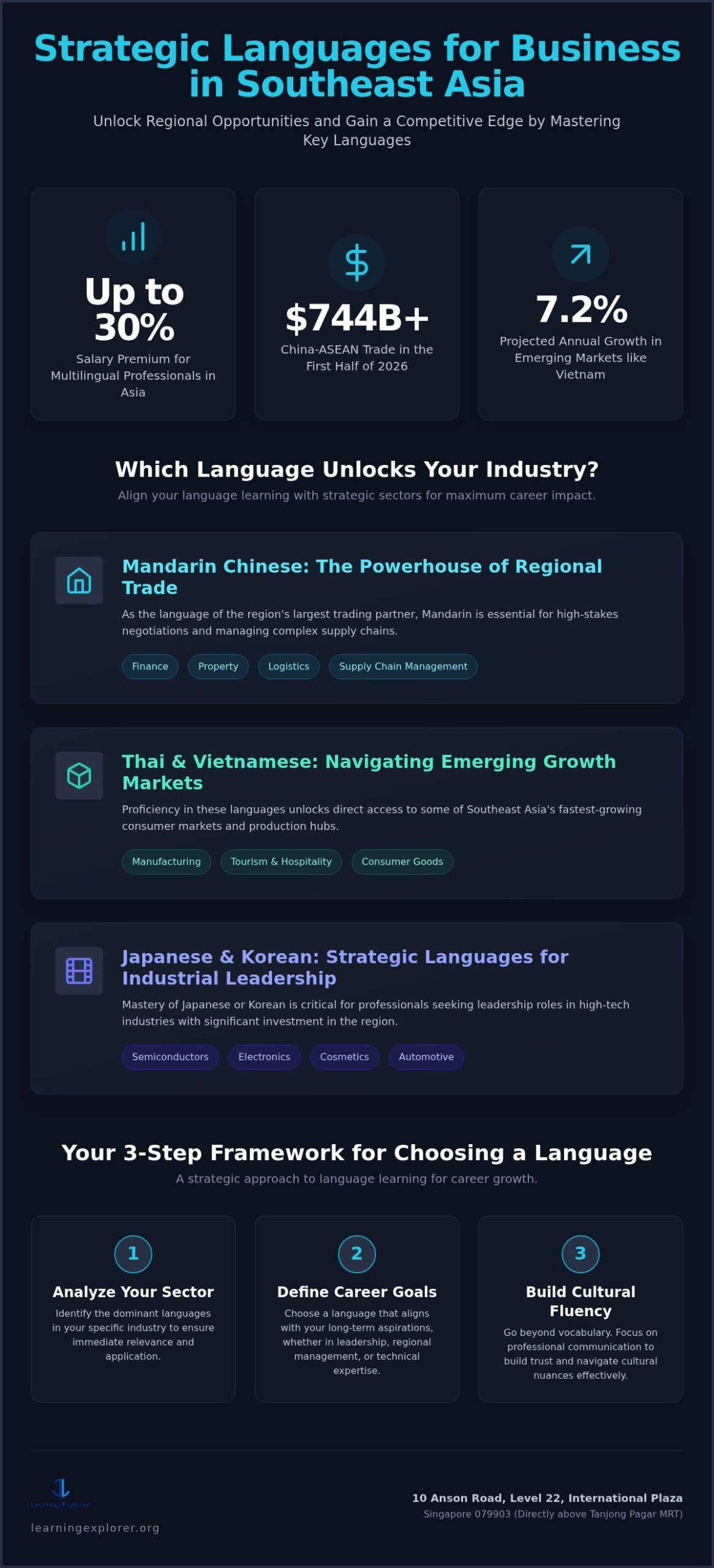
Did you know that multilingual professionals in Asia now command salary premiums of up to 30% over their peers? With trade between China and ASEAN surging to over $744 billion in the first half of 2026, the regional landscape has never been more competitive. You might find yourself asking, what is the most useful language for business in southeast asia to stay ahead? It’s common to feel disconnected from regional clients or overwhelmed by the linguistic diversity of ASEAN. You don’t want to miss out on ground-floor opportunities in emerging markets like Vietnam, where growth is projected at 7.2% this year.
We understand the pressure of staying relevant in a fast-moving economy. This article will help you identify the strategic languages driving growth and show you how to choose the right one to accelerate your professional impact. We’ll explore the cultural nuances of regional business and help you find a supportive training partner at 10 Anson Road, level 22, International Plaza, Singapore 079903, located directly above Tanjong Pagar MRT. Get ready to transform your career from a place of seeking to a position of discovery and influence.
Key Takeaways
- Learn how to identify what is the most useful language for business in southeast asia by analyzing 2026 trade statistics and regional growth sectors.
- Discover the critical role of Mandarin Chinese in navigating the deepening economic integration and rising FDI across the ASEAN region.
- Explore how Thai and Vietnamese proficiency unlocks high-growth opportunities in Southeast Asia’s booming manufacturing and tourism hubs.
- Understand the strategic importance of Japanese and Korean for leadership roles in the semiconductor, electronics, and cosmetics industries.
- Gain a clear framework for selecting a language course that aligns with your specific industry requirements and long-term career aspirations.
The Shifting Landscape of Business Communication in ASEAN
The 2026 business climate in Southeast Asia has evolved far beyond simple export-import models. As regional integration deepens through agreements like the CAFTA 3.0 Upgrade Protocol, the focus has shifted toward hyper-localized consumer markets. While English often serves as the initial bridge, relying on it exclusively often limits your reach. To truly penetrate these markets, you need to understand what is the most useful language for business in southeast asia based on your specific sector. Relying on a lingua franca can leave you feeling like an outsider, missing the subtle cues that define successful regional deal-making. This is where Cultural Intelligence (CQ) becomes your greatest asset. It’s the ability to adapt across cultures, turning a standard transaction into a long-term partnership that feels both authentic and expert.
Beyond the Lingua Franca: Why Local Languages Matter
Speaking the local tongue builds a level of trust that English simply cannot replicate. It allows you to navigate the complex nuances of regional negotiations and legal frameworks without getting lost in translation. When you speak a client’s language, you reduce administrative friction and demonstrate a genuine commitment to the market. Understanding the linguistic landscape of Southeast Asia helps you see how these languages influence one another, giving you a deeper perspective on regional trade dynamics. By 2026, the competitive edge belongs to those who can engage directly with localized consumer bases. This approach transforms your professional impact, ensuring you aren’t just present in a market, but actively thriving within its unique cultural ecosystem.
Singapore: The Gateway to Regional Fluency
Singapore stands as the central command center for ASEAN operations. Choosing to master a new language here provides a unique advantage. You aren’t just learning in a vacuum; you’re practicing in a multicultural business ecosystem that mirrors the region’s diversity. Our training center at 10 Anson Road, level 22, International Plaza, Singapore 079903, sits right above Tanjong Pagar MRT, making it easy to integrate learning into your busy professional schedule. This strategic location allows you to transition from the labor of seeking information to the satisfaction of discovery. You’ll gain the tools to lead with confidence, moving from being overwhelmed by diversity to leveraging it as a strategic tool for growth. It’s about more than just vocabulary; it’s about becoming a visionary leader in a multilingual region.
Mandarin Chinese: The Powerhouse of Regional Trade
Trade between China and ASEAN reached $744.41 billion in the first seven months of 2026. This 24.7% year-on-year increase solidifies Mandarin’s position as a dominant force in the regional economy. When assessing what is the most useful language for business in southeast asia, Mandarin often tops the list because of its deep integration into finance, property, and logistics. Over 1.1 billion people speak Mandarin globally, and in ASEAN, it acts as the primary conduit for Foreign Direct Investment (FDI) shaping regional infrastructure. It’s the language of the capital that builds our skyline and powers our ports. Business Mandarin serves as a high-precision linguistic tool designed specifically for high-stakes corporate negotiation and strategic partnership development.
The ROI of a Business Mandarin Course
Social fluency is great for networking, but professional mastery is what closes deals. A structured guide to Mastering Conversational Mandarin in Singapore shows how learners can transition from basic greetings to articulating value propositions with clarity. Choosing a course that focuses on boardrooms and complex contract reviews helps you build a level of rapport that signals respect and long-term commitment. This professional edge reduces administrative burden and increases the likelihood of favorable outcomes in regional markets. If you want to enhance your professional impact, enrolling in a Business Mandarin Course can provide the confidence you need to lead in high-stakes environments.
Mandarin for Regional Supply Chains
Trade in intermediate goods between China and ASEAN grew by 24.5% in the first half of 2026, reaching approximately $422 billion. This surge makes Mandarin vital for anyone managing manufacturers or distributors across the Greater China region. In Singapore, Mandarin also plays a strategic role in trade with Malaysia and Indonesia, where many business owners are part of the Chinese diaspora. Mastering the language helps you navigate these supply chains with fewer misunderstandings. It transitions your daily work from the labor of seeking clarity to the satisfaction of discovery and efficient execution. Whether you are coordinating logistics or auditing a factory, speaking the language of your partners ensures you aren’t left out of critical conversations. It empowers you to handle the taxing nature of cross-border trade with visionary expertise and expert local knowledge.
Thai and Vietnamese: Navigating Emerging Growth Markets
While Mandarin dominates broad regional trade, specific high-growth sectors require a more localized approach. When you ask what is the most useful language for business in southeast asia for 2026, the answer increasingly points toward the Mekong region. Vietnam’s economy is a standout performer, with the Asian Development Bank forecasting 7.2% growth this year. It has firmly established itself as a global manufacturing alternative for electronics and textiles. Meanwhile, Thailand’s export-driven recovery is hitting its stride, with export growth projected between 12% and 16% for 2026. For professionals in Singapore, these markets represent the next frontier of expansion, requiring more than just a passing acquaintance with the local culture.
Vietnamese for Property and Manufacturing
Property investment circles in Singapore are buzzing about Vietnam’s resilient urban growth. Investors are no longer content with translated reports; they want to understand the ground reality. Learning Vietnamese allows you to navigate the six vocal tones that often act as a barrier to entry for outsiders. Our Language Courses in Singapore provide the structured coaching needed to master these nuances. By moving beyond the labor of seeking basic information, you can focus on satisfying discovery in the Hanoi and Ho Chi Minh City markets. Enrolling in a conversational Vietnamese course for property investors signals to your partners that you’re a visionary leader committed to long-term success in their territory.
Thai for Hospitality and Trade
Thailand remains Southeast Asia’s second-largest economy, expanding 1.9% annually as of mid-2026. Its dominance in the automotive and hospitality sectors makes it a frequent destination for Singapore-based executives. Enrolling in a basic thai speaking course for frequent business travelers sg is a strategic move for any frequent traveler. In the Bangkok business world, even a basic attempt at the language is seen as a high-value compliment. It wins points that English alone cannot secure. This effort helps build long-term partnerships rooted in mutual respect. Instead of feeling like a visitor, you’ll engage as a reliable ally who understands the local rhythm. Our center at International Plaza, situated directly above Tanjong Pagar MRT, provides the creative catalyst you need to turn these travel tasks into rewarding professional outcomes.
Japanese and Korean: Strategic Languages for Industrial Leadership
While Mandarin and Mekong-region languages are vital for broad trade, Japanese and Korean remain the gold standard for industrial leadership and high-tech innovation. If you’re asking what is the most useful language for business in southeast asia for the technology sector, Japanese is a primary contender. Japan remains a powerhouse in semiconductors and electronics, recently strengthening ties through the “Japan-ASEAN Co-creation Initiative for AI.” Meanwhile, Korea’s influence on Singapore’s retail and entertainment sectors is reaching new heights in 2026. These languages aren’t just for social interaction. They’re strategic tools for professionals aiming to lead in specialized, high-value industries across the region.
Mastering Japanese for High-Tech Sectors
Japanese remains a top-tier choice for engineering and tech professionals. Deepening your understanding of Japanese corporate culture allows you to navigate complex hierarchies with confidence. Learning “Keigo,” or formal honorifics, is essential for high-level meetings where respect is as important as technical expertise. It transforms your interactions from basic communication to sophisticated partnership building. It’s a transition from the labor of seeking clarity to the satisfaction of discovery. If you’re ready to start, Learn Japanese Language in Singapore through our specialized curriculum. This investment reduces the administrative burden of cross-border technical collaboration and increases your professional impact.
Korean for Retail and Creative Industries
The “K-Business” expansion into Singapore’s retail market is a defining trend of 2026. For professionals in the beauty, cosmetics, and FMCG sectors, Korean proficiency offers a massive strategic advantage. It facilitates smoother partnerships with Seoul-based brands and helps you understand the creative vision behind the products. While the Hangul system might seem daunting at first, native-speaker guides make the learning process feel like a supportive journey rather than a chore. Enrolling in a Conversational Korean Course helps you bridge the gap between Singaporean retail and Korean innovation. It empowers you to handle the taxing nature of cross-border trade with visionary expertise. Take the first step toward regional expertise and explore our language programs to see how we can support your growth.
Choosing Your Path: How to Align Language Learning with Your Career Goals
Selecting your next professional milestone shouldn’t feel like a burden. It’s about finding the perfect alignment between your personal skills and the region’s economic trajectory. When you evaluate what is the most useful language for business in southeast asia, you aren’t just picking a subject. You’re choosing a market. Start by identifying your primary growth zone. If your firm is pivoting toward the massive intermediate goods trade with China, a Business Mandarin Course is your best move. If you’re managing supply chains in Bangkok, focus on a Conversational Thai Course designed for Singapore business travelers. Assess your industry’s specific needs, such as formal honorifics for Japanese tech roles, and choose a learning format that respects your limited time.
- Identify your primary growth market based on your 2026 revenue targets.
- Assess industry-specific linguistic requirements to ensure boardroom readiness.
- Select a learning format that fits seamlessly into a busy CBD schedule.
- Choose a school with native-speaker instructors for authentic cultural insight.
- Commit to a structured course for long-term ROI and professional impact.
Strategic Learning in the Heart of Singapore
Convenience is the creative catalyst for consistent progress. Our training center is located at International Plaza, situated directly above Tanjong Pagar MRT. This strategic location makes lunch-break or after-work learning entirely feasible for busy professionals. You can transition from the stress of the office to the satisfaction of discovery in minutes. By choosing the Best Language School Singapore has to offer for corporate learners, you ensure your time is used efficiently. We position ourselves as your reliable ally, providing the expert guidance needed to navigate ASEAN’s diverse linguistic landscape without the administrative headache.
Vetted Materials vs. Unorganized Sources
Free apps often lead to the labor of seeking without the satisfaction of finding. For professional-level communication, relying on unorganized sources is a risk you don’t need to take. High-quality, vetted materials act as a catalyst for better outcomes, ensuring you learn the specific terminology used in your industry. Our curriculum is designed by practitioners for practitioners, focusing on real-world execution rather than academic theory. This expert-led approach transforms your professional impact, allowing you to lead with visionary confidence. It turns the taxing nature of daily tasks into a series of successful cross-border engagements. Invest in your growth today and feel the difference that professional support makes in your career journey. For organizations looking to justify training budgets, calculating ROI on corporate language programs in Singapore provides the exact financial framework and evidence needed to secure executive approval.
Elevate Your Professional Impact in ASEAN
Strategic language learning is the creative catalyst that transforms regional obstacles into professional milestones. By 2026, the question of what is the most useful language for business in southeast asia depends entirely on your target growth market and industry niche. Whether you’re securing deals in the high-tech sectors of Japan and Korea or navigating the emerging manufacturing hubs of Vietnam, your ability to communicate with cultural intelligence will be your greatest asset.
Our team at Learning Explorer acts as your reliable ally, providing high-quality, vetted materials that ensure your time is spent on satisfying discovery. With certified native-speaker instructors and an interactive, adult-focused curriculum, we help you bridge the gap between classroom theory and real-world execution. We’re conveniently located at 10 Anson Road, International Plaza, making it easy to fit mastery into your daily routine. Start your journey to regional mastery with Learning Explorer today and lead with visionary confidence in the world’s most dynamic economic region. Your next big opportunity is just one conversation away.
Frequently Asked Questions
Which language is most useful for business in Southeast Asia if I only learn one?
Mandarin Chinese is often the most versatile choice due to the massive volume of China-ASEAN trade, which reached $744.41 billion in early 2026. However, the answer to what is the most useful language for business in southeast asia really depends on your specific growth market. If you’re targeting manufacturing, Vietnamese is essential. For automotive or tourism, Thai is better. We help you align your choice with your career goals through expert-led discovery.
Is it worth learning Vietnamese for business in 2026?
Yes, it’s highly valuable as Vietnam’s economy is projected to grow by up to 7.2% in 2026. As a primary global manufacturing alternative, Vietnam attracts significant foreign investment. Learning the language through a conversational Vietnamese course for property investors helps you build deep rapport with local partners and navigate complex supply chains. It transforms your role from a visitor to a trusted insider in a high-growth market, increasing your professional impact and reducing administrative friction.
How long does it take for a professional to become conversational in Thai?
Most professionals reach basic social fluency in about 3 to 6 months with consistent practice. Our Conversational Thai Course focuses on immediate utility for business travel and networking. By learning key phrases and cultural etiquette, you can start building long-term partnerships in the Bangkok business world quickly. Native-speaker instructors ensure you master the tones correctly from the start. This structured approach helps you transition from the labor of seeking to the satisfaction of discovery.
Can I learn Business Mandarin if I have no prior Chinese background?
Absolutely. Our Business Mandarin Course is designed to take absolute beginners through a structured path toward professional mastery. We focus on high-stakes corporate negotiation and industry-specific vocabulary right from the start. Using vetted materials and bilingual native instructors, we reduce the administrative burden of learning. You’ll move from basic greetings to understanding regional trade dynamics without feeling overwhelmed. It’s about gaining a creative catalyst for better outcomes in the Greater China region.
What are the best language schools in the Singapore CBD for adults?
Learning Explorer is a premier choice for working professionals in the Singapore CBD, situated right at Tanjong Pagar. We offer a supportive, interactive environment tailored to adult learners. Our flexible learning formats include private and group classes to fit busy corporate schedules. Our instructors are bilingual native speakers who understand the cultural nuances of regional business. We provide high-quality materials that ensure you gain practical skills that have an immediate professional impact on your daily tasks.
Does learning a regional language actually increase my salary in Singapore?
Multilingual professionals in Asia command salary premiums between 10% and 30% over their peers. Companies value the ability to manage cross-border projects and maintain regional client relationships without translators. Proficiency in a language like Vietnamese or Thai demonstrates visionary leadership and a commitment to regional expansion. It’s a strategic investment that pays off through increased engagement and better career opportunities. We act as your reliable ally in achieving these transformative professional outcomes.
How do native-speaker instructors improve my business negotiation skills?
Native speakers provide authentic cultural insights that go beyond simple vocabulary. They teach you the subtle cues, such as formal honorifics in Japanese or the etiquette of Thai business, which win points in high-stakes meetings. This expert-led discovery helps you navigate negotiations with confidence and respect. You’ll learn to handle the taxing nature of regional trade by understanding the emotional expectations of your partners, ensuring your professional impact is both authoritative and kind.
What is the most useful language for the tech industry in ASEAN?
Japanese remains a critical language for the semiconductor and electronics sectors, especially with Japan’s focus on regional AI initiatives. However, Korean is also a powerhouse for digital retail and creative tech. When deciding what is the most useful language for business in southeast asia within the tech space, consider where your supply chain is located. Mastery of these languages reduces technical friction and enhances your leadership in regional innovation, making you a knowledgeable guide. Business leaders seeking to justify investment in these programs can benefit from a detailed guide to calculating ROI on corporate language programs in Singapore to build a compelling case for their finance teams.