The secret to mastering Thai script isn’t memorizing all 76 characters at once; it’s focusing on the high-impact few that actually appear in daily life. Most busy professionals look at a Thai menu and see nothing but a wall of “squiggles” without a single space to guide the eye. It’s natural to feel a sense of dread when faced with 44 consonants and 32 vowels, but knowing how to learn the thai writing system fast is simply a matter of strategic prioritization. You want to bridge the gap between being a visitor and becoming a respected partner in the Thai business landscape, and that starts with a smarter approach to literacy.
We understand that your time is your most valuable asset. This guide reveals a proven 80/20 grouping strategy designed to help you master the script’s fundamentals without the typical academic overwhelm. At our training center at 10 Anson Road, level 22, International Plaza, Singapore 079903, located right above Tanjong Pagar MRT, we’ve refined a system that cuts through the noise. You’ll learn to identify essential characters, decode basic business correspondence, and build a solid foundation for perfect pronunciation. We’ll move quickly from high-level logic to specific functional steps, ensuring you gain maximum literacy with minimum effort.
Key Takeaways
- Prioritize the 35 high-frequency consonants to understand up to 90% of daily Thai text while avoiding initial memorization fatigue.
- Discover how to learn the thai writing system fast by grouping characters into Mid, High, and Low classes to simplify complex tone rules.
- Master the phonetic logic of “dead” and “live” syllables to accurately predict pronunciation for street signs and business documents.
- Use component recognition and mnemonics to quickly identify character shapes, turning confusing “squiggles” into meaningful language.
- Accelerate your mastery through professional bilingual instruction that bridges the gap between English logic and Thai script structure.
Thai Writing System: Why It’s Easier Than It Looks
Thai script often receives an unfair reputation for being impenetrable. While the 44 consonants and 32 vowels seem daunting, the system operates on a highly logical phonetic framework. Unlike the Roman alphabet, which places letters in a linear sequence, Thai is an abugida. This means the script is built around consonant units, with vowels functioning as modifiers that “orbit” the main character. For those looking for a comprehensive overview of the Thai script, its origins date back to the Sukhothai period in the 13th century. This historical depth isn’t just a fun fact; it explains why the script remains so consistent compared to the chaotic spelling rules of English.
One common fear is the lack of spaces between words. New learners often feel like they’re reading a secret code. However, Thai uses spaces to mark the end of a sentence or a distinct thought, much like we use periods. Once you understand the rules of syllable endings, your brain begins to “see” the breaks naturally. Understanding this structure is the first step in discovering how to learn the thai writing system fast without getting bogged down in visual clutter.
The Logic of an Abugida Script
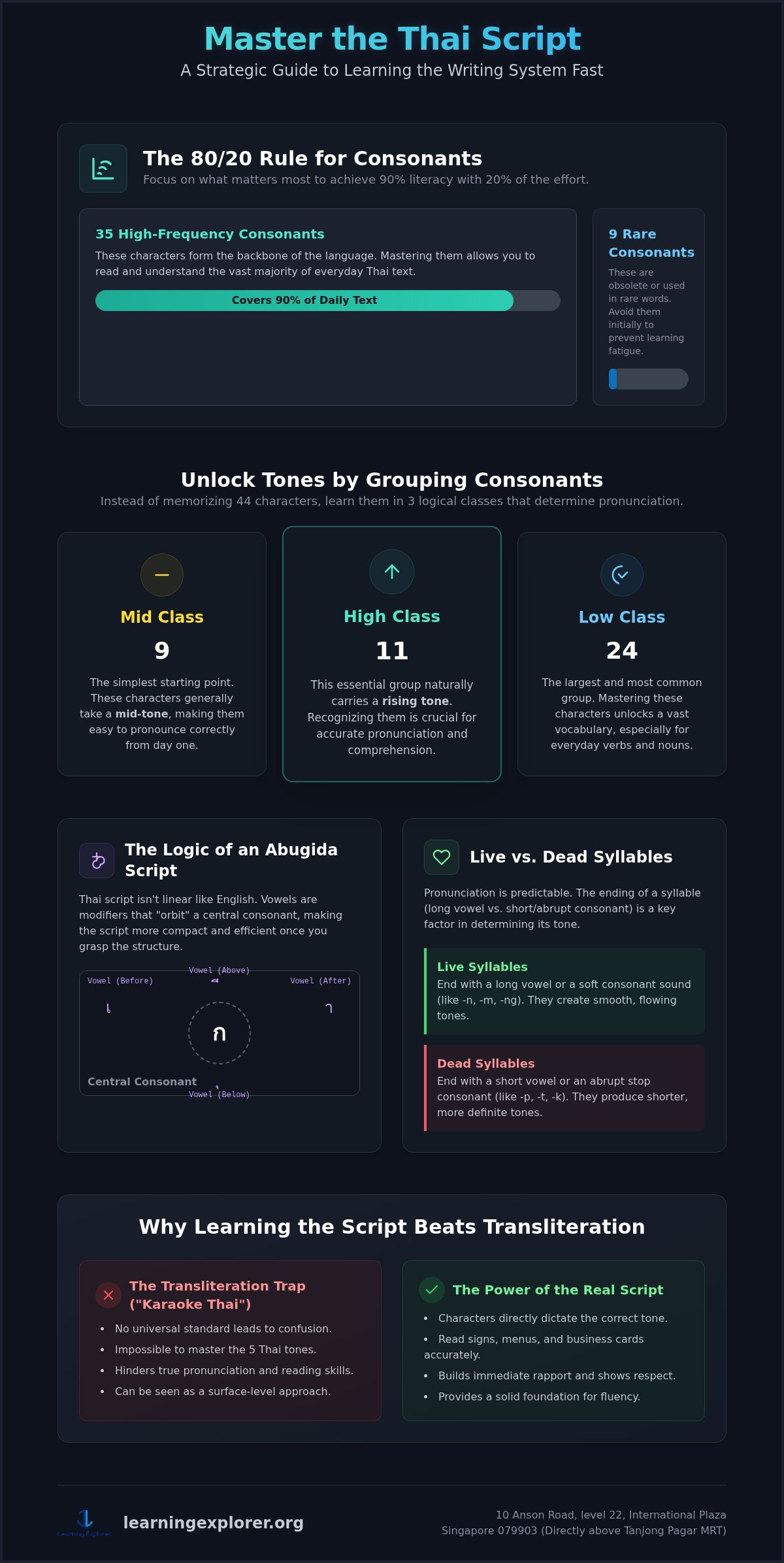
In a standard alphabet, every sound gets its own dedicated slot. In Thai, every consonant comes with an “inherent vowel” (usually an ‘o’ or ‘a’ sound) unless another vowel mark is present. Think of it like musical notation. The consonant is the primary note on the staff, while the vowels are like sharps or flats placed above, below, or even before the note to change its pitch or quality. This multi-dimensional layout actually makes the language more compact and efficient once you stop trying to read it in a straight line.
Why Learning the Script Beats Transliteration
Relying on “Karaoke Thai” or Romanized transliteration is a trap that many beginners fall into. Because there’s no universal standard for how Thai sounds should be written in English, you’ll find three different spellings for the same street name. Learning the actual script is the only way to master the five Thai tones, as the characters themselves dictate the pitch. Beyond the technical benefits, showing up to a meeting able to read a business card or a menu builds immediate rapport. It signals that you’ve invested in understanding the culture’s logic, not just its surface-level sounds. Mastering these basics is essential for anyone serious about how to learn the thai writing system fast to achieve professional fluency.
The 80/20 Roadmap: Grouping Consonants and Vowels for Speed
Most beginners fail because they treat every character with equal importance. To understand how to learn the thai writing system fast, you must apply the Pareto Principle: focus on the 35 high-frequency consonants that appear in 90% of everyday text. The remaining nine are rare or obsolete; don’t let them clutter your progress in the first week. Understanding the Thai alphabet writing system also requires recognizing “paired” consonants. For example, the unaspirated “p” (like “spin”) and the aspirated “ph” (like “pool”) are distinct letters that change the meaning of a word entirely.
Mastering the Three Consonant Classes
Instead of memorizing a random list, group consonants by their “Class” immediately. This is the secret to mastering tones without the usual frustration. Categorizing them early ensures you aren’t just learning a shape, but also how that shape behaves in a sentence. If you find this logic tricky to grasp alone, our conversational Thai course provides the expert guidance needed to bridge these gaps.
- Mid Class: These nine letters are the easiest starting point because they usually take a mid-tone.
- High Class: This group of eleven letters naturally carries a rising tone.
- Low Class: The largest and most diverse category with 24 letters, essential for common verbs.
Vowel Placement and High-Frequency Marks
Thai vowels are more dynamic than English ones. While there are 32 vowel sounds, you only need 12 to navigate street signs and menus effectively. Start by identifying “leading vowels” that sit before the consonant, even though they’re pronounced after it. You should also distinguish between long and short vowels, as vowel length is a primary factor in determining the syllable’s tone. Vowels frequently change their visual shape or disappear entirely when followed by a final consonant. Mastering these high-frequency marks allows you to decode words as units rather than individual letters.
Our training center at 10 Anson Road, level 22, International Plaza, Singapore 079903, right above Tanjong Pagar MRT, specializes in these high-impact strategies. We help you move past the “alphabet song” and into real-world literacy. This targeted approach is the fastest way to turn those initial squiggles into meaningful information for your professional life.
Cracking the Thai Tone Rules and Reading Framework
Tones are often cited as the biggest hurdle for language learners. However, the Thai writing system provides a consistent mathematical formula to determine the correct pitch every time. You don’t have to guess the inflection of a word if you can read the script. By understanding how consonant class, vowel length, and the syllable’s ending sound interact, you unlock the ability to speak with precision. This logic is a core component of any comprehensive guide to the Thai script and serves as the foundation for professional communication.
Mastering this framework is essential for anyone researching how to learn the thai writing system fast. Instead of relying on your ear alone, you rely on a visual system that never changes. This clarity is especially useful when reviewing Thai for Singapore Business Travelers, where mispronouncing a client’s name or a company title could lead to awkward social friction.
Live vs. Dead Syllables Simplified
The secret key to reading Thai is distinguishing between “Live” and “Dead” syllables. Think of a Live syllable as one that can be hummed or held indefinitely. These syllables end in a long vowel or a sonorant sound like “m,” “n,” or “ng.” Because the sound continues, the tone rules are generally more flexible.
Conversely, a Dead syllable is a “stop” sound. These end in a short vowel or an abrupt consonant like “p,” “t,” or “k.” The sound is cut short, which forces the tone into a specific register. Categorizing every word you see into one of these two buckets immediately narrows down your tone options. It turns a complex linguistic problem into a simple binary choice.
Visualizing the Tone Matrix
To accelerate your progress, visualize a mental grid that maps the three consonant classes against the two syllable types. While there are five possible tones, most combinations only allow for two or three. For example, a Mid Class consonant in a Live syllable defaults to a mid tone. It’s predictable and reliable.
Tone marks act as overrides. When a mark appears above a consonant, it tells you to ignore the default rule and shift to a specific pitch. While there are four marks, you’ll primarily encounter the first two in daily business correspondence. At our training center located directly above Tanjong Pagar MRT, we teach students to ignore rare exceptions in the first month. Focusing on the high-frequency rules is how to learn the thai writing system fast without burning out on technicalities that rarely appear in the real world.
Actionable Drills to Speed Up Your Thai Literacy
Passive reading only gets you so far. To understand how to learn the thai writing system fast, you must engage your muscle memory through active recall. While digital apps offer convenience, the physical act of writing characters creates stronger neural pathways. Start by transcribing your own name or common business titles into Thai script. This simple exercise forces you to grapple with vowel placement and consonant classes in a personal, memorable context. It’s the difference between recognizing a shape and owning the language.
Mnemonics and Visual Association
Visual association is your best ally when characters look like abstract art. Take “Kor Kai,” the first letter of the alphabet. Its shape mimics the beak and head of a chicken, making the “k” sound easy to remember. Use the “Head-Loop” rule to navigate the dozens of similar characters. Most Thai letters begin with a small circle or “head.” Identifying whether this loop faces inward, outward, or sits at the top or bottom is the key to distinguishing between lookalikes. In Thai script, the letter “n” (No Nu) has its loop at the end of the stroke, while the letter “m” (Mo Ma) features an additional loop at the front.
Immersion in Singapore
Singapore offers a unique advantage for learners: localized immersion. Spend an afternoon at Golden Mile Tower or visit authentic Thai eateries in the city to practice reading real-world “Thai-glish” signs. These signs often use English loanwords written in Thai script. They provide a perfect bridge for your brain to recognize sounds without needing a dictionary. Reading a menu or a product label in the wild builds the confidence you need for high-stakes environments. For those preparing for a trip to Bangkok, pairing your reading drills with our guide on Essential Thai Business Etiquette ensures you arrive both literate and culturally savvy.
Consistency is the catalyst for discovery. If you find yourself stuck on a specific character or tone rule, professional feedback can save you hours of frustration. Join our conversational Thai course and work with native speakers who can refine your technique. Our instructors act as your personal guide, helping you turn these drills into a permanent skill set that enhances your professional impact.
Why Professional Guidance in Singapore Accelerates Mastery
While self-study apps like Ling or ThaiPod101 provide a useful starting point, they often leave learners stranded when it’s time to grasp the nuances of script logic. Attempting to decode 44 consonants and 32 vowels alone usually leads to plateau fatigue. You might recognize a character but fail to understand why its tone shifts in a specific syllable. This is where professional guidance becomes the catalyst for your success. Real-time feedback on your stroke order and pronunciation ensures you don’t bake in bad habits that are difficult to correct later. If you’re looking for how to learn the thai writing system fast, having a native speaker explain the “why” behind the “what” is the most efficient path forward.
Bilingual instructors bridge the gap between English and Thai logic in ways an algorithm simply can’t. They understand the specific struggles of English-speaking professionals, such as the confusion over aspirated vs. unaspirated sounds. By providing a structured framework rather than fragmented YouTube clips, a dedicated course transforms the learning process from a chore into a mission-driven achievement. It reduces the administrative burden of seeking out quality resources and allows you to focus on the satisfaction of discovery.
Structured Learning at Learning Explorer
We’ve designed our conversational Thai course to respect the limited time of busy professionals. Our small group sizes allow for interactive drills that simulate real-world business scenarios. You aren’t just memorizing an alphabet; you’re learning to read menus, business cards, and correspondence that you’ll encounter in daily life. Our training center is conveniently located in the heart of the CBD, situated directly above Tanjong Pagar MRT. This makes it easy to transition from your office to the classroom for a high-impact session before heading home. We focus on high-frequency language patterns that provide the quickest results for adult learners.
The ROI of Language Proficiency
Literacy is a powerful tool for regional business expansion. When you can read Thai script, you reduce the administrative friction of navigating a new market. You build a deeper level of rapport with colleagues and clients that transliteration can’t match. It shows a level of respect and commitment that opens doors to new opportunities. For those looking at broader trends, understanding Useful Languages for Business in SE Asia reveals that Thai remains a critical pillar for trade and investment in 2026. Investing in this skill now creates a long-term professional advantage that distinguishes you as a visionary leader in the Southeast Asian landscape.
Unlock Your Potential in the Thai Market
Mastering the Thai script is a transformative step for any professional working in Southeast Asia. By applying the 80/20 rule to high-frequency consonants and understanding the mathematical logic of tone rules, you turn a complex visual challenge into a manageable, professional asset. Literacy isn’t just about reading street signs; it’s about building genuine rapport and reducing administrative friction in your daily business operations. Discovering how to learn the thai writing system fast is ultimately about choosing a smart strategy over brute-force memorization.
Our native-speaker instructors provide the interactive drills and immediate feedback that self-study apps simply can’t offer. We’ve designed our curriculum specifically for working adults, ensuring every lesson translates to real-world efficiency. Master the Thai script with our expert-led Conversational Thai Course in Singapore. Your journey from seeing confusing squiggles to understanding meaningful language starts with a single character. Take that step today and watch your professional impact grow with newfound confidence and clarity.
Frequently Asked Questions
How long does it take to learn the Thai writing system?
Most learners grasp the fundamental logic of the Thai script within two to four weeks of consistent study. While full mastery of all 76 characters takes longer, focusing on high-frequency consonants allows for quick progress. If you’re looking for how to learn the thai writing system fast, dedicating thirty minutes a day to active recall exercises is the most effective timeframe for busy professionals.
Is it better to learn to speak or read Thai first?
We recommend learning to read and speak simultaneously. While many beginners start with basic phrases, the Thai script provides the visual cues necessary for correct pronunciation and tones. Relying solely on Romanized transliteration often leads to persistent errors. By learning the script early, you build a solid phonetic foundation that makes your spoken Thai sound more natural and professional to native speakers.
Do I need to learn all 44 Thai consonants?
You don’t need to memorize all 44 consonants immediately. Several characters are obsolete or extremely rare in modern business correspondence. By prioritizing the 35 most common consonants, you can decode roughly 90% of daily text. This strategic focus is a core part of how to learn the thai writing system fast without feeling overwhelmed by the sheer volume of the traditional alphabet.
Why does Thai have no spaces between words?
Thai script uses spaces to indicate the end of a sentence or a distinct clause rather than individual words. This structure stems from the language’s historical roots as a script designed for concise expression. Once you understand the rules for syllable endings and vowel clusters, your brain begins to recognize natural word breaks. It’s similar to how we recognize words in a URL without needing spaces.
What is the fastest way to memorize Thai tone rules?
The most efficient method involves grouping consonants into their three classes: Mid, High, and Low. Instead of memorizing individual words, you apply a logical formula based on the consonant class and the syllable type. Categorizing syllables as Live or Dead provides a mathematical certainty to your pronunciation. This visual framework removes the guesswork and allows you to predict the correct tone of unfamiliar words with high accuracy.
Can I learn the Thai script using only an app?
Apps are excellent tools for repetitive drills and basic character recognition. However, they often lack the nuance required to explain complex tone interactions and stroke order. For professionals who require accuracy, a structured curriculum provides the necessary context that a digital platform can’t. Human instructors can correct subtle pronunciation errors and explain the logic behind the script in a way that feels personal and mission-driven.
Where can I find Thai language courses in Singapore?
Learning Explorer offers professional Thai language courses at our center in International Plaza, located right above Tanjong Pagar MRT. We provide conversational Thai courses tailored for working adults and corporate teams in the Singapore CBD. Our lessons are led by native speakers who use interactive methods to ensure you gain practical skills quickly, making it the ideal choice for those working in the city.
Is the Thai writing system similar to any other languages?
The Thai writing system shares significant historical roots with the Lao script, making the two languages somewhat mutually intelligible in written form. Both scripts evolved from the Old Khmer alphabet and are influenced by ancient Sanskrit and Pali structures. While the characters look different, the underlying logic of an abugida script is a common feature across many Southeast Asian languages, providing a helpful starting point for regional learners.