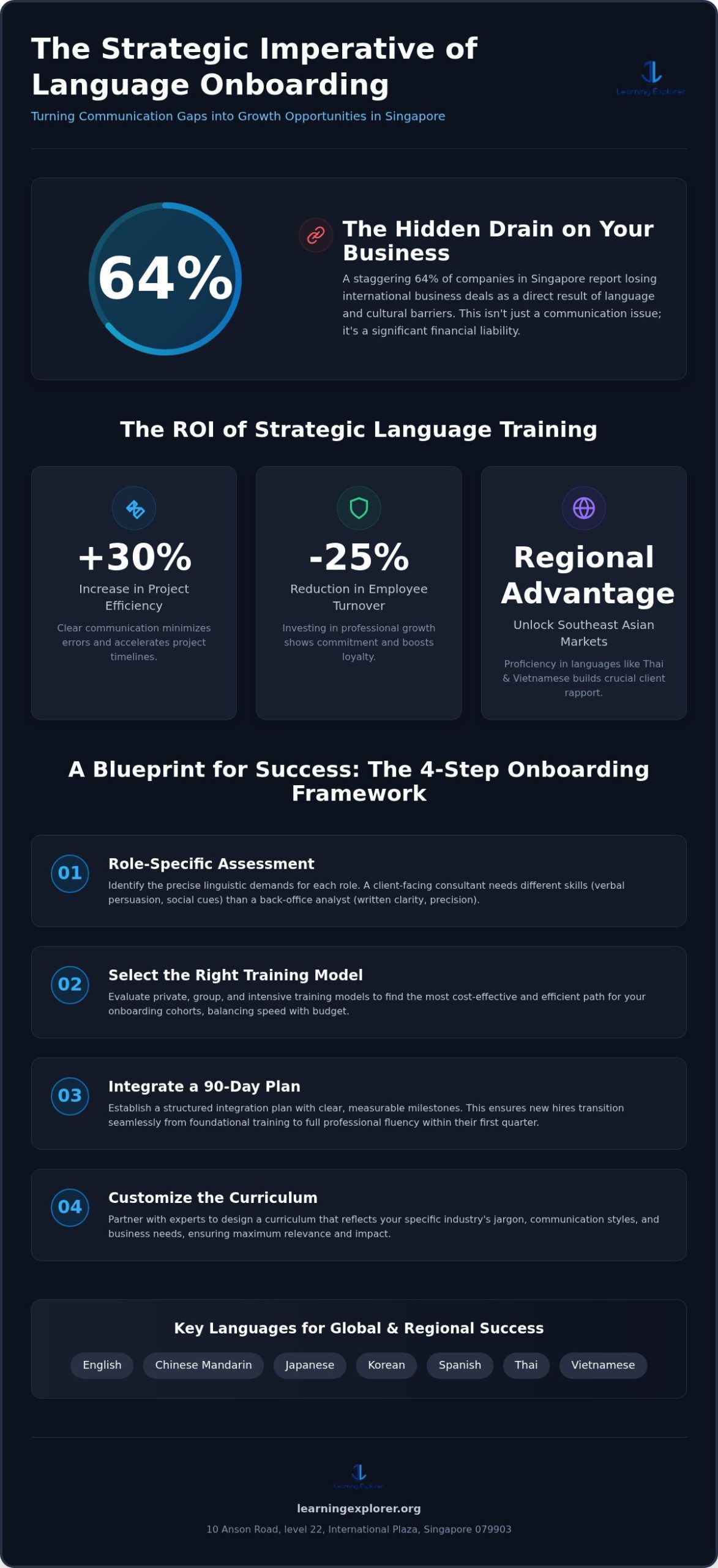
Did you know that 64% of companies in Singapore lose international business deals simply because of language and cultural barriers? It’s a staggering figure that highlights a critical gap in the onboarding process. When you bring in global talent, you expect immediate results, yet miscommunication often stalls progress before it even begins. This is why implementing structured corporate language training for new hires Singapore is no longer a luxury but a strategic necessity for 2026. Our training center at 10 Anson Road, level 22, International Plaza, Singapore 079903, sits right above Tanjong Pagar MRT, making it a convenient hub for your team’s development during those first crucial weeks.
You likely feel the pressure of justifying training budgets while watching your teams struggle with the subtle nuances of local professional English. It’s frustrating to see high-potential talent held back by communication friction. We understand the daily challenges HR practitioners face and want to help you turn that administrative burden into a source of engagement. This guide promises to provide a comprehensive framework for assessing and upskilling your team effectively. We’ll walk you through a step-by-step checklist to standardize your language onboarding, ensuring every new hire is client-ready and confident from their very first day.
Key Takeaways
- Learn how early language alignment reduces miscommunication costs and strengthens team cohesion in Singapore’s competitive business environment.
- Use a role-specific assessment checklist to implement corporate language training for new hires singapore that meets global linguistic standards.
- Evaluate the speed and cost-effectiveness of private versus group training models to select the most efficient path for your onboarding cohorts.
- Establish a structured 90-day integration plan with clear milestones to ensure new hires move from training to professional fluency seamlessly.
- Partner with expert guides to design customized curricula that reflect your specific industry needs and improve overall talent retention.
The Strategic Role of Corporate Language Training for New Hires in Singapore
Effective communication is the heartbeat of Singapore’s business hub. In the high-stakes environments of the CBD’s finance and tech sectors, a single misunderstood email or a botched client presentation can stall a deal. The Strategic Role of Corporate Language Training extends far beyond simple vocabulary; it’s about ensuring every team member speaks the same professional language. When you invest in corporate language training for new hires singapore, you aren’t just teaching grammar. You’re building a foundation for team cohesion that allows diverse global talent to collaborate without friction. Miscommunication isn’t just awkward; it’s expensive. In fact, 64% of companies acknowledge losing international business specifically due to language and cultural barriers.
We’ve seen a significant shift in 2026. Companies no longer settle for “general fluency.” They demand professional competence. This means new hires must master the specific jargon and social cues unique to their industry. Beyond performance, offering these development opportunities acts as a powerful retention tool. Research indicates that companies investing in high-quality training can see a reduction in employee turnover by as much as 25%. It shows your new talent that you’re committed to their long-term growth. Providing this support at our center at 10 Anson Road, level 22, International Plaza, Singapore 079903, ensures your team has the tools they need to thrive right from the start.
To better understand how these trends are shaping the modern workplace, watch this helpful video:
Bridging the Gap Between Resume Claims and Reality
A “fluent” label on a CV is often subjective and can lead to surprises during the first week of employment. Boardroom expectations in Singapore are precise; they require clarity, brevity, and cultural awareness. Objective benchmarking during the onboarding phase helps you identify exactly where a new hire stands. By setting clear communication KPIs for the probation period, you replace guesswork with data. This approach reduces the administrative burden on managers and sets the stage for a successful, long-term placement. It’s about moving from the labor of seeking the right skills to the satisfaction of discovering them in your own team.
The Impact of Local Context on New Hire Success
Success in Singapore requires more than just standard English. It requires an understanding of local business etiquette and the ability to navigate regional relationships. For firms managing Southeast Asian accounts, having new hires who can speak Thai or Vietnamese provides a massive competitive edge. These regional skills are vital for sectors like manufacturing and technology where precision is key. When you align these skills with your business goals, you begin calculating ROI on corporate language programs singapore through improved project efficiency and higher client rapport. Businesses that address these communication challenges report a 30% increase in project efficiency.
Language Proficiency Assessment for Job Candidates: A Step-by-Step Checklist
Hiring managers often struggle to quantify actual communication ability during a standard interview. A structured approach to assessment ensures your investment in corporate language training for new hires singapore delivers a clear return. Start by identifying the specific linguistic demands of the role. A back-office analyst might prioritize written clarity, while a client-facing consultant requires high-level verbal persuasion and the ability to read social cues. Once you’ve defined these needs, align them with global standards like the CEFR levels. This provides a universal language for proficiency that removes bias from the hiring process.
A truly effective checklist must go beyond simple grammar checks. It should include a multi-modal evaluation covering speaking, listening, and writing. Listening is frequently overlooked, yet it’s the foundation of effective teamwork. Additionally, evaluate cultural competency. A candidate might be linguistically accurate but culturally tone-deaf; assessing their understanding of local business etiquette is crucial. By establishing this baseline during the hiring phase, you create a roadmap for future growth that can be tracked and measured against company KPIs.
Phase 1: Pre-Hire Screening and Benchmarking
Screening should begin well before the first day on the job. Use short, targeted verbal tests during the final interview round to see how a candidate handles spontaneous questions. This reveals their true comfort level better than a prepared presentation. You should also identify red flags in their written business communication early. Determining whether a candidate needs remedial support or just advanced refinement helps you prioritize your resources. This is the ideal time to evaluate different training models to determine which path best suits your specific talent pipeline and regional goals.
Phase 2: Post-Hire Deep Dive Assessment
The first 48 hours of employment offer a golden window for a detailed diagnostic assessment. This deep dive moves beyond general skills to match a new hire’s abilities with specific daily tasks like leading project meetings or drafting executive summaries. By matching assessment results to these high-stakes activities, you can create a personalized development plan for the onboarding phase. This turns the daunting task of integration into a structured journey toward professional excellence. If you want to see how tailored programs can transform your team, consider partnering with a knowledgeable guide to design your curriculum.
Comparing Training Models: Private, Group, or Intensive?
Selecting the right delivery model is as critical as the curriculum itself. When you organize corporate language training for new hires singapore, you must balance the urgency of the role with the available budget. Intensive formats offer rapid progress, while part-time sessions provide steady growth without overwhelming the employee’s schedule. Small cohorts often benefit from the personalized attention of private coaching. Larger groups thrive on interactive peer learning. Our central location at International Plaza helps minimize travel time. This ensures that training fits seamlessly into a busy workday, reducing the downtime that often accompanies off-site learning.
The choice between these models often depends on the seniority of the talent and the specific business goals. For example, C-suite executives often require a high degree of discretion and highly tailored content that only one-on-one coaching can provide. On the other hand, junior teams might find more value in a collaborative setting where they can practice with colleagues. By matching the training format to the specific needs of your workforce, you create a more efficient onboarding experience that respects everyone’s time.
Intensive Onboarding Programs for Immediate Impact
A 2-week intensive ‘bootcamp’ can save months of slow integration. For relocated expats or regional managers, this immersion is vital. It allows them to absorb high-priority languages like Business Mandarin or Japanese quickly. Instead of struggling with basic phrases for half a year, they gain the confidence to lead meetings within their first month. This model works best when immediate impact is the priority. It transforms the daunting task of relocation into an empowering experience. Your team moves from the labor of seeking basic understanding to the satisfaction of professional discovery in record time.
Continuous Support: Group and Private Formats
Group classes offer unique social benefits for new hire cohorts. They build camaraderie and allow employees to practice together in a safe environment. This peer support is often the creative catalyst for better team outcomes. However, for niche industries like Law or Finance, private lessons are often superior. They allow for a deep dive into specialized terminology that general courses might miss. If your team includes regional roles requiring specific European languages, you might look for Spanish tutors for adults near me in Singapore to bridge those cross-continental communication gaps. Providing effective corporate language training for new hires singapore often requires this mix of formats to ensure that your high-level talent remains engaged and effective in their specific market.
Integrating Language Development into the First 90 Days
Onboarding doesn’t end after the first week. To maximize the impact of corporate language training for new hires singapore, you need a roadmap that spans the first 90 days. Think of this period as a transition from learning to performing. By setting specific milestones, you give your new talent a clear target and a sense of accomplishment. At the 30-day mark, focus on internal cohesion; the hire should understand company-specific jargon and feel comfortable in team huddles. By day 60, they should be contributing to meetings and drafting client emails with minimal oversight. Finally, by day 90, aim for the ability to lead specific project segments or handle client interactions independently.
Encourage ‘on-the-job’ practice by pairing new hires with a language mentor during meetings. This allows them to observe professional nuances in real-time. Complement these sessions with digital-first resources for self-study, ensuring they can refine their skills during quiet moments in the day. To ensure the training is hitting the mark, conduct a follow-up language proficiency assessment for job candidates at the end of the quarter. This data-driven approach allows you to measure progress accurately and adjust the development plan for the next phase of their career.
Building a Supportive Learning Culture
Growth happens best in an environment where people feel safe. Encourage your local teams to support new hires as they navigate these linguistic challenges. Reducing the ‘fear of making mistakes’ is essential for rapid improvement. When a workplace celebrates effort rather than demanding perfection, engagement levels skyrocket. If you’re struggling to get management on board, see our guide on building a business case for corporate language training for tips on securing stakeholder buy-in. It’s about showing that better communication leads directly to better business outcomes.
Logistics and Accessibility in the CBD
Productivity is a priority for every Singapore professional. Our center’s location right above Tanjong Pagar MRT at International Plaza makes it incredibly easy for your team to attend sessions without disrupting their workflow. Scheduling lessons during lunch hours or immediately after work respects their personal time while keeping development on track. We use modern, interactive materials that fit the fast-paced nature of the CBD. This convenience reduces the administrative burden on your HR team and ensures higher attendance rates. Ready to transform your onboarding process? Explore our corporate training solutions and see how we can support your team’s growth.
Partnering with Learning Explorer for Seamless New Hire Integration
Choosing the right partner for your 2026 onboarding strategy involves more than just selecting a language school; it requires a visionary ally that understands the high-pressure environment of Singapore’s corporate world. Learning Explorer acts as your knowledgeable guide, transforming the administrative burden of staff development into a creative catalyst for team engagement. Our approach to corporate language training for new hires singapore focuses on customized curriculum design that precisely mirrors your specific industry needs. We don’t believe in generic, one-size-fits-all solutions. Instead, we align our modules with your business goals, whether you require a Business English Course to sharpen executive communication or a Business Mandarin Course for regional expansion.
Our certified native-speaker instructors are bilingual and deeply familiar with the local corporate ethos. They bridge the gap between linguistic theory and workplace reality, utilizing high-quality materials from Oxford University Press and Hanban to ensure every lesson is relevant. We have a proven track record of transforming hesitant new hires into high-performing assets who build immediate rapport with international clients. By providing flexible training locations, we ensure your team’s development never stalls. We can conduct sessions directly at your office for maximum team integration or at our professional CBD centre, allowing you to choose the format that best fits your company culture and workflow.
Our CBD Training Centre: Professional and Convenient
Our facility is designed specifically for the needs of adult professional learners, providing a state-of-the-art environment that inspires focus and creativity. We understand that in the fast-paced CBD, time is your most valuable resource. Efficiency is at the core of our location choice; our centre is situated at International Plaza, directly above Tanjong Pagar MRT. This makes it incredibly easy for new hires to attend sessions during their first few weeks without the stress of a long commute or complex logistics. It is a supportive, user-centric space where your talent can transition from the labor of seeking skills to the satisfaction of professional discovery.
Next Steps for Your Onboarding Strategy
Building a linguistically aligned workforce starts with a clear, actionable plan. We invite you to take the next step in securing your team’s success in the competitive 2026 market. You can book a consultation with our experts to design a bespoke training roadmap that aligns with your specific hiring targets and timelines. We also offer a sample language proficiency assessment for job candidates, allowing you to see firsthand how our benchmarking system provides the clarity you need for better hiring decisions. Don’t let communication gaps hold your global talent back; start your journey toward higher retention and improved project efficiency today by partnering with a team that values your results as much as you do.
Empowering Your Global Talent for 2026
Success in Singapore’s fast-paced business landscape requires more than just technical skill; it demands the ability to communicate with precision and cultural awareness. By shifting from subjective fluency claims to objective benchmarking, you ensure your new hires are ready to contribute from day one. Integrating these milestones into the first 90 days of employment turns the onboarding process into a high-engagement journey that boosts both performance and long-term retention. Investing in structured corporate language training for new hires singapore is the most effective way to eliminate miscommunication risks and build a cohesive, high-performing team.
We’re here to act as your knowledgeable guide through this transition. With certified native-speaker instructors and bespoke corporate training solutions, we help you reduce administrative burdens while maximizing professional impact. We’re conveniently located at International Plaza, Tanjong Pagar, making it easy for your team to access world-class education right in the heart of the CBD. Ready to transform your onboarding strategy? Design Your New Hire Language Training Roadmap Today and watch your global talent thrive. It’s time to move from the stress of seeking skills to the satisfaction of seeing your team excel.
Frequently Asked Questions
How do I choose between Business English and Conversational English for new hires?
Choose Business English when your priority is professional tasks like leading meetings or drafting reports. Conversational English is better for social integration and daily survival. Most firms opt for a Business English Course to ensure hires are client-ready. Implementing corporate language training for new hires singapore helps bridge the gap between general fluency and the professional competence required in Singapore’s fast-paced business environment.
What is the typical duration of an intensive language onboarding program?
An intensive language onboarding program typically lasts two weeks. This “bootcamp” format provides a concentrated burst of learning that can save months of slower, part-time progress. It’s particularly effective for relocated expats or regional managers who need to become functional in a new language quickly. This model ensures that new talent can contribute meaningfully to projects and team discussions within their first month of employment.
Can we customise the training for specific industries like Fintech or Legal?
We certainly do. Our instructors design customized curricula that reflect the specific jargon and social cues of industries like Fintech, Legal, or Finance. This ensures that our language programs are directly applicable to their daily tasks. By tailoring the content, we reduce the time spent on irrelevant topics and focus on the high-stakes communication skills your team needs most during their first 90 days.
How do you measure the progress of employees during the 90-day onboarding?
We measure progress by setting clear milestones at the 30, 60, and 90-day marks. This includes conducting a follow-up assessment to compare current skills against the initial baseline. We also look at practical outcomes, such as their ability to lead a meeting or handle client inquiries independently. This structured tracking ensures that the corporate language training for new hires singapore is delivering tangible improvements in communication efficiency.
Is it better to have training at our office or at your CBD centre?
Both options have unique benefits. Training at our CBD centre provides a dedicated, professional learning environment right above Tanjong Pagar MRT. It’s perfect for individual coaching or small groups who want to step away from office distractions. However, if you have a larger cohort of new hires, having our instructors come to your office can minimize travel time and keep your team focused on their primary work tasks.
How many languages does Learning Explorer offer for corporate clients?
Learning Explorer currently offers corporate training in seven major languages. These include English, Chinese Mandarin, Japanese, Korean, Spanish, Thai, and Vietnamese. This broad range allows you to support diverse regional teams and global clients from a single, reliable partner. Whether your team needs a Business Mandarin Course or conversational skills in Thai, we provide the expert guidance needed to ensure successful cross-border communication.
Why is a language proficiency assessment for job candidates necessary if they have a degree?
A degree proves academic ability but it doesn’t always guarantee professional communication skills in a specific business context. A language proficiency assessment for job candidates identifies exactly how well a hire can perform under pressure during meetings or negotiations. It provides an objective benchmark that removes guesswork, ensuring you know exactly where a new hire stands and what support they need to become client-ready.
Do you provide training for regional languages like Thai and Vietnamese?
Yes, we offer both Conversational Thai Course and Conversational Vietnamese Course options for our corporate clients. As Singapore serves as a gateway to Southeast Asia, these regional language skills are increasingly vital for sectors like manufacturing and technology. Our certified native-speaker instructors focus on practical, application-based learning that empowers your new hires to communicate effectively across borders and build stronger relationships with regional partners.