The course with the broadest business label may not be the one that helps you speak up in your next meeting. If you find it hard to share ideas clearly, respond with confidence, or keep up in workplace conversations, choosing a business english speaking course singapore starts with identifying the situations you want to handle better.
It’s understandable to wonder whether you need business-focused training or should first strengthen your general English. You also need to know whether the teaching approach and class format fit your ability, goals, and routine. The right choice should connect learning to the communication challenges you actually face, not just sound relevant on a course page.
This guide will help you assess your workplace communication needs, compare course options, and decide what to ask before making an enquiry. You’ll learn how to evaluate practical relevance and teaching approach, and consider Learning Explorer’s private, group, and intensive formats. By the end, you’ll have a clearer way to find training that suits your level and supports more confident communication at work.
Key Takeaways
- Start with the workplace conversations you want to handle more confidently, from team discussions to client conversations.
- Look for speaking practice linked to your goals, with guidance and opportunities to apply feedback.
- Choose between Business English and general English based on your current ability and intended use, not the course title alone.
- Use a checklist to compare a business english speaking course singapore, and confirm levels, schedules, class arrangements, and lesson content with each provider.
- Explore Learning Explorer’s Business English Course and compare its private, group, and intensive formats with your learning needs.
Goals of a Business English Speaking Course in Singapore
Business English speaking isn’t a separate language. It’s the use of English to communicate effectively at work, where the purpose, audience, and setting influence how you express an idea. Business English is a specialism within English learning, used in professional contexts that can include international communication.
Your goals depend on the conversations you face. You may want to contribute in meetings, explain an idea to a colleague, present information, respond to an interview question, or speak with a client. A business english speaking course singapore professionals consider should relate to these real communication needs, rather than relying on a business-focused label alone.
For a quick example of workplace conversation, watch this video:
What should a speaking-focused course address? Practice expressing ideas clearly, choosing an appropriate tone, responding to others, and adapting your speech to workplace situations that matter to you.
Which workplace speaking situations matter most?
Start by listing the conversations that recur in your role or feel especially important. Think about where you hesitate, lose your train of thought, or struggle to make your point understood. For example, is it difficult to enter a fast-moving team discussion, explain a proposal to a colleague, or answer a client’s follow-up question?
These are prompts for setting your own learning goals, not a promise that a particular course covers each task. Naming the situations helps you ask providers whether their teaching approach can support the communication you want to practise. Make your goals specific, such as “explain my recommendation clearly” or “respond to questions in a meeting,” so you can compare each provider’s answers against the same needs.
Business English and everyday English: what changes at work?
The core language is still English. At work, clarity, tone, and context matter because you’re communicating with a purpose, whether that’s sharing an update, asking for clarification, or discussing an idea with a colleague. Professional speech doesn’t need to sound stiff or unusually formal. It should be clear, respectful, and suited to the people and situation.
Workplace speaking practice is guided English conversation focused on communicating clearly and appropriately in situations you encounter at work. This differs from broader English study, which may focus on grammar, writing, or everyday conversation. If your main challenge is speaking, check that speaking practice is central to the course. If you need wider language support, ask whether the course scope fits those goals too.
What Effective Business English Speaking Practice Looks Like
A course can cover workplace topics without giving you much opportunity to speak. To judge its practical value, look beyond lesson titles and ask how activities connect to your communication goals. Useful practice gives you a chance to try a task, receive guidance, and apply what you’ve learned, rather than only listening to information about business.
For anyone comparing a business english speaking course singapore providers offer, the key question is simple: will you actively practise speaking, and understand how to make your message clearer?
How to assess speaking activities and feedback
Ask what a typical lesson involves and how much time learners spend speaking. Find out whether activities can relate to situations you want to handle, such as explaining a recommendation or responding to a colleague’s question. These are examples to discuss with a provider, not assumptions about a particular course’s content.
Also ask how instructors help learners communicate more clearly. Feedback might help you notice whether your main point is easy to follow or whether your tone suits the situation. Check whether learners get a chance to try again after receiving guidance. Don’t assume a specific teaching method; ask each provider to explain its approach.
- Speaking time: How often do learners speak during a lesson?
- Practical relevance: Can activities connect with your communication goals?
- Guidance: How do instructors help learners improve clarity and delivery?
- Repeat practice: Is there an opportunity to apply feedback in another attempt?
A course that mainly presents business information may build topic knowledge, but that alone doesn’t show how much speaking practice it includes. Ask for a clear explanation of what learners do, what they speak about, and what they receive feedback on.
Why natural, clear English matters more than formal-sounding phrases
Professional communication doesn’t require complicated vocabulary or stiff expressions. A clear sentence such as “I recommend starting with the first option because it’s simpler to implement” can sound more natural and useful than an elaborate phrase that hides the point. The right tone depends on your audience and purpose: you may need to be concise in a quick update, or more measured when raising a concern.
Effective workplace speaking practice helps you express your point clearly, choose an appropriate tone, and respond naturally to others.
Use these questions to compare course approaches, then explore Learning Explorer’s language courses as you consider which learning option may suit your goals.
Business English Course or General English: Which Fits Your Needs?
The right choice depends on what you need English for and where you are now, not just the course title. A business-focused course isn’t automatically too formal, and it isn’t the best starting point for every learner. Compare the purpose of the learning, the speaking practice offered, and whether you’re comfortable with the level the course expects.
| What to compare | Business English | General English |
|---|---|---|
| Main focus | Communication in workplace situations and tasks | Everyday communication across a wider range of situations |
| Goals | Expressing ideas, exchanging information, or responding appropriately at work | Building confidence and ability in general conversation |
| Speaking practice | May connect practice to work-related communication goals; check the actual course content | May focus on broader conversational situations; ask how speaking is practised |
| Readiness | Consider whether you can follow and participate in the course’s activities | May suit learners seeking wider support before focusing on work contexts |
When a workplace-focused English course may be a good fit
A business focus may suit you if you already use English and want to feel more prepared for recurring work conversations. Perhaps you want to explain a recommendation, contribute to a team discussion, or speak with clients more clearly. Before enrolling, compare those goals with the provider’s stated aims and ask whether the course content relates to the situations you want to handle. Don’t assume every business course covers the same tasks.
When broader English practice may be a better starting point
If you want to strengthen everyday conversation or build wider language confidence before narrowing your focus, general English may be a comfortable place to begin. That isn’t a judgment about your ability. Tell the provider what feels easy or difficult now, what you want to do with English, and which course goals fit. Learning Explorer offers both a Business English Course and a Conversational English Course, so you can compare the focus that best matches your needs.
As you assess a business english speaking course singapore option, ask about its expected starting ability and the kinds of speaking activities included. For a broader framework on comparing learning options, read this English course guide for adults in Singapore.
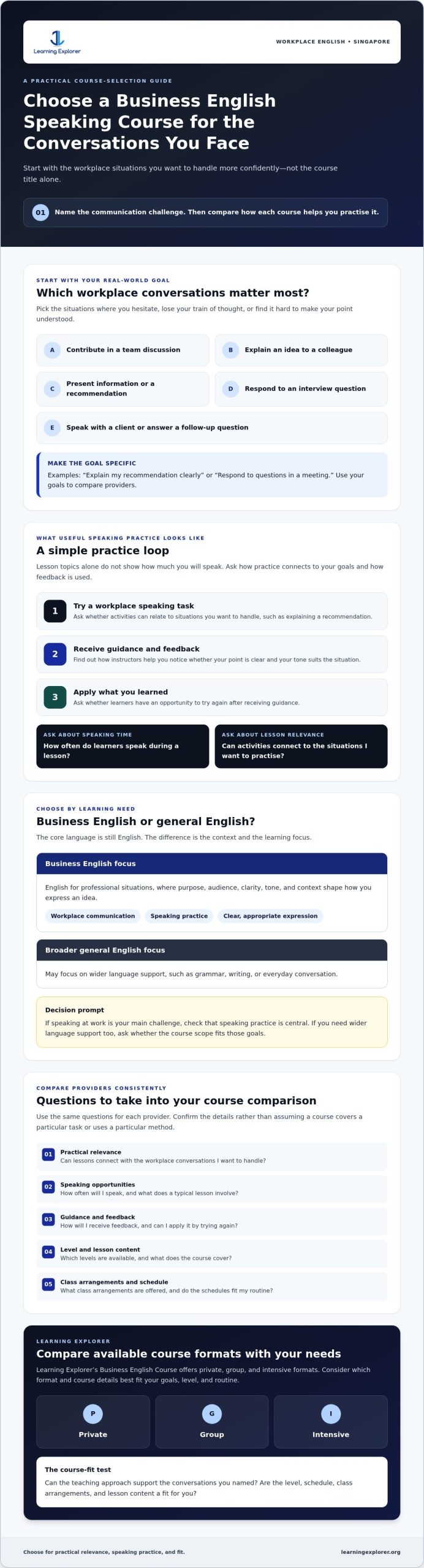
How to Compare Business English Speaking Courses in Singapore
A clear comparison starts with your needs, then checks whether each provider’s course, teaching approach, format, and location fit. Use this checklist to compare a business english speaking course singapore option without relying on the course label alone.
- 1. Define your goals. Note the workplace conversations you want to manage more confidently, such as sharing an update, explaining an idea, or joining a discussion.
- 2. Assess your current needs. Consider what feels challenging now and whether you need focused workplace practice or broader support with English. Ask what starting levels the provider currently caters for.
- 3. Inspect the speaking practice. Find out how much lesson time is devoted to speaking, whether activities can relate to your goals, and how instructors give feedback.
- 4. Compare formats and logistics. Consider private, group, and intensive classes in relation to your learning preferences and availability. Confirm current schedules and class arrangements directly with each provider.
- 5. Ask what the course includes. Check which communication goals, lesson content, and learning materials are covered. Confirm current fees with the provider rather than relying on assumptions or outdated information.
Questions to ask before choosing a course
Make your enquiry specific. Ask which workplace communication goals and proficiency needs the course is designed to support. Find out how speaking opportunities and instructor feedback are incorporated. If the course description focuses mainly on business topics, ask what learners actually do during lessons. Confirm levels, schedules, class arrangements, fees, and lesson content directly, since these details can vary between providers.
How to weigh course format and location
Think about how you prefer to learn and what you can realistically fit into your routine. Private classes may appeal if you prefer individual learning, while group classes provide a shared learning setting. Intensive classes are another format to compare. Ask providers about their current arrangements so you can assess the fit without assuming a particular schedule.
Location matters too, especially if you work in Singapore’s Central Business District. Learning Explorer is directly above Tanjong Pagar MRT, which may be a practical consideration if you work nearby. Weigh the commute alongside the course format and learning focus. To explore the location in context, compare English school options in Singapore’s CBD.
Explore Learning Explorer’s Business English Course in Singapore
Once you’ve identified your communication goals and compared course formats, consider how a provider’s offering fits your needs. Learning Explorer offers a Business English Course in Singapore, with private, group, and intensive learning formats. Its instructors are certified native speakers who are also bilingual. These details give you a starting point for an enquiry, but you’ll still want to confirm the current course focus and arrangements directly.
What prospective learners can confirm with the school
Share the workplace situations you’d like to handle with more confidence, and explain what currently feels difficult. Then ask how the course’s current lesson focus relates to your goals. For example, you might want to clarify an idea in conversation or communicate more comfortably with colleagues. Treat these as goals to discuss, not as confirmed course modules.
Before deciding, ask about:
- Level suitability: Which current course levels are available, and how can you tell which may suit your ability?
- Lesson focus: What communication needs does the course currently address?
- Format availability: Are private, group, or intensive classes suitable and available for your needs?
- Schedules and arrangements: What are the current class times and arrangements?
Clear answers can help you judge whether the course is a practical fit. Don’t assume a specific assessment, trial, schedule, or speaking activity is included unless the school confirms it.
Plan a convenient next step in the Singapore CBD
Location can shape how manageable regular learning feels alongside work. Learning Explorer is in Singapore’s Central Business District, directly above Tanjong Pagar MRT, which may be a practical consideration if you work nearby. Alongside the commute, weigh the confirmed formats against your preferences and availability. Ask the school for current details before choosing.
If you’re considering a business english speaking course singapore, an enquiry can help you connect your goals with the course’s current content and arrangements. You don’t need to have every detail figured out first. Explain what you want to work on, ask your questions, and use the answers to decide whether this learning path feels right.
Contact Learning Explorer to discuss your Business English learning goals and ask about current levels, lesson focus, schedules, and format availability.
Choose a Learning Path That Fits Your Work
The right course starts with the conversations you want to handle more confidently. Identify your workplace goals, consider your current English ability, and check whether course activities offer relevant speaking practice and useful feedback. A Business English label alone won’t tell you whether the content or learning format is right for you.
If you’re comparing a business english speaking course singapore option, ask providers to confirm current lesson focus, levels, schedules, and class arrangements. Learning Explorer offers private, group, and intensive learning formats for adult and corporate learners in Singapore’s Central Business District. Its instructors are certified native speakers who are also bilingual.
Take the next step at your pace. Share the workplace communication goals you have in mind and ask which course details you should consider. Contact Learning Explorer to discuss your Business English learning goals. With a clearer sense of what you need, you can choose a path that feels practical and move forward with greater confidence.
Frequently Asked Questions
What do you learn in a Business English speaking course?
A Business English speaking course focuses on using English in workplace communication. Depending on the course, learners may work towards clearer contributions in discussions, more organised explanations, or a suitable tone when speaking with colleagues and clients. Course content varies, so ask the provider which speaking goals and activities are currently included. This helps you check that the lessons align with the conversations you want to handle at work.
Is a Business English course suitable for beginners?
It may be, but suitability depends on the course’s current level requirements and your English needs. Ask the provider which levels it offers and whether the lesson focus matches your present ability. You don’t need to judge your level alone. Explain what you can currently do in English and where you need support. If you want broader conversation practice, you could also ask about general English options before deciding.
How do I choose a Business English course in Singapore?
Choose a business english speaking course singapore option by matching its aims and learning arrangements to your goals. First identify the workplace conversations you want to manage more confidently. Then ask about current course levels, lesson content, speaking opportunities, instructor feedback, formats, schedules, and fees. Compare providers using the same questions, and consider the location and commute too. Clear answers make it easier to assess practical fit before you enquire further.
Can a Business English course help me speak more confidently in meetings?
Relevant speaking practice may help you prepare for meetings, but results depend on the course and your learning needs. Ask whether the current lesson content includes speaking activities suited to your goals, how instructors guide learners, and whether feedback is part of the learning process. You can explain the moments you find challenging, such as sharing an update or asking a question, and confirm whether the course focus aligns with them.
What is the difference between Business English and general English?
Business English applies English skills to workplace communication, while general English usually focuses on communication across broader everyday situations. The core language is the same, but work conversations may call for particular attention to clarity, tone, and context. Neither option is automatically right for everyone. Consider how you use English now and what you want to do next, then ask a provider which course focus and level best fit those goals.
Are private or group Business English classes better for working adults?
Neither format is universally better; the right choice depends on your learning preferences, goals, and availability. Private classes may suit learners who prefer an individual setting, while group classes offer a shared learning environment. Learning Explorer offers private, group, and intensive formats. Ask about current availability, schedules, and class arrangements before choosing, so you can weigh the options against your work commitments and preferred way of learning.
Where is Learning Explorer’s English training centre in Singapore?
Learning Explorer’s training centre is in Singapore’s Central Business District, directly above Tanjong Pagar MRT. This location may be convenient if you work in or travel through the CBD. Before planning a visit, confirm any details you need directly with the school. You can also ask about the Business English Course, current learning formats, and class arrangements to help decide whether the course suits your needs.