Japanese keigo for professionals is the set of polite and respectful language choices used to show consideration for the person you’re speaking with. It includes ways to speak politely, honour someone else’s position, and speak humbly about your own actions. At work, these choices signal respect for colleagues, clients, and business partners.
Keigo can be challenging because the right expression depends on who is speaking, who is listening, and whose actions are being described. It becomes easier to use when you focus on these relationships instead of trying to memorise every form at once. Understanding respectful, humble, and generally polite speech can help make workplace conversations more considered.
This guide explains what keigo is and how it conveys respect, then explores when it matters in professional settings. You’ll see how Japanese keigo for professionals supports client meetings and business communication, with practical examples to help you distinguish respectful, humble, and generally polite speech.
Key Takeaways
- Understand how keigo signals respect and reflects the relationship between speakers in a professional setting.
- Learn when honorific prefixes refer to another person’s actions, and how to avoid applying them to your own.
- Recognise how respectful, humble, and generally polite speech serve different roles in workplace conversations.
- Prepare for meetings and business messages by choosing language that suits the situation and the people involved.
- Build confidence with practical Japanese for work, while keeping client-facing communication courteous and clear.
What is polite language in Japanese business?
Japanese business speech uses keigo, a set of grammar and vocabulary choices that express respect and social relationships. For example, speakers may choose a respectful form for a client’s action and a humble form for their own.
Using Honorific Prefixes
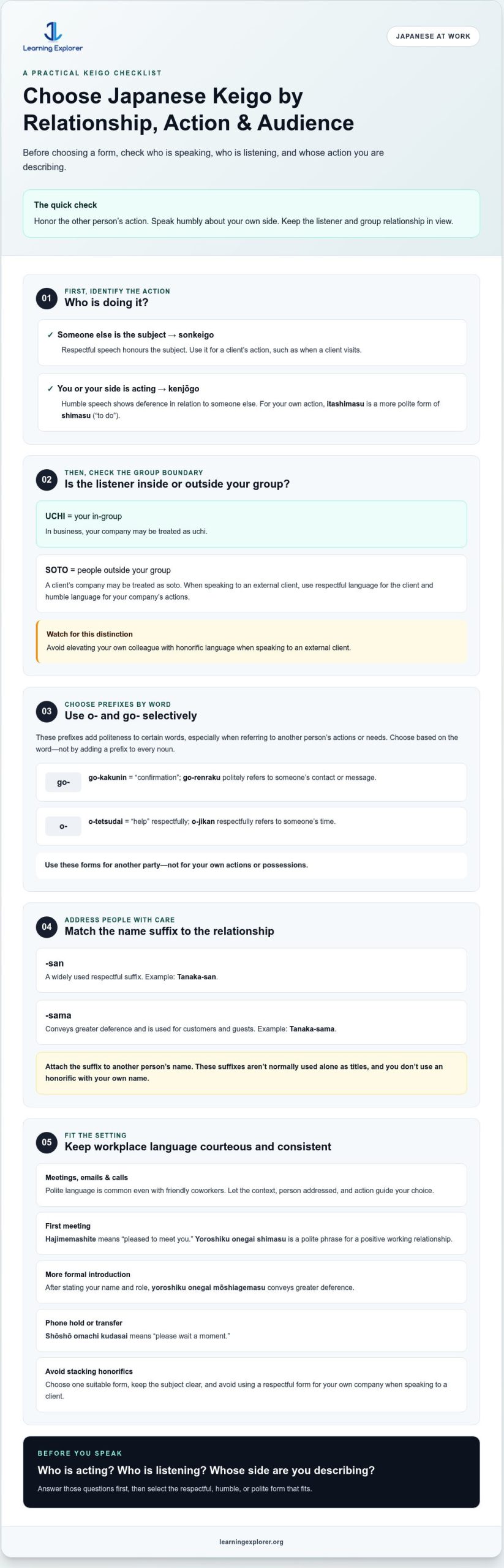
The prefixes o and go add politeness to certain words, especially when referring to someone else’s actions or needs. For example, go-kakunin is a polite form meaning “confirmation,” while o-tetsudai means “help” respectfully.
Choose the prefix based on the word rather than adding one to every noun. Go-renraku politely refers to someone’s contact or message, while o-jikan respectfully refers to someone’s time. These forms are generally used for another party, not for the speaker’s own actions or possessions. This distinction keeps respectful language focused on the person being addressed.
Honorific and Humble Forms
The form you choose depends partly on who performs the action: sonkeigo honours the subject, while kenjōgo humbles the speaker in relation to someone else. If a client visits, a respectful expression can elevate the client’s action. If you say you will contact them, a humble form can show deference.
This distinction matters in meetings because a verb can change according to its subject. For example, itashimasu is a more polite form of shimasu, “to do,” when describing the speaker’s action. Identify who acts before choosing a form.
The Uchi and Soto Distinction
Uchi means one’s in-group, while soto refers to people outside that group. In business, your company may be treated as uchi and a client’s company as soto. This relationship can shape whether you elevate someone’s actions or speak humbly about your own side.
When speaking to an external client, you would generally avoid using honorific language to elevate your own colleague. Instead, use respectful language for the client and humble language when describing your company’s actions. Consider the audience and whose action you’re describing before selecting a form.
Honorifics Within and Between Groups
Honorific choices can shift between colleagues in the same group and people across group boundaries. A senior colleague may receive respectful language, while an external customer may call for a more formal choice. The relationship, setting, and person being discussed all influence what sounds appropriate.
For example, senpai refers to a senior colleague or classmate. When describing a coworker to a client, however, group boundaries matter: speakers commonly avoid elevating their own colleague while showing respect to the client. Consider the listener and the person discussed separately.
Titles and Name Suffixes
Japanese honorifics such as san and sama attach to the end of a person’s name. San is a widely used respectful suffix, while sama conveys greater deference and is used for customers and guests. These suffixes follow names and aren’t normally used alone as titles.
Use an honorific with another person’s name, not your own. For example, a speaker might address a colleague as “Tanaka-san” and a customer as “Tanaka-sama.” Choosing a suitable suffix signals the relationship, while leaving an honorific off your own name avoids claiming respect for yourself.
Business meeting language and preparation
In Japanese business settings, polite language is common in meetings, emails, and calls, even with friendly coworkers. The right phrase depends on the context, the person addressed, and the action being discussed.
For professionals in Singapore, the practical difference is that Japanese often requires choosing a form that reflects the relationship and workplace hierarchy. Consider who is speaking, who is listening, and whether the subject is a client, superior, or yourself.
For a greeting or introduction, use hajimemashite (“pleased to meet you”) and introduce yourself with a polite phrase such as yoroshiku onegai shimasu. In a more formal request, yoroshiku onegai mōshiagemasu conveys greater deference.
On the phone, begin with a courteous greeting and your organisation’s name, then identify yourself. Before transferring a call or placing the caller on hold, say shōshō omachi kudasai (“please wait a moment”).
Common mistakes include stacking multiple honorific elements onto one verb and using a respectful form for your own company when speaking to a client. Choose one appropriate form and keep the subject clear. Osshatta is a correct respectful form for “said.”
For an apology, mōshiwake gozaimasen expresses a formal “I’m very sorry.” Make a request with yoroshiku onegai itashimasu; muzukashii desu ne can soften a refusal.
Keigo in Meetings and Daily Conversation
Keigo appears in formal meetings and routine workplace exchanges, where polite speech can remain appropriate even among friendly coworkers. The setting and relationship help determine how formal to sound.
For example, use polite language when opening a meeting with a client, then keep it consistent during questions and follow-up. A superior’s presence may also affect how you address participants. Matching the context helps your message sound considerate without making every sentence elaborate.
Greetings and Introductions
Business greetings combine a courteous opening with a clear introduction. Hajimemashite suits a first meeting, while yoroshiku onegai shimasu expresses a polite request for a positive working relationship.
For a more formal introduction, state your name and role plainly, then use the more deferential yoroshiku onegai mōshiagemasu. These familiar phrases give professionals in Singapore a useful opening for a Japanese client meeting.
Business Email Phrases
Keigo is commonly used in Japanese business emails. A standard email has five parts: greeting, self-introduction, main message, closing request, and signature.
Before writing, identify the subject of each verb. This helps make clear who will act. For a request, yoroshiku onegai itashimasu provides a formal closing; for a simple confirmation request, okakunin kudasai means “please check.”
Keigo Verb Forms
Business keigo changes verbs to show consideration for the person performing an action. Select a respectful form for a client’s or superior’s action, and a humble form when describing your own.
Avoid piling honorific elements onto the same verb. For instance, osshatta is a respectful form of “said”; adding another honorific construction can make the expression incorrect. Practise identifying the subject before selecting a verb form.
Build fluency by practising realistic meeting exchanges and polite requests through conversational Japanese practice.
When to use respectful speech in Japanese?
The main types of Japanese keigo are sonkeigo, kenjōgo, and teineigo. In professional settings, choose respectful, humble, or generally polite expressions by considering who acts and who listens.
Respectful and Humble Verb Forms
Sonkeigo uses respectful verb forms for a client’s or superior’s actions, while kenjōgo uses humble forms for the speaker’s actions toward them. This distinction matters because the same meeting can include both kinds of action, and the grammar should reflect each one.
For example, describe a client’s explanation with a respectful form, then use a humble form when saying you’ll send the meeting notes. The first expression shows respect for the client as the subject; the second lowers your own action in relation to the listener.
Teineigo provides a general polite baseline, often through the -masu form. Teichōgo, a form of addressee honorific, is used with the -masu form. These choices help maintain courteous language even when a sentence doesn’t require a distinct respectful or humble verb.
Combining Respectful and Humble Speech
Combining respectful and humble speech means choosing a form for each action, rather than applying one level to an entire conversation. This helps professionals show respect to a client while speaking modestly about their own work.
Imagine a meeting where a customer explains a concern and you respond that you’ll review it. Use a respectful expression for the customer’s explanation and a humble one for your review. The exchange remains courteous, while each verb reflects its subject.
Keep the speaker, listener, and subject distinct. A sentence about what your superior will do calls for respect toward that person; a sentence about what you will do for a customer may call for humility. A polite form can connect these choices and keep the exchange consistent.
Don’t stack honorific elements onto one verb to make it sound more formal. Japanese expressions rely on appropriate form and context, not piles of markers. Choose the verb form that matches the actor, then consider whether the sentence addresses a client, collaborator, or workplace superior.
For professionals in Singapore, this distinction is useful in client meetings with Japanese colleagues: plan each sentence around its actor. A native speaker’s phrasing can vary with the relationship and setting, so focus on the purpose of each expression rather than translating English word for word.
Polite speech (teineigo) at work
Teineigo is general-purpose polite Japanese, often used with strangers and people the speaker doesn’t know well. In workplace meetings, familiar sentence endings such as -desu and -masu offer a courteous baseline without changing every verb into a special honorific form.
That baseline can also suit colleagues who work closely together. Japanese speakers generally use polite language in business meetings, even with friendly coworkers. For example, a presenter can explain a proposal using -desu and -masu forms, keeping the discussion professional without making every sentence highly formal.
Teineigo differs from sonkeigo, which shows respect for the subject, and kenjōgo, which humbles the speaker. These forms respond more directly to who acts and whom the speaker addresses. Start with polite speech, then consider whether the situation calls for a respectful or humble expression.
Degrees of politeness also depend on the relationship and setting. A first conversation with a customer may call for a more formal choice than a familiar exchange with a teammate. In Japanese, longer honorific forms are generally more polite than shorter ones, but length alone doesn’t make a phrase suitable.
For instance, okakunin kudasai means “Please check it” in a polite request. It can be useful when asking a business contact to review a document. Choose expressions for the task and listener rather than adding honorific wording to every sentence.
Customer-facing roles often use keigo in daily speech. Wait staff, concierge staff, and shop staff commonly use these forms with customers. In a client meeting, the same principle keeps requests and explanations courteous as the discussion moves between greetings, questions, and decisions.
Hierarchy can influence how speakers address a superior, but teineigo provides a useful foundation across workplace interactions. Practise changing a plain statement into a -masu sentence, then consider whether the subject needs a more respectful verb. This focused practice makes each form easier to recognise.
Professional mastery takes more than memorising endings. Keigo is important in Japanese business, and training in its use usually takes place at the company rather than at school or university. A language course can help learners rehearse workplace speech, identify the listener, and choose a suitable level of formality for each exchange.
What keigo is and how it conveys respect
Keigo changes Japanese grammar and vocabulary from their informal equivalents. Its professional value lies not in making every sentence elaborate, but in shaping communication for the setting. Japanese keigo for professionals has a practical purpose: use language that fits the workplace exchange while keeping the message clear.
Consider a short update about a delayed document. The information may be simple, but the wording can affect whether it sounds abrupt or considerate. Keigo helps frame the message so the recipient can focus on the update and next step. Clarity still matters: a courteous sentence that hides the main point can make work harder.
For professionals learning Japanese, keigo is part of communication, not a collection of decorative phrases. Before speaking or writing, decide what the other person needs to understand: a status update, a decision, or a request for input. Then choose wording that conveys the purpose without burying it under unnecessary formality.
Keigo also rewards attention to the whole exchange. A phrase that fits an opening may feel too formal later in a familiar conversation. Instead of memorising one script for every client interaction, notice how the discussion develops and keep your language consistent with its purpose. Japanese keigo for professionals is a communication skill as much as a grammar topic.
In Singapore, professionals may encounter Japanese in meetings, email, and everyday workplace conversations. Practise recognising the purpose of an expression, then build your response around a clear message. This approach supports comprehension as well as speaking, especially when a direct English translation misses the nuance.
For spoken practice, try using workplace scenarios that require concise updates and thoughtful responses. Conversational Japanese learning can help you practise expressing ideas clearly in everyday exchanges.
Learning Explorer: Conversational English Course
Learning Explorer offers a Conversational English Course for learners who want to build confidence in everyday spoken English. After exploring Japanese keigo, you may also want to strengthen the English you use to clarify ideas, contribute to discussions, and connect with colleagues in Singapore’s multilingual workplaces.
Choose conversational English practice when your goal is smoother everyday exchanges. For work-focused communication, the Business English Course is a more relevant option. Learning Explorer also offers Conversational Mandarin and Business Mandarin Courses for learners developing Mandarin communication.
Choose the language that best supports your next conversation, whether you’re preparing for a Japanese client meeting or communicating across languages at work. Contact Learning Explorer or visit learningexplorer.org to explore your learning options.
Put Your Language Skills Into Practice
Your next step is to connect language study with the conversations you want to handle more confidently. For Japanese keigo for professionals, choose a work scenario, such as opening a client meeting, asking for clarification, or responding to a request. Practising with a clear purpose helps you focus on language for real interactions.
Learning Explorer offers a Conversational English Course, a Business English Course, and a Conversational Mandarin Course. These options can support everyday communication, workplace exchanges, or Mandarin conversations, depending on your goals. Build language skills that complement your professional relationships while continuing to develop your Japanese communication.
Choose a learning direction that fits the conversations ahead, and take the next step at a pace that works for you. Contact Learning Explorer to explore your options. With focused practice, each new exchange can become an opportunity to communicate with greater clarity and confidence.
Frequently Asked Questions
What is keigo?
Keigo is the system of Japanese expressions used to communicate politeness and social consideration. In a professional conversation, it affects how a message comes across, not just its literal meaning. For instance, a request can sound more considerate when its wording acknowledges the other person. Understanding this purpose helps you interpret expressions in context instead of translating each word separately.
Do native speakers always use Keigo perfectly?
No. Native speakers may use an expression that feels too formal, too casual, or simply awkward for a particular exchange. Their choices can also vary by workplace and personal speaking style. Treat what you hear as useful exposure, not an infallible template. Notice how the phrase fits the setting, then practise a clear, courteous version for your own professional conversations.
Is Teineigo enough for daily conversations?
Often, yes, especially for routine exchanges with people you don’t know well. A polite response can work at a reception desk or in a first conversation with a new contact. In a close, familiar setting, the same register may feel distant. Pay attention to how the other person speaks and whether the interaction is formal, then adjust your tone while keeping your meaning clear.
What are the levels of formal language in Japanese?
Japanese communication includes plain speech and polite or honorific forms, with keigo commonly grouped into teineigo, sonkeigo, and kenjōgo. These aren’t simply consecutive steps from casual to formal; they describe different functions. In practice, listen for the formality of the exchange and the purpose of each expression. That helps you understand a conversation even when its register shifts.
When should I use Kenjougo?
Use kenjōgo when speaking about your own actions to show deference to the listener. A practical cue is a sentence about something you’ll do for a customer or business contact. Choose a humble expression that fits the action, then keep the rest of your message natural and easy to follow. Avoid adding honorific markers simply to sound more formal.
When should I use Sonkeigo?
Use sonkeigo to show respect for the person performing an action, such as a customer or workplace superior. It’s useful when discussing their decisions, comments, or requests. As you listen, notice who the sentence describes before interpreting its verb. This habit helps you follow who did what without confusing the speaker’s actions with someone else’s.
How do sonkeigo, kenjōgo, and teineigo differ?
Sonkeigo expresses respect for another person’s actions, kenjōgo uses humble wording for the speaker’s actions, and teineigo provides general politeness. Their useful distinction is function, not a ranking in which one always replaces another. A speaker may shift forms as the conversation changes. Identifying what an expression does can make unfamiliar workplace speech easier to understand.
How do you use keigo in Japanese business emails?
Use keigo consistently and make the requested action easy to identify. Before sending an email, read it as the recipient: can they tell what you’re asking and who will act next? Keep honorific wording appropriate instead of stacking forms for emphasis. A concise, courteous message helps business contacts understand its purpose without losing the thread in elaborate phrasing.