An app can help you recognise Mandarin words without preparing you to use them in a real conversation. That’s why language apps won’t make you fluent in Mandarin on their own: tapping the right answer is different from recalling words, building a sentence and responding in the moment.
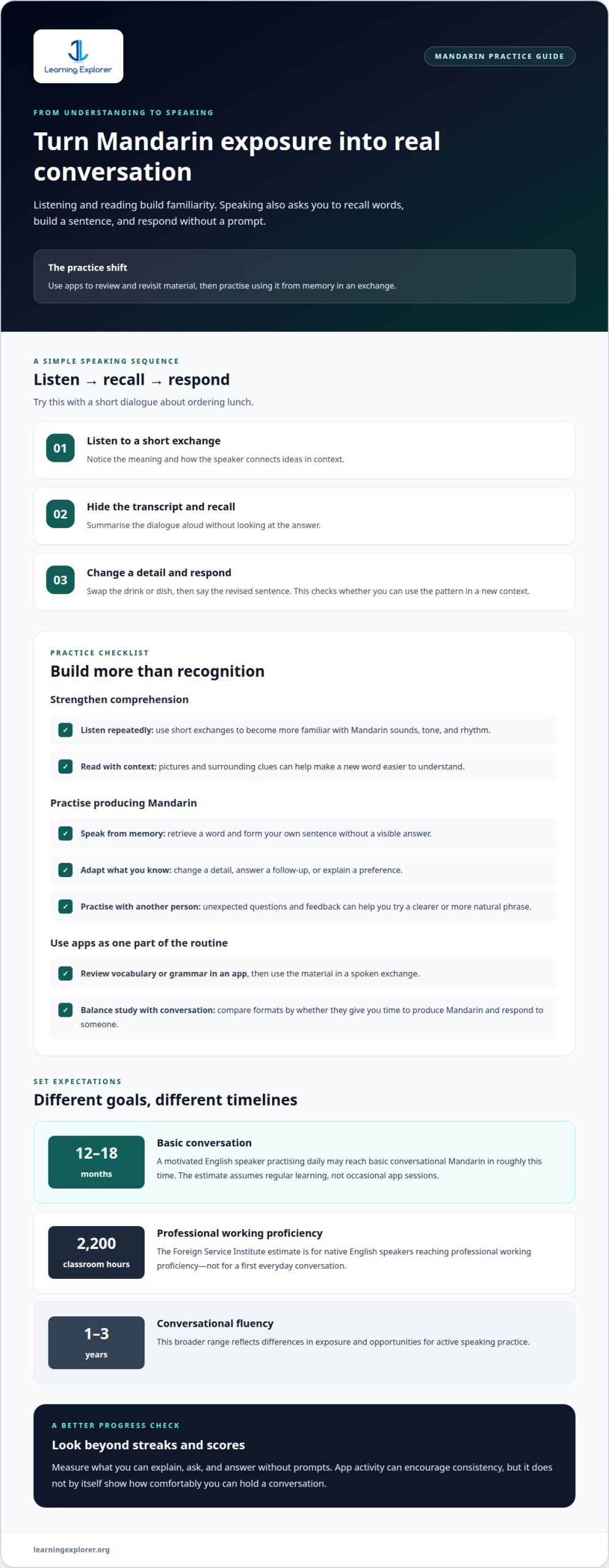
Apps can still make practice easier and help you review vocabulary. But if you’re hoping to chat comfortably, it’s natural to wonder how long that takes and whether your daily streak is moving you towards speaking. A motivated English speaker practising daily may reach basic conversational Mandarin in roughly 12 to 18 months, while the Foreign Service Institute estimates about 2,200 classroom hours for professional working proficiency.
This guide explains why app exposure and recognition exercises can leave a gap between understanding Mandarin and speaking it. You’ll learn what affects the path to conversation, how active speaking practice helps, and how to make apps one part of a balanced learning routine.
Key Takeaways
- Use apps to review vocabulary, but pair recognition exercises with speaking from memory.
- Listening and reading can strengthen comprehension; practise forming your own sentences to build speaking ability.
- Look beyond streaks and scores: progress in an app may not reflect how comfortably you can hold a conversation.
- Develop vocabulary, grammar, pronunciation and natural phrasing together for more flexible communication.
- Consider guided Mandarin lessons when you want structured opportunities to practise speaking and receive feedback.
How long does it take to reach conversational Mandarin?
A motivated English speaker practising daily may reach basic conversational Mandarin in roughly 12 to 18 months. That estimate assumes regular learning, not occasional app sessions between other tasks. Comfortable conversation usually requires more than recognising familiar words. You also need to retrieve vocabulary, form sentences and respond when someone phrases an idea differently. The timeline depends on your practice routine, starting point and chances to speak.
Professional proficiency is a much longer goal. The Foreign Service Institute estimates that native English speakers need roughly 2,200 classroom hours to reach professional working proficiency in Mandarin. That figure describes professional proficiency, not a first everyday conversation. It helps set expectations: ordering a meal or introducing yourself takes a different level of skill from handling detailed workplace discussions.
Apps make learning convenient. A short session can fit into a commute or lunch break, while streaks and points can encourage a regular habit. But completing an exercise is not the same as having a spoken exchange. Matching a written phrase to its meaning may help you recognise it, for example, but recalling it during conversation calls for a different kind of practice.
Cost also affects how sustainable a routine is. App subscriptions, learning materials and taught practice can involve different expenses, so consider what each format helps you practise. A low-cost routine may support vocabulary review, while regular conversation practice targets speaking directly. The useful comparison is not simply how many lessons or exercises you get, but whether your study includes time to produce Mandarin and respond to another person.
Build a simple weekly routine that includes both study and conversation. Use an app to review words or revisit a grammar point, then use what you’ve learned in a spoken exchange. A practice partner or teacher can ask an unexpected follow-up, prompting you to recall and adapt a sentence. Correcting a phrase during the exchange helps connect study with real communication.
Conversational fluency is often achievable in 1-3 years with high input and active practice. This broader range reflects differences in exposure and speaking opportunities. If you study Mandarin in Singapore, regular lessons, conversations and listening practice can bring different kinds of input together. Track progress by what you can explain, ask and answer without prompts, rather than by app streaks alone.
How exposure supports comprehension but does not guarantee production
Repeated listening makes Mandarin more familiar. A learner who hears “你想喝什么?” may recognise it as a question about what someone wants to drink. Context offers clues, such as a menu, a cup or a friend pointing to a café counter. These signals support comprehension, even if the learner cannot yet ask the question independently.
Reading works in a similar way. A sentence paired with a picture can make a new word easier to understand, and repeated exposure can reinforce its meaning. But recognising a word on screen doesn’t mean you can recall it in conversation. Without prompts, you have to retrieve the word, arrange it with the right grammar and say it clearly enough to be understood.
Take the phrase “我想喝茶,” meaning “I want to drink tea.” An app may help you match the phrase with its translation or hear its pronunciation several times. In a café conversation, though, you might need to replace “tea” with “water,” answer a follow-up or explain your preference. Adapting the phrase requires producing language, not just identifying it.
Input also helps you notice how Mandarin sounds in context. Listening to a short exchange can draw your attention to tone, rhythm and the way a speaker links ideas. But a recording cannot respond to your own wording. If you only replay the audio, you may understand each line without learning to create a similar exchange from memory.
To turn exposure into speaking ability, follow a simple sequence: listen, recall, then respond. First, hear a short dialogue about ordering lunch. Next, hide the transcript and summarise its meaning aloud. Then change one detail, such as the drink or dish, and say the revised sentence. This small change tests whether you can use the pattern in a new context.
Live conversation adds another layer. A teacher or speaking partner can ask an unexpected question, give you time to reply and clarify a confusing phrase. You can then try again with a more natural sentence. This feedback helps you spot where grammar or word choice breaks down, while supportive practice can build confidence to keep speaking through mistakes.
Use Mandarin listening and reading to strengthen comprehension, then give yourself regular chances to speak without a visible answer. If you want structured opportunities to practise building spoken sentences, explore guided Mandarin conversation practice.
Why app progress can plateau before speaking ability develops
Language apps don’t make learners fluent because recognition drills are not the same as producing Mandarin. You may identify a correct phrase on screen yet struggle to recall it while speaking. The gap becomes clear when a conversation requires you to choose words, shape a response and adapt to what another person says.
Apps often make progress visible through points, streaks and completed lessons. These features can encourage you to keep learning, but they measure activity more readily than spontaneous speaking. A lesson may show, for example, that you matched a greeting with its meaning. It doesn’t show whether you can greet someone, ask a follow-up and respond naturally.
The difference matters because prompts narrow the task. In a multiple-choice exercise, possible answers are provided, so you only need to recognise a familiar option. In conversation, those options disappear. If someone asks what you did at the weekend, you have to retrieve words, organise them and speak without waiting for a translation prompt.
Vocabulary learned in isolation can also be difficult to use flexibly. A review led by Associate Professor Victor Lim found limited effectiveness in learning vocabulary separately, a common feature of many apps. Knowing a word’s meaning is useful, but a sentence shows how it works with grammar and other words. Memorising “busy,” for instance, doesn’t automatically prepare you to explain why you’re busy.
Practice can plateau when lessons repeat familiar formats. You might choose the right answer several times, then encounter a new question that uses the same words differently. The challenge is not just remembering a phrase. It’s adapting it to new information, such as changing a person, place or preference while keeping the sentence clear.
Speaking also involves listening and responding in real time. Associate Professor Victor Lim said language is best learnt through interaction, while most language apps focus on drill and practice. A recorded line cannot react to your answer or ask what you mean. A human conversation can prompt you to clarify, giving you a reason to rephrase your thought rather than end the exercise.
Treat app scores as evidence of completed practice, not as a complete measure of speaking progress. After a lesson on introductions, close the screen and introduce yourself aloud without reading. Then add a detail, such as your work or reason for learning Mandarin. Expressing the idea in your own words is practice in a skill the score may not capture.
Keep apps in your routine for convenient review, but pair them with open-ended speaking practice. A useful session moves from recognising a phrase to recalling it, then using it in a new exchange. This shift helps turn digital progress into language you can draw on when a real conversation takes an unexpected turn.
Integrated language skills
Mandarin conversation draws on several skills at once: vocabulary, grammar, pronunciation, listening and response. Many apps focus on one or two areas, such as character recognition or vocabulary recall. Those exercises can strengthen a specific skill, but they don’t automatically connect it to the others. Knowing the word for “busy” is different from using it to explain why you can’t meet.
Flashcards are useful for reviewing an individual word or character. To make that vocabulary usable, connect it to a sentence and a purpose. For example, practise “我想喝茶” (“I’d like tea”), then change the drink and say the new sentence aloud. The same pattern links word meaning, sentence structure and pronunciation.
A connected learning activity can move from input to output. First, listen to a short dialogue about making plans. Next, pick out its key phrases and notice how the speaker asks about availability. Then create a new exchange by changing the activity and day. This progression gives each phrase a context instead of leaving it as a translation to recognise.
Grammar becomes more practical when learned alongside vocabulary. A learner might know “明天” (“tomorrow”) and “有空” (“be free”), but still need to arrange them into a clear question. Practising “你明天有空吗?” (“Are you free tomorrow?”) connects those words to a useful sentence pattern. Reusing the pattern with another time or person builds flexibility.
Practise pronunciation and listening together. Hear a phrase, repeat it, then listen for whether its meaning changes when tones differ. Next, use it in a spoken response. A dialogue partner can ask a follow-up, prompting you to listen for meaning and choose your next words instead of simply repeating a recording.
Feedback helps turn recurring mistakes into focused learning. If a learner often places a time expression awkwardly, note the pattern and practise it in fresh sentences. A fluency-focused approach can track recurring errors and revisit weak structures in new contexts. That makes correction specific: work on the sentence pattern, not just the individual word that happened to be wrong.
To keep skills connected, pair input-heavy study with active language production. After reading a short exchange, retell its meaning without looking, then adapt one detail. Track whether you can recall the vocabulary, form the sentence and respond clearly. Over time, this gives you a more useful picture of communication progress than a collection of completed exercises alone.
Teachers can bring vocabulary, grammar, pronunciation, idioms and common phrases together in a lesson. Integrated practice helps learners understand how each element supports the next. Apps can still be useful for focused review; combine them with opportunities to listen, speak and apply familiar patterns in new situations.
Recognition-based exercises versus independent language production
Recognition exercises help you identify familiar Mandarin, while independent production asks you to create language without prompts. Both support learning, but they test different abilities.
Pronunciation and Tone Practice
Pronunciation practice means producing Mandarin sounds and tones clearly, not just recognising them in an audio exercise. Apps can model a phrase, but replaying it alone may not show how your speech sounds to another person. Tone and pronunciation affect whether a listener understands your intended word. Practise listening, repeating and then using the phrase in a natural exchange.
Vocabulary and Grammar Lesson Limits
App-based vocabulary and grammar lessons often use matching, translation or sentence-choice tasks. These formats can support review, but may leave learners reliant on visible prompts. Knowing a word’s meaning doesn’t ensure you can recall it, place it correctly or adapt it to a new sentence. Try producing a fresh example instead of only selecting one.
Characters and Reading Practice
Chinese characters help learners read Mandarin, recognise written vocabulary and understand text without relying only on sound. Reading a Mandarin newspaper may require around 2,000 to 3,000 characters, while HSK 6 requires knowledge of 5,000 or more characters. These figures show how reading develops over time, but character recognition alone doesn’t teach you to speak spontaneously.
Reading and speaking involve related but distinct kinds of recall. A learner might recognise a character in a familiar phrase, yet pause when asked to use its spoken equivalent. Connect reading to production: read a short sentence, cover it, explain its meaning aloud, then change one detail. This makes the text a starting point for creating language, not simply identifying it.
Recognition tasks also offer clues that everyday conversation does not. A multiple-choice screen narrows the possible answers, and a written prompt shows you the vocabulary you need. Independent production removes those supports. You decide what to say, select words, organise the grammar and monitor your pronunciation while listening to the other person’s response.
Build your practice around that difference. Use flashcards to review vocabulary, then put selected words into original sentences. Read a brief passage and retell its main idea without looking. In conversation, focus on communicating the message first, then use feedback to refine mistakes. These activities connect character knowledge, vocabulary and speech without expecting one exercise to do everything.
If you want to strengthen spoken Mandarin through guided practice, explore Mandarin conversation learning.
Learning Explorer
Learning Explorer offers structured, interactive learning to complement app-based Mandarin study. If you can recognise words but find it difficult to form responses, guided speaking practice can help you express ideas, listen and respond in context. The Conversational Mandarin Course suits learners developing everyday communication skills, while the Business Mandarin Course is for those focused on workplace communication. Keep using apps for convenient review and add guided learning to practise using Mandarin beyond prompts and exercises.
Contact Learning Explorer to discuss your Mandarin learning goals.
Make Your Next Mandarin Practice Count
Choose a speaking goal that matters in your daily life, such as introducing yourself, sharing an opinion or keeping a conversation going. Then shape each study session around it. An app can help you review vocabulary, while a real exchange gives you the chance to use it with purpose. Understanding why language apps won’t make you fluent in Mandarin isn’t a reason to abandon them; it’s a prompt to balance screen-based review with active communication.
Learning Explorer offers a Conversational Mandarin Course for learners developing everyday communication. Its Conversational English Course and Business English Course support different English-learning goals. The right next step is a structured place to practise expressing your own ideas and responding with growing ease.
Contact Learning Explorer today to discuss your language-learning goals. Keep showing up, keep speaking, and let each conversation build on the last.
Frequently Asked Questions
Speak easy: Can AI and language learning apps really help you achieve fluency?
Yes, AI and language apps can support Mandarin learning, but they’re tools rather than complete routes to fluency. AI chatbots can offer spoken conversation practice suited to your level, while apps can help reinforce vocabulary. Understanding why language apps won’t make you fluent in Mandarin means recognising the difference between guided practice and using language in varied situations. Try a chatbot for rehearsal, then practise the same topic with a person.
What does Mandarin fluency mean in speaking, listening, reading, and writing?
Mandarin fluency means using the language effectively for your goals across the skills you need. A learner focused on daily conversation may prioritise understanding questions and expressing ideas aloud. Someone who reads work documents also needs to understand written characters, while writing requires producing them in meaningful sentences. For example, confidently discussing a meal doesn’t necessarily mean you can read a menu without support or write a clear message.
How effective are language learning apps for Mandarin compared with tutors or classes?
Apps are useful for convenient review and focused practice, while tutors or classes can provide structured interaction and feedback. A vocabulary exercise can help reinforce words for transport, for example; a conversation lesson can practise using them to ask for directions and understand the reply. Each format serves different needs. Combining them can connect independent study with supported communication, especially if you want feedback on how you express an idea.
How much Mandarin study and practice is typically needed to reach conversational fluency?
One suggested routine is 1-2 hours of focused Mandarin speaking practice each day, alongside 30-60 minutes of spaced-repetition study for characters and vocabulary. Treat these as substantial practice recommendations, not a universal requirement. Your starting level, consistency and opportunities to use Mandarin all shape progress. Set a practical speaking goal, such as describing your workday, and track whether you can do it with fewer prompts over time.
How can learners get enough real Mandarin conversation and listening practice?
Build conversation into familiar activities rather than waiting for a perfect opportunity. In Singapore, you could practise a short food-ordering exchange with a speaking partner, then listen to Mandarin audio on the same topic. A teacher can speak at a natural pace and help you notice phrases you missed. Voice messages also let you practise forming a reply before sending it, then listen again to the response.
How can a learner combine apps, tutors, immersion, and study to become fluent in Mandarin?
Give each format a clear role in one learning cycle. Use an app to review words for a topic, such as planning a weekend. Practise those words in a lesson, then listen to Mandarin content about similar plans and note useful expressions. In your next conversation, use one new expression in your own sentence. This approach connects review, instruction and real-world input without relying on a single tool.