What if the reason you’re struggling with Korean particles isn’t a lack of talent, but a simple misunderstanding of their purpose? With enrollment in Korean courses increasing by nearly 45 percent over the last decade, you’re certainly not the only one wrestling with these grammar points. If you’ve felt your progress stall or your excitement fade, you aren’t alone. Understanding how to maintain motivation when learning korean particles is a common challenge for students at our center at 10 Anson Road, level 22, International Plaza, Singapore 079903. We know these tiny markers can feel like giant roadblocks on your path to fluency.
You likely agree that the non-English structure of these grammar points feels alien and often exhausting. This 2026 guide promises to transform your perspective by offering proven psychological strategies and practical hacks to conquer particles without losing your momentum. We’ll explore a clear mental framework for these markers, share ways to spark your excitement, and provide actionable daily habits that make study feel like a discovery rather than a burden. It’s time to turn that frustration into your next big linguistic breakthrough.
Key Takeaways
- Identify the structural differences between English and Korean to stop viewing particles as a barrier and start seeing them as navigational tools.
- Learn how to maintain motivation when learning korean particles by developing linguistic resilience, allowing you to stay consistent even when grammar feels complex.
- Apply the “Anchor Strategy” to group particles by function, ensuring you master foundational concepts before layering on subtle nuances.
- Integrate practical micro-habits like the 5-minute commute audit and color-coded note-taking to make daily practice effortless and engaging.
- Recognize how a structured classroom environment with native speakers provides the cultural context and social support needed to prevent self-study burnout.
Why Korean Particles Feel Like a Learning Wall
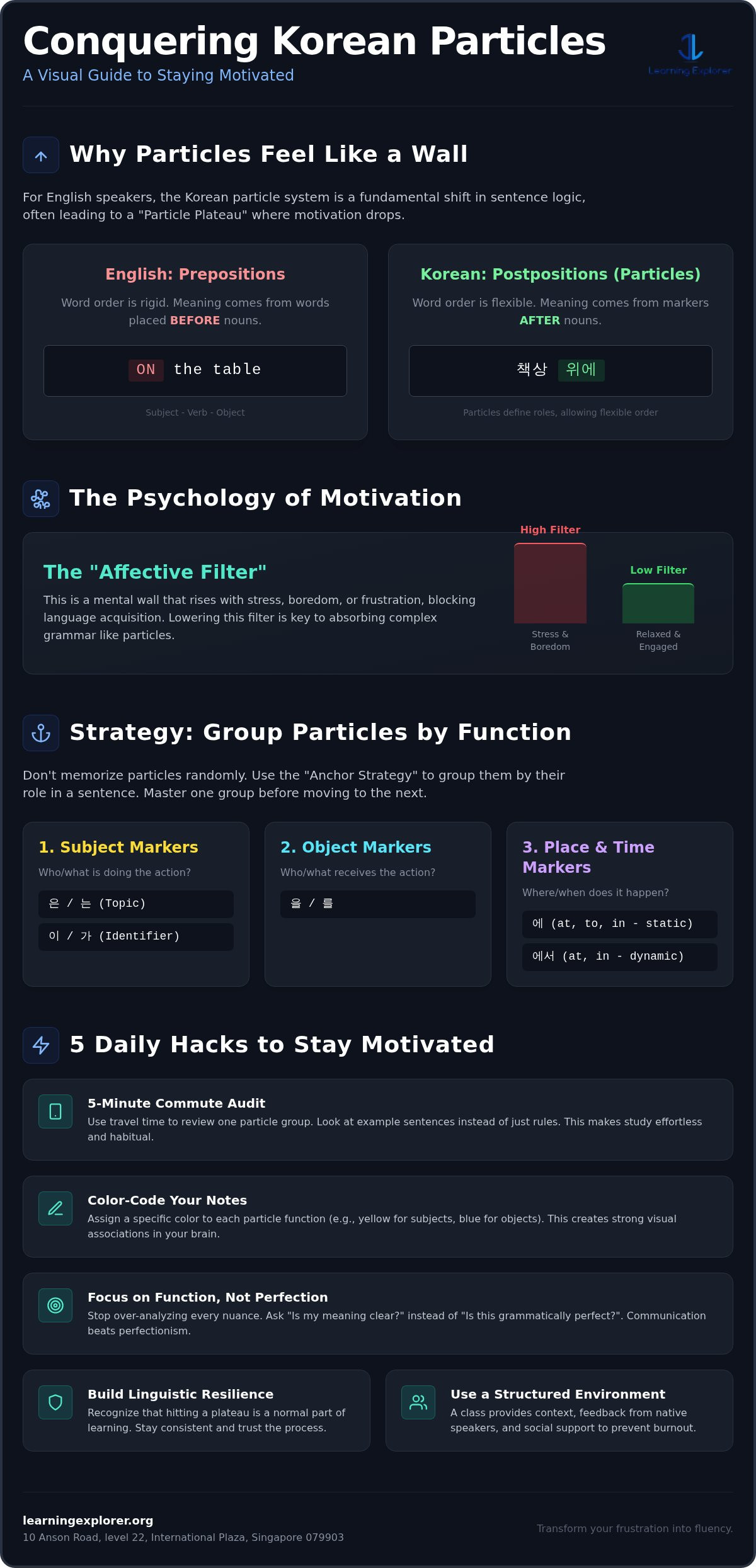
Hitting a wall during your Korean language journey is a common experience, especially when you encounter the unique system of particles. For English speakers, the struggle usually stems from a linguistic clash. English relies on prepositions that come before a word to provide context. Korean uses postpositions, which are markers that attach to the end of a noun. This structural reversal forces your brain to process information in a completely different order. It’s not just a grammar change; it’s a fundamental shift in how you perceive logic within a sentence.
The most notorious hurdle is the 은/는 versus 이/가 debate. This single nuance is often the primary motivation killer for beginners. You might understand the basic definition, but the subtle shift in emphasis feels impossible to master. Around the three-month mark, many students hit what we call the “Particle Plateau.” Your brain feels saturated, and the excitement of learning Hangul is replaced by the frustration of choosing the wrong marker. Understanding how to maintain motivation when learning korean particles requires recognizing that this feeling of being overwhelmed is a natural part of the psychology of language learning motivation. You aren’t failing; you’re simply recalibrating your mental map.
The Role of Particles in Korean Syntax
Think of particles as functional labels. In English, word order tells you who is doing what. If you swap the subject and object, the meaning changes entirely. Korean is different. Because particles clearly label the subject, object, and location, the word order becomes incredibly flexible. While this provides creative freedom, it places a heavy burden on your memory. For a native English speaker, losing the rigid “Subject-Verb-Object” structure can feel like losing your compass in the middle of a conversation. Learning to trust these markers is the key to unlocking fluid sentence structures.
Common Misconceptions That Drain Motivation
One major myth that leads to burnout is the belief that you must master every nuance before moving forward. Perfectionism is the enemy of progress. If you spend twenty minutes over-analyzing a single sentence, you lose the momentum needed for conversational flow. Many students find that a structured environment helps break this cycle of over-thinking. At our center, located at 10 Anson Road, level 22, International Plaza, Singapore 079903, we emphasize functional usage over rote memorization. Joining an Intensive Korean Course for Beginners in Singapore can provide the professional guidance needed to navigate these hurdles. By focusing on how particles function in real-world scenarios, you’ll find it much easier to discover how to maintain motivation when learning korean particles without getting lost in academic jargon.
The Psychology of Language Learning Motivation
Linguistic Resilience is the ability to persist through grammar hurdles. While your first few weeks of study are often fueled by the thrill of decoding a new script, that “Initial Excitement” eventually meets the reality of complex syntax. You might find that learning new vocabulary provides quick dopamine hits because the results are immediate. In contrast, mastering markers like -eul/reul is a “slow burn” that requires consistent effort over time. Many learners stop making progress because of the “Affective Filter,” which is a psychological wall that goes up when you feel stressed or bored. If you’re wondering how to maintain motivation when learning korean particles, the answer lies in managing this filter. When you’re relaxed and engaged, your brain becomes a sponge for these subtle grammar rules.
This psychological barrier often peaks during the transition from basic survival phrases to intermediate structures. When the cognitive load increases, your brain might naturally resist the effort required to distinguish between similar-sounding markers. Understanding the psychology of language learning motivation can help you recognize these moments as temporary hurdles rather than permanent roadblocks. By lowering your stress levels and focusing on the joy of communication, you allow your mind to process these complex rules more efficiently. You’ll find that once the filter is lowered, the logic of the language begins to surface.
Intrinsic vs. Extrinsic Motivation in Korean
Intrinsic motivation is your strongest ally. Students who learn because they want to understand the nuances of their favorite K-drama characters often stay the course longer than those motivated by a looming exam. To keep your momentum, try setting micro-goals that focus on small wins. Instead of viewing particles as a massive obstacle, transform your internal dialogue. Move away from “I have to memorize these markers” and toward “I want to express specific nuances in my speech.” This subtle shift changes your study sessions from a chore into a rewarding act of self-expression. When you connect your study to a personal passion, discovering how to maintain motivation when learning korean particles becomes a natural part of your daily routine.
The Power of the Growth Mindset
Adopting a growth mindset means viewing every incorrect particle as a valuable data point. Mistakes aren’t signs of failure; they’re evidence that you’re pushing your boundaries. This perspective is especially helpful when you visualize your future professional life. For example, understanding a Korean workplace hierarchy requires a firm grasp of how particles alter the politeness and focus of a sentence. Use positive self-talk to quiet your grammar anxiety. If you find that self-study feels like an uphill battle, consider joining a Conversational Korean Course. Learning alongside others helps normalize the struggle and provides the encouragement needed to push through the plateau. Small, consistent steps lead to significant long-term results.
Strategy: Grouping Particles to Prevent Overwhelm
One of the most effective ways to understand how to maintain motivation when learning korean particles is to stop treating them as a single, massive list. Instead, categorize them by their specific functions: Case, Auxiliary, and Conjunctive. Case particles mark the role of a word, such as a subject or object. Auxiliary particles add extra meaning, like “also” or “only.” Conjunctive particles join words together. By organizing your notes this way, you reduce the cognitive load and make the system feel far more manageable. This structural organization transforms a chaotic list of markers into a logical system that your brain can easily navigate.
Use the “Anchor Strategy” to build your confidence. Pick one primary function for a particle and master it in real-world contexts before trying to learn every obscure nuance. Visual mind maps can also help you see how these markers connect ideas within a sentence. Rather than memorizing isolated lists, learn particles in “chunks” or phrases. For instance, don’t just learn the object marker; learn it as part of a common phrase like “keopi-reul masyeoyo” (drink coffee). This method ensures you see the particle in action, making it easier to remember and reducing the administrative burden of rote memorization.
Topic vs. Subject Markers: A Simplified Framework
Distinguishing between 은/는 (Topic) and 이/가 (Subject) is often where learners feel most stuck. Use this simple rule: 은/는 is for old information or contrast, while 이/가 introduces new information. In a professional Singaporean setting, you might say, “Jeo-neun [Name]-imnida” (As for me, I am [Name]). Here, “I” is the topic because you are the focus of the conversation. If someone asks who the manager is, you’d reply, “[Name]-i maenijeo-imnida,” using the subject marker to focus on the specific person as the “new” answer to the question.
| Particle | Function | Usage Rule |
|---|---|---|
| 은/는 | Topic Marker | Old information or Contrast |
| 이/가 | Subject Marker | New information or Specific focus |
Mastering Directional and Time Particles
Confusing 에 and 에서 is a common frustration, but the distinction is clear when applied to your daily routine. Use 에 for destinations or static time, and 에서 for locations where an action takes place. For example, your commute to our training center involves going to (에) the building. Once you are at (에서) your desk or in the classroom, you perform the action of studying or working. This logic also applies to specialized vocabulary, such as terms used in the Korean beauty industry, where you might describe an action happening at a clinic or a product being applied to a specific area. Breaking these down into functional groups is a powerful way to discover how to maintain motivation when learning korean particles by focusing on practical utility over abstract theory.
5 Practical Hacks to Stay Motivated Daily
Consistency often trumps intensity when you are mastering a new language. For a busy professional, the key to discovering how to maintain motivation when learning korean particles is integrating small, manageable tasks into your existing routine. Instead of carving out hours of study time, try the “5-Minute Particle Audit” during your MRT commute. Focus on identifying just one type of particle in a news headline or a song lyric. This micro-habit prevents burnout and keeps the language fresh in your mind without adding to your administrative burden.
Visual organization is another powerful tool for your toolkit. Color-code your notes by assigning specific colors to different particle groups. For instance, use blue for subject markers and green for topic markers. This creates a visual mental map that helps your brain categorize information faster. You can also try “Particle-First” journaling. Write three short sentences about your day, but select the particles before you choose the verbs. This forces you to think about the relationship between words rather than just translating from English. To keep things light, gamify your learning with low-stakes flashcard apps or listen to professional Korean podcasts that offer comprehensible input during your lunch break.
Integrating Korean into your Singapore Lifestyle
You don’t need to be in Seoul to immerse yourself in the language. Start by labeling items in your office with their corresponding object markers. Seeing “keopi-reul” on your mug every day reinforces the grammar naturally. While walking through the Tanjong Pagar CBD, use your surroundings to practice. Describe the buildings or the weather using the particles you’ve learned. When you visit a local Korean BBQ spot, challenge yourself to use the correct markers when ordering. These real-world applications turn abstract rules into functional skills, making it much easier to see how to maintain motivation when learning korean particles.
Social Learning and Accountability
Isolation is a common motivation killer. Finding a study buddy to quiz you on subtle nuances can transform your progress. If you prefer a digital approach, the “Studygram” community on social media provides a supportive space to share your notes and track your consistency. Publicly documenting your journey creates a sense of accountability that’s hard to replicate alone. If you’re looking for a more structured way to stay engaged, consider joining a Conversational Korean Course to practice these hacks with fellow learners and expert guides. Engaging with others who share your goals provides the social catalyst needed for long-term success.
Why a Structured Classroom Environment Sustains Momentum
Self-study often feels like a solo climb up a steep mountain. While mobile apps provide quick vocabulary fixes, they frequently fail to explain the “why” behind complex grammar. This gap is where many learners fall into the “Isolation Trap.” Without immediate feedback, small errors in particle usage can snowball into major confusion, leading to burnout. Understanding how to maintain motivation when learning korean particles becomes much easier when you have a native instructor to guide you. They don’t just teach you the rules; they provide the cultural context that makes those rules click in your mind.
For a busy professional in Singapore, a fixed schedule serves as a psychological anchor. It removes the daily burden of deciding when to study. Instead of relying on fleeting willpower, you rely on a consistent commitment. This structure transforms your language journey from a taxing professional task into an inspiring habit. Having a dedicated time and place to focus allows your brain to shift gears, making it easier to absorb the subtle nuances of Korean syntax without the distractions of your inbox. It turns the labor of seeking into the satisfaction of discovery.
The Learning Explorer Advantage in Singapore
Our center offers more than just a classroom. It provides a visionary environment where interactive lessons turn dry grammar drills into engaging conversations. You’ll find yourself practicing markers while building professional networks with fellow learners in the heart of the CBD. This social connection is a powerful tool for how to maintain motivation when learning korean particles, as it replaces the labor of seeking answers with the satisfaction of shared discovery. Our bilingual native instructors act as reliable allies, ensuring you never feel lost in the complexity of the language or the administrative burden of unvetted resources.
Your Next Steps Toward Korean Mastery
Transitioning from a frustrated beginner to a confident speaker requires a clear, expert-led roadmap. Structured courses do more than just fill your schedule; they strategically prepare you for high-impact Korean careers in Singapore. Whether you are aiming for a role in a multinational corporation or the booming creative industries, professional fluency starts with mastering the foundational markers that define Korean logic. Don’t let grammar hurdles stall your progress. Experience the difference of a supportive learning community by joining a trial lesson and feel your confidence grow with every sentence you build.
Unlock Your Path to Korean Fluency
Mastering the nuances of Korean grammar requires more than just willpower; it demands a strategic shift in how you approach the language. By grouping particles by function and integrating micro-habits into your Singapore lifestyle, you turn a daunting learning wall into a series of manageable steps. You’ve discovered that linguistic resilience is built through consistency and a clear mental framework, allowing you to move past initial frustration and toward genuine conversational flow. These strategies ensure your progress remains steady and your interest stays high.
If you’re still wondering how to maintain motivation when learning korean particles, remember that you don’t have to navigate this path alone. Our native-speaker instructors provide the expert guidance and cultural context needed to make complex grammar points click. Experience the benefits of interactive classes in a supportive professional environment located right in the heart of the CBD. Start your journey to fluency with our Conversational Korean Course today! We’re here to help you transition from the labor of seeking to the satisfaction of discovery. Your future as a confident Korean speaker begins with a single, inspired step.
Frequently Asked Questions
Is it normal to feel confused by Korean particles even after months of study?
Yes, feeling confused after months of study is a standard part of the process. Korean particles involve a syntax logic that differs significantly from English prepositions. This often leads to a plateau where your brain needs time to rewire its linguistic map. Understanding how to maintain motivation when learning korean particles involves accepting that confusion isn’t a sign of failure. It’s actually a signal that you’re tackling high-level concepts that eventually lead to deeper fluency.
Can I speak Korean fluently if I occasionally make particle mistakes?
You can absolutely achieve conversational fluency even if you make occasional particle errors. Communication is primarily about being understood, and many native speakers omit or contract particles in casual speech. While precision is vital for professional settings, don’t let the fear of a small mistake stop you from speaking. Focus on the flow of the conversation first. Over time, your intuition for the correct marker will naturally sharpen through consistent exposure and practice.
How much time should I spend studying particles every day?
Aim for approximately 10 to 15 minutes of focused particle practice within your daily study routine. Research shows that consistent daily practice of 60 to 90 minutes total is the sweet spot for achieving conversational fluency in less than a year. Spending a small, dedicated block on particles prevents burnout while ensuring these markers stay fresh. Use this time for active exercises like sentence building or identifying markers in a short Korean news clip.
Which Korean particles are the most important for beginners to learn first?
Beginners should prioritize four main groups to build a strong foundation:
- Topic markers (은/는) for establishing context.
- Subject markers (이/가) for identifying the doer.
- Object markers (을/를) for identifying the receiver of an action.
- Location markers (에/에서) for describing place and time.
Mastering these foundational anchors allows you to form basic thoughts and ask essential questions with confidence.
Are there any apps that specifically help with mastering Korean particles?
While many general language apps exist, tools like Mirinae or flashcard systems like Anki are excellent for mastering particles. These platforms allow you to analyze sentence structures and drill specific grammar points. However, apps often lack the interactive feedback needed to understand subtle contextual differences. This is why many learners find it useful to discover how to maintain motivation when learning korean particles by supplementing digital tools with professional guidance that explains the cultural logic behind each marker.
What happens if I omit particles in a Korean conversation?
In casual Korean conversations, particles are frequently omitted without losing the core meaning. However, in formal or business environments, omitting them can make your speech sound fragmented or overly blunt. Using markers correctly provides clarity and shows respect for the listener. If you’re unsure, it’s usually safer to include them. As you become more comfortable, you’ll learn exactly when a native speaker would naturally drop a marker for a more relaxed tone.
How do I know if I need a professional Korean course or if I can self-study?
If you find yourself stuck on the same grammar point for weeks, it’s likely time for a professional course. Self-study works well for learning Hangul or basic vocabulary, but particles require immediate feedback to correct subtle misunderstandings. A structured course at Learning Explorer provides native-speaker instructors who can explain these nuances in real-time. This interactive environment acts as a motivation booster, helping you move past the isolation that often leads to self-study burnout.
How can I practice particles if I don’t have a Korean speaking partner?
You can practice effectively by narrating your daily activities out loud or through journaling. Describe your commute or your office tasks using the markers you’ve learned. Listening to professional Korean podcasts also provides comprehensible input, helping your brain recognize natural patterns. Another great method is to label office items with their corresponding object markers. These micro-practices build your confidence and ensure you’re ready to speak when you finally find a conversation partner.