Clearer workplace communication starts with the conversations your team already has. A corporate business english course singapore teams choose should connect learning to everyday tasks, from writing concise emails to contributing to meetings. When employees have different roles and communication needs, it helps to identify the situations where English matters most before setting learning goals.
To plan relevant training, decide which communication skills your team wants to focus on, gather employee perspectives, and compare learning formats. This guide covers practical ways to do that, from identifying workplace priorities to considering physical and online learning.
Learning Explorer Language Centre has taught languages to adults in Singapore since 2015 and provides corporate language training. Its Business English Course combines native-teacher instruction and communicative teaching methods, with learning materials sourced from Oxford University Press. Use the steps below to connect your organisation’s goals with the communication situations employees encounter at work.
Key Takeaways
- Identify the workplace situations where communication feels challenging, then set learning goals around those needs.
- A corporate Business English course can focus on professional communication across speaking, listening, reading, and writing.
- Compare physical and online learning in light of employees’ work locations, schedules, and participation preferences.
- Gather employee perspectives so learning goals connect with real tasks rather than abstract language study.
- Use a simple planning sequence: clarify needs, define goals, consider learners, compare formats, and decide on next steps.
Why a Corporate Business English Course Matters for Singapore Teams
A project update needs to be understood quickly. A colleague may need to explain a delay, ask a clarifying question in a meeting, or write a handover for the next shift. In Singapore workplaces, English is widely used for business and administration, and clear exchanges help teams coordinate work across roles and responsibilities.
General English develops broad language skills. Business English applies those skills to professional situations, such as contributing to discussions, sharing progress, understanding workplace documents, and communicating with colleagues. The Business English overview describes its connection to professional and international business contexts. For a team, the practical starting point is the communication employees actually use.
Corporate Business English learning focuses on the language employees use to share information, coordinate tasks, and take part in everyday workplace communication. The goal is not to assume that everyone needs the same material. Priorities can differ according to employees’ roles, the communication tasks they handle, and their confidence using English at work.
For example, staff who give project updates may want to practise organising information and making key points clear. Employees who contribute to meetings may prioritise asking follow-up questions or expressing a view. Colleagues who read instructions or draft internal messages may focus on understanding and writing professional information. These examples can help organisations define relevant learning goals without assuming a particular proficiency level or promising a specific outcome.
Which workplace communication challenges can learning address?
Start with moments when shared understanding matters: a discussion where some employees hesitate to speak, an update that needs a clearer structure, or a handover where colleagues need to confirm details. Turn these observations into possible learning goals. For instance, a team could focus on explaining ideas, checking understanding, or organising information more clearly.
Look for recurring communication tasks rather than labelling employees as weak or strong. Ask which exchanges feel effortful, where people would value more confidence, and what information colleagues need to share accurately. The answers can reveal whether a priority is shared across the team or specific to certain roles.
Who should consider corporate English learning?
HR teams, managers, and organisations supporting professional development can consider a corporate business english course singapore employees can connect with their work. It may suit organisations with a shared communication priority, as well as teams whose employees in different roles need to collaborate using English. Start by listening to staff and identifying the situations that matter most, rather than assuming one course level or goal fits everyone.
What a Corporate Business English Course Can Cover
Business English focuses on communication in professional settings. Rather than treating English as a subject in isolation, it considers how people understand and share information at work. In Singapore, English is used alongside other languages across a bilingual workforce. The Singapore Economic Development Board provides context on Singapore’s English Proficiency and Bilingual Workforce. Each organisation can then identify the communication skills its employees want to strengthen.
General English goals build broad language ability; Business English goals focus on using that ability for professional communication. The difference is the context and purpose, not a fixed set of skills. For a team, the starting point might be spoken exchanges, written information, or both.
Consider four connected skill areas:
- Speaking: expressing ideas clearly and choosing language suited to a professional exchange.
- Listening: following what others say, noticing key points, and responding relevantly.
- Reading: understanding written information and identifying details needed for a task.
- Writing: organising messages so readers can understand the purpose and next steps.
Use these areas to discuss learning needs, not as a checklist of fixed course components. Employees may feel comfortable in one area and want more practice in another. A corporate business english course singapore organisations consider is more relevant when its goals reflect the actual communication demands of their teams.
Speaking and listening in professional situations
Speaking needs may include contributing to a meeting, explaining an idea, or keeping a conversation with a colleague focused. Listening matters just as much. Employees may need to understand a question, pick out a concern, or recognise when to clarify a point. Together, these skills support considered exchanges. These examples can help an organisation identify priorities for its team.
Think about what employees need to do before, during, and after a conversation. Do they share information, respond to others, or summarise what has been agreed? Naming the communication task gives the team a practical learning focus without assuming everyone has the same experience or confidence.
Writing and reading for work
Professional writing needs can range from a short email to a concise update or a longer workplace document. Information is easier to follow when it is organised, the main point is easy to find, and any requested action is clear. Reading is equally practical: employees may need to locate relevant details, follow written guidance, or understand a colleague’s message.
Use familiar document types to describe what effective communication would look like for your team. For example, discuss the kinds of messages employees write most often and what readers need to understand from them. Explore Learning Explorer’s Business English learning as you consider which communication areas matter most to your organisation.
How to Compare Corporate English Learning Formats for Your Team
Learning Explorer offers physical and online classes. To compare formats for your organisation, consider where employees work, how their schedules are organised, and what kind of interaction helps them participate. The right choice is the one that fits the team’s working context and supports engagement.
Use this comparison to guide your discussion. The questions can help you weigh practical considerations against your team’s learning priorities.
| Format to consider | May suit teams that | Questions to explore |
|---|---|---|
| In-person learning | Prefer face-to-face interaction and can attend at a shared location. | Does the location work for employees, and would direct interaction support their learning preferences? |
| Online learning | Need remote participation or have employees working from different locations. | Can learners take part comfortably online, and does this fit their usual work routines? |
| Group learning, as a general format | Value shared discussion and learning alongside colleagues. | Would learning together connect to the team’s objectives and encourage useful exchange? |
| Private learning, as a general format | Prefer individual instruction focused on a learner’s specific priorities. | Would a more individual learning context align with the needs being addressed? |
When might in-person or online learning suit a team?
Consider employees’ work locations, schedules, and preferred interaction. A team based near a shared learning location may favour face-to-face contact, while remote participation may be more practical for employees spread across locations. Neither format is automatically more effective. Focus on what supports participation and how learning can fit alongside work.
Also consider the kind of interaction employees find useful. Some may value direct conversation in the same room; others may be comfortable learning online. Discussing these preferences helps an organisation choose a format that feels accessible and workable for the people involved.
What should organisations consider about group or private learning?
As general learning formats, group instruction brings learners together, while private instruction focuses on an individual. Shared learning may appeal to employees who benefit from exchanging perspectives; individual instruction may suit someone with distinct learning priorities. Connect the approach to learner preferences and organisational objectives instead of assuming all employees need the same experience.
For a corporate business english course singapore team, compare learning approaches against the outcomes you want to support, such as participation, practical interaction, or focused individual development. A short discussion with employees can surface useful preferences before planning. There is no universal best option. Choose based on the team’s learning context, work routines, and communication priorities.
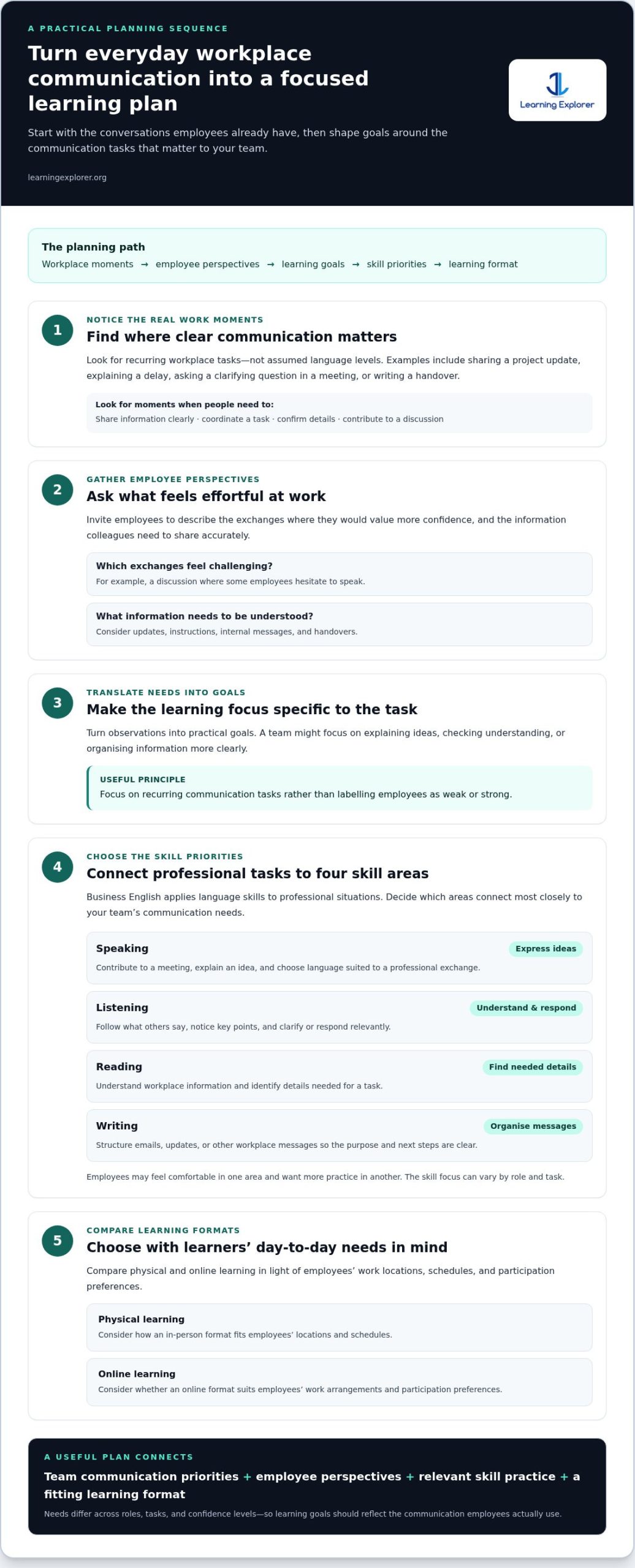
How to Plan Corporate Business English Learning Step by Step
A clear plan starts with employees’ real communication needs, not with a course format or a broad goal such as “improve English.” Use these steps to set a practical direction while keeping organisation-wide priorities distinct from individual learning needs.
- Identify workplace situations. Ask employees and managers which recurring communication tasks feel challenging or important. Consider where clearer English could help people participate, share information, or coordinate work.
- Define realistic goals. Turn broad priorities into observable aims, such as communicating ideas more clearly in a discussion or organising a written update. Treat these as learning objectives, not guaranteed results.
- Consider the learners. Gather employee perspectives on their priorities, confidence, and preferred ways to learn. Look for shared needs while recognising that individual employees may have different goals.
- Compare formats. Consider physical and online learning in light of work routines, location, schedules, and interaction preferences. Choose a format that supports participation without adding unnecessary friction.
- Plan next steps. Bring communication goals and learner preferences together. Decide what the organisation wants to prioritise and how managers can encourage employees to engage with learning.
Start with workplace situations and learning goals
Make the first conversation specific. Ask which communication situations arise regularly and where employees would value more confidence or clarity. Depending on the organisation, that could mean expressing an idea to colleagues, summarising information, or following written instructions. Keep examples grounded in your own work context. A useful objective describes what employees are aiming to do without implying that every learner starts from the same point.
Separate shared priorities from individual needs. An organisation may want communication to be more consistent across a team, while an employee may want to focus on a particular task. Both perspectives matter. The phrase Corporate English Learning for Singapore Teams captures the team-needs lens: connect organisational goals with the communication situations employees actually encounter.
Make learning practical for employees
Before settling on a plan, consider schedules, preferred class format, and where employees might use or practise what they learn. These details help keep learning relevant to work. Managers can support participation by making the purpose clear, encouraging employees to share useful learning, and recognising efforts to apply new communication approaches in appropriate workplace situations.
Keep expectations grounded. A learning aim can describe a skill employees want to practise or a workplace task they want to approach with greater clarity. Avoid promising a measurable change by a set date without a basis for that commitment. For a corporate business english course singapore plan, connect the goals, learners, and format before deciding on next steps. Explore Business English learning with Learning Explorer as you shape a plan around your team’s needs.
Learning Explorer’s Corporate Business English Learning in Singapore
Choosing workplace language learning means looking beyond course topics. Organisations need a learning partner whose teaching approach, resources, and educational purpose support communication goals that matter to employees. Learning Explorer Language Centre is part of the Learning Explorer group and provides corporate language training in Singapore.
Learning Explorer has taught languages to adults in Singapore since 2015. Its brand promise is “Top quality resources – Global Standards in language learning”. For teams considering a corporate business english course singapore, the centre’s approach combines professional learning with a structured language-learning foundation.
A Singapore language centre with global learning resources
Learning Explorer’s teaching approach combines native-teacher instruction with communicative teaching methods. Materials and syllabus sources include Oxford University Press. These resources and teaching methods give organisations a clear picture of the centre’s approach as they consider how Business English learning can relate to employees’ workplace needs.
The centre offers physical and online classes. It is located at 10 Anson Road #22-07, International Plaza, Singapore 079903, directly above Tanjong Pagar MRT. Organisations looking for broader information about English learning can also explore the topic of an English language school in Singapore.
Take the next step for your organisation
Start with the communication priorities you have identified. Sharing the workplace situations employees want to handle with greater clarity, along with relevant organisational goals, gives planning a useful focus. It keeps the conversation grounded in real learning needs rather than assumptions about what every employee requires.
You do not need to have every detail settled before exploring Business English learning. A clear sense of your team’s priorities helps you consider how it may fit your organisation. Explore language learning with Learning Explorer and share the goals you are planning around.
Turn Communication Priorities Into a Practical Next Step
Workplace communication develops through everyday use, not just through a plan on paper. As your organisation considers a corporate business english course singapore option, think about how to keep learning connected to employees’ responsibilities. A check-in after planning can help you identify which priorities remain relevant and where staff would welcome further support.
Keep the next step manageable. Bring together the people who understand your team’s learning needs, agree on what you want to explore, and make room for employees to share their perspectives. A thoughtful starting point can make professional learning purposeful without requiring every detail to be settled in advance.
Explore language learning with Learning Explorer to discuss workplace communication learning that reflects your organisation’s goals.
Frequently Asked Questions
What is a corporate Business English course?
A corporate business english course singapore organisations consider is English learning focused on communication in professional settings. It helps an organisation set language-learning priorities around the communication employees handle in their roles. For example, a customer-facing team and an internal operations team may have different workplace contexts to consider. Those differences can guide planning without assuming every employee has identical goals.
Why do companies offer Business English learning to employees?
Companies may offer Business English learning to support communication as part of employees’ professional development. A shared learning priority can help colleagues approach common workplace exchanges with greater clarity and coordinate across roles. It can also give managers a constructive way to support employee growth. Begin with the communication needs employees and managers identify rather than assuming a particular challenge applies to everyone.
What is the difference between Business English and general English?
Business English focuses on using English in professional contexts, while general English develops broader language ability for a range of situations. The distinction is useful when setting a learning purpose: consider whether employees need language connected to work responsibilities or a wider foundation. A team might prioritise language for internal communication, while an individual may have broader learning interests. These purposes can inform planning without suggesting one approach is inherently better.
Can corporate English learning take place online in Singapore?
Yes. Learning Explorer offers online classes. For an organisation, remote participation may be relevant if employees work from different locations or prefer not to travel to a learning venue. Consider whether employees have a suitable place to join and how online participation fits their work routines. The format should reflect the learning context rather than an assumption that one method suits every team.
How can an organisation identify its employees’ English learning needs?
Start with informal conversations. Invite employees to describe situations where they want to communicate more confidently, and ask managers which workplace exchanges would benefit from clearer shared understanding. Compare their perspectives to find common priorities while leaving room for individual interests. Employees may identify a recurring communication task that managers had not considered. Their feedback gives planning a practical starting point.
What should a company consider when planning English learning for a team?
Clarify the organisation’s learning purpose, the employees involved, and the work context the learning should relate to. Then consider participation preferences, work schedules, and whether physical or online learning fits the team. Keep aims realistic and describe what employees may want to practise rather than promising a specific change. A useful plan makes space for shared priorities and individual perspectives, so employees can see how learning relates to their work.
Where is Learning Explorer Language Centre in Singapore?
Learning Explorer Language Centre is in Singapore’s Central Business District, directly above Tanjong Pagar MRT. If coordinating an in-person visit for colleagues, share the venue details with attendees and consider where they will be travelling from so they can plan their journey.